China’s little Europe

This weekend Jordyn and I took a trip to England. And Italy. And Germany. And the whole time, we stayed in China.

Tianjin is one of those places that all the foreigners in Beijing say they’re planning to go to, eventually. Even though it’s only 30 minutes away by bullet train, most of them never do. We finally did.

At 14 million people, Tianjin is the fourth largest city in China behind Shanghai, Beijing, and Guangzhou and is one of the country’s four direct-controlled municipalities along with Shanghai, Beijing, and Chongqing. It’s location on the Bohai Gulf as well as on the banks of the Hai River, which connects northern China to the Yangtze River via the Grand Canal, also made it one of the most important ports in China, especially after it was forcibly opened to French and British trade by the Treaty of Tianjin, which was signed in 1860 following China’s defeat in the Second Opium War. Over the following decades, Great Britain and France were joined by Japan, Austria-Hungary, Italy, and Belgium in establishing self-administered foreign concession areas in Tianjin, each with its own government buildings, public facilities, and neighborhoods.

That’s what makes Tianjin so interesting: The city is a patchwork of early-20th-century European buildings and avenues that trumpet the cities colonial past and steel-and-glass skyscrapers that announce its intent to own the future. And underneath it all scoot the overstuffed electric tricycles ubiquitous to China.

Sunday was Qingming festival, or Tomb Sweeping Day, so I was off work. Jordyn also had Monday off, so we decided it was time to take the trip. We’d tried to do the same with Toby on the same weekend last year but showed up to the train station too late and didn’t have time to make the trip. This time we planned ahead and bought tickets a few days before.

Tianjin is a walking city.

There’s the old downtown, lined with European-turned-Chinese banks of the columned variety, most of them (of course) webbed by renovation scaffolding during our visit.
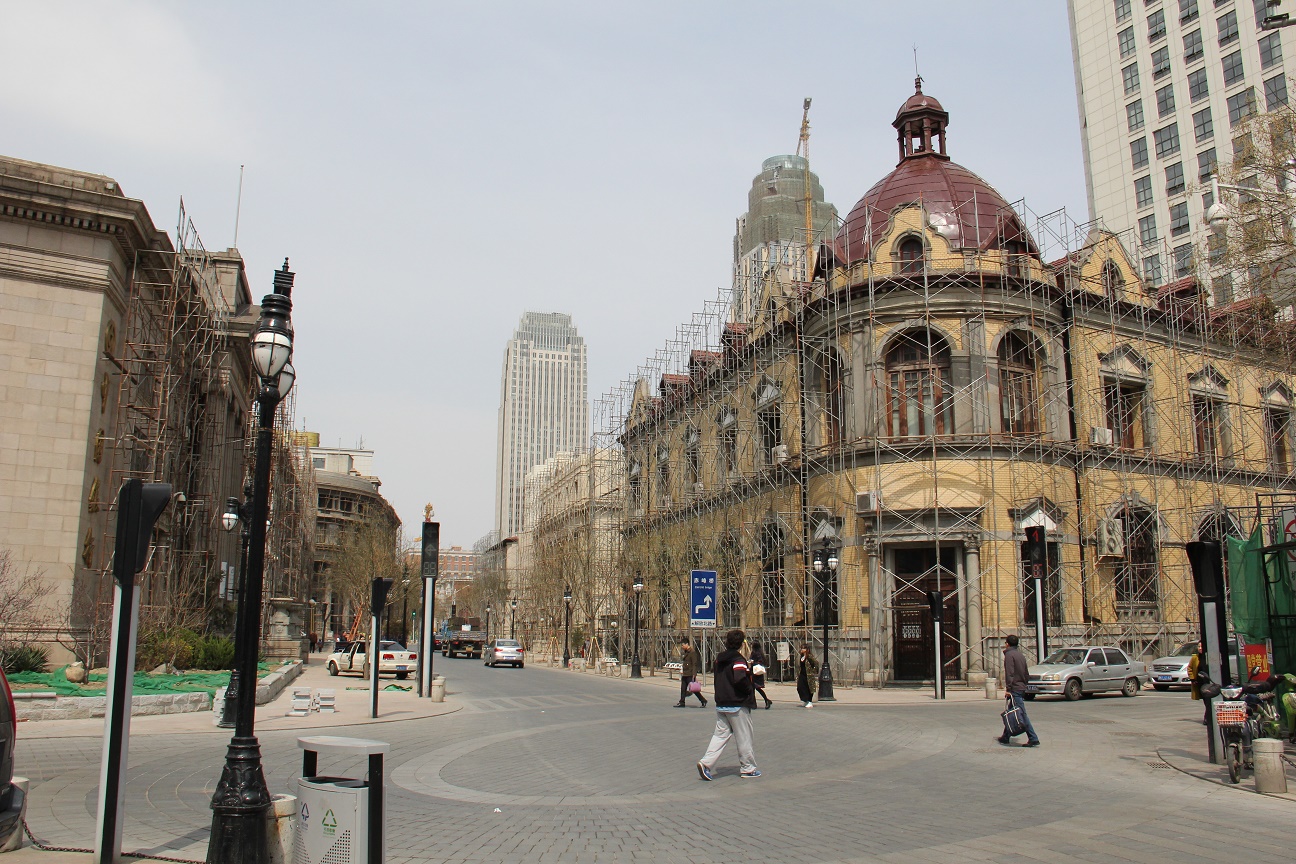
Banks in Tianjin's downtown

Tianjin’s downtown is mostly banks built during the early 20th century to house European companies. These days they are mostly Chinese banks.

There’s the riverside parks, lined first across from the train station and a giant clock with the old British treaty port, then with fishermen, then with the skyscrapers.
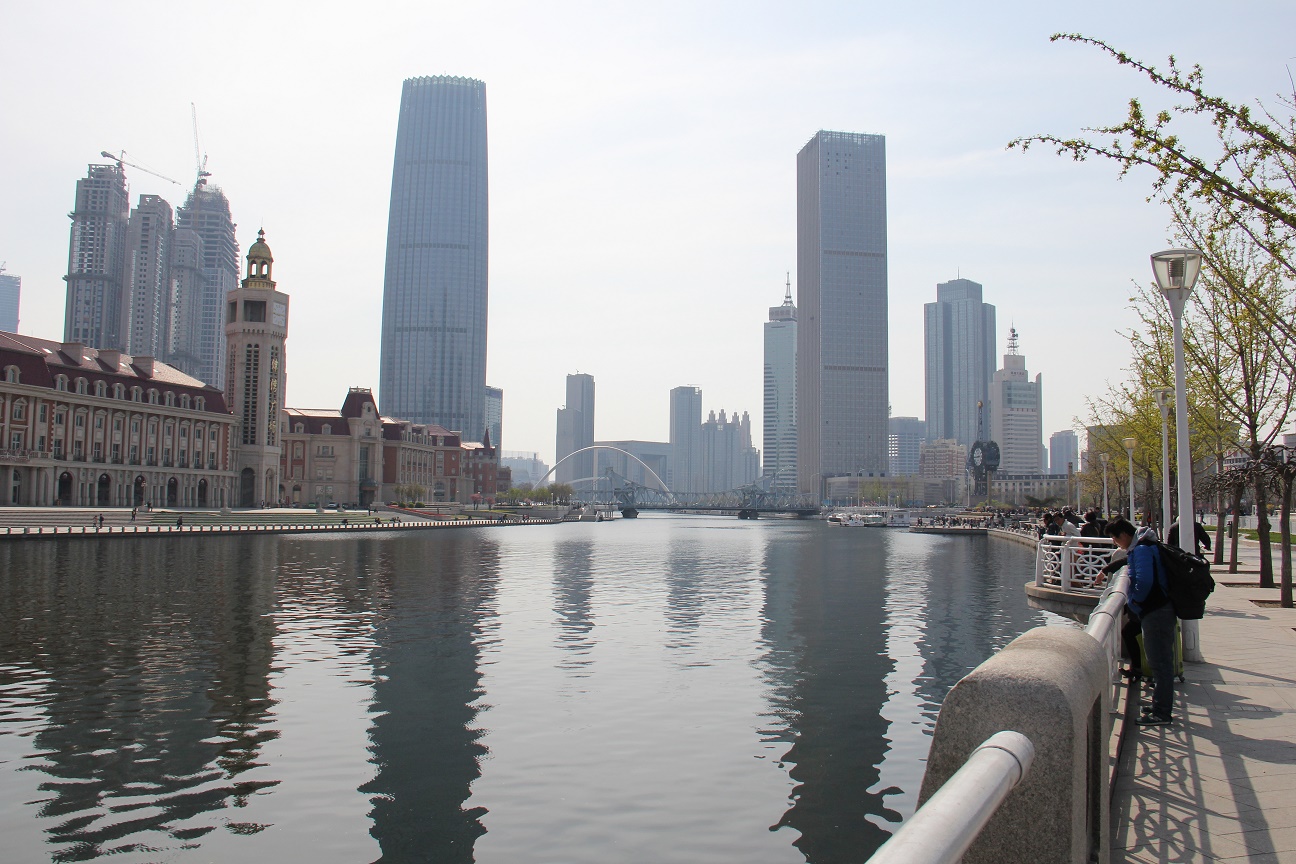
Tianjin

The treaty port sits on the river across from Tianjin’s train station. Past the bridges down the river, the city’s skyscrapers project a different attitude.

There’s the Italian Concession, Tianjin’s version of Little Italy, lined with Italian villas and European-style restaurants and souvenir shops catering to the domestic crowd.
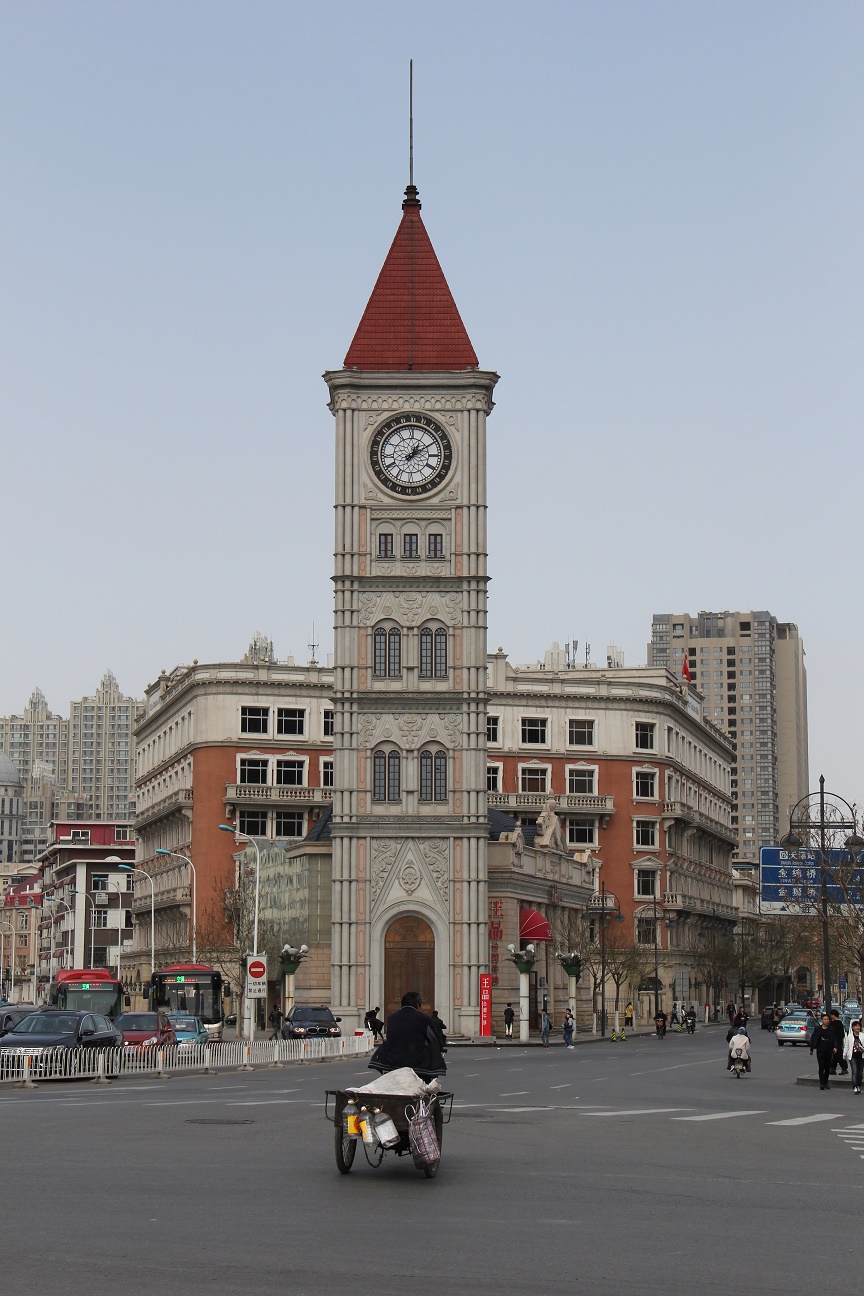
Tianjin's Italian concession

This clock tower marks the entrance to Tianjin’s Italian concession, complete with gold statues, fountains, and lots of cheesy Italian (and German?) restaurants.

There’s the ancient town street, lined with traditional Chinese craft shops that look like they’ve seen better days.

There’s the creepy China house, a house lined with tourists and constructed entirely of concrete and vases or pieces of vases.
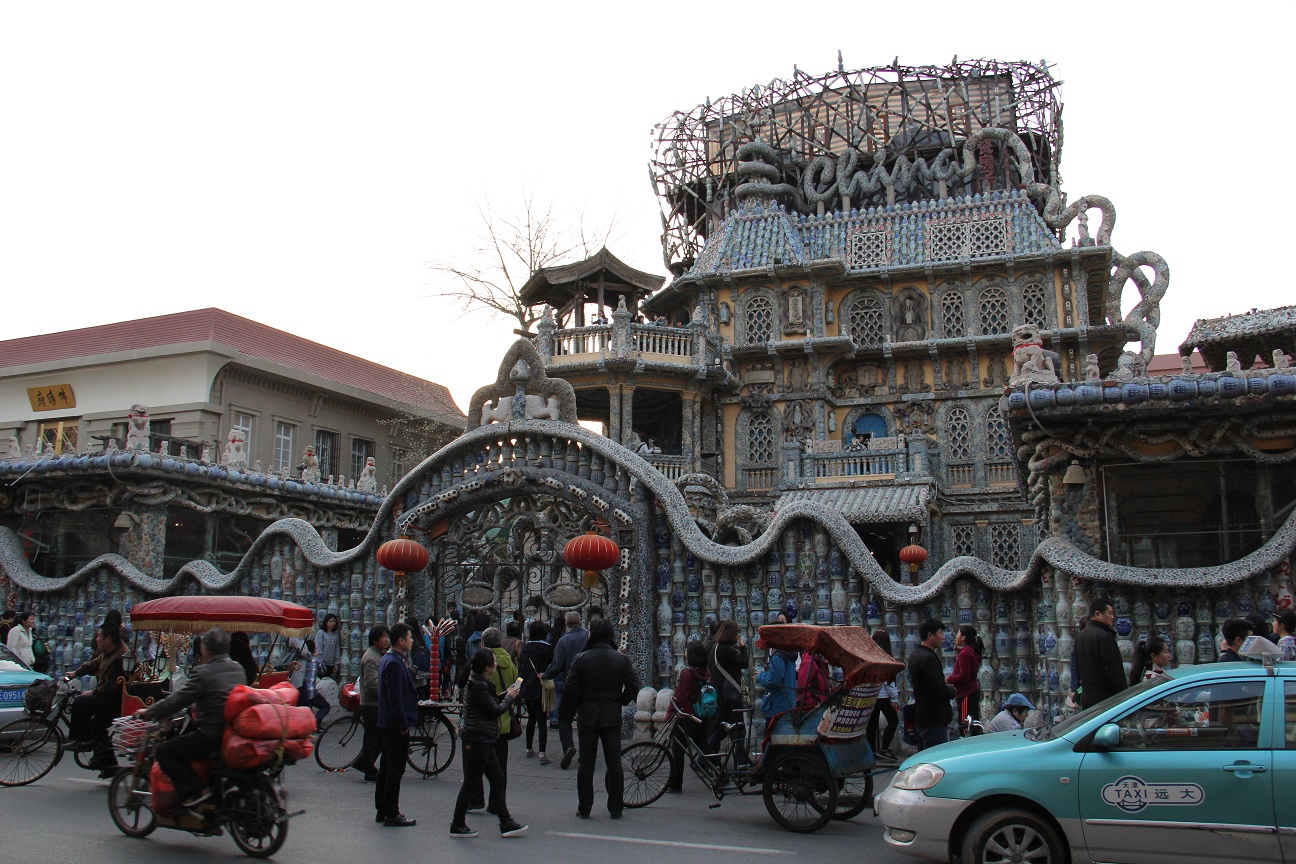
Tianjin's China house.

Tianjin’s China house.

There’s the wide avenues, lined with buses and cars and where, on Qingming, you might catch a man burning piles of paper money for his ancestors in the middle of an intersection or a group of people trying to keep the grass from catching on fire when their paper money takes off with the wind.
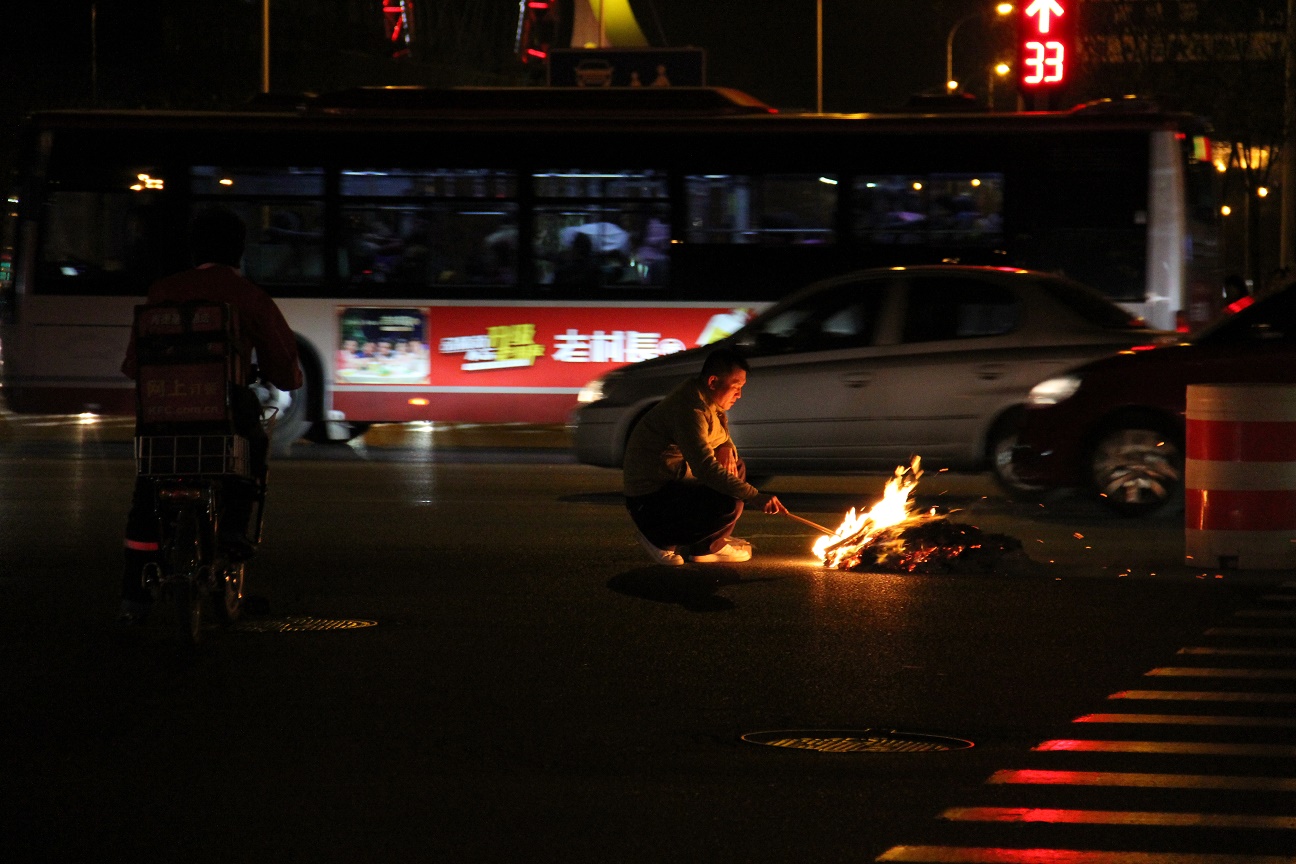
A man burns paper money in Tianjin

On Qingming, people burn paper money as well as iPhones and other gadgets, for their ancestors to use in the afterlife.

There’s the Yongle Bridge, topped with the Tianjin Eye, the world’s only Ferris wheel ( (120-meters) built on top of a bridge, and lined by a riverwalk where revelers launch flaming lanterns into the night.
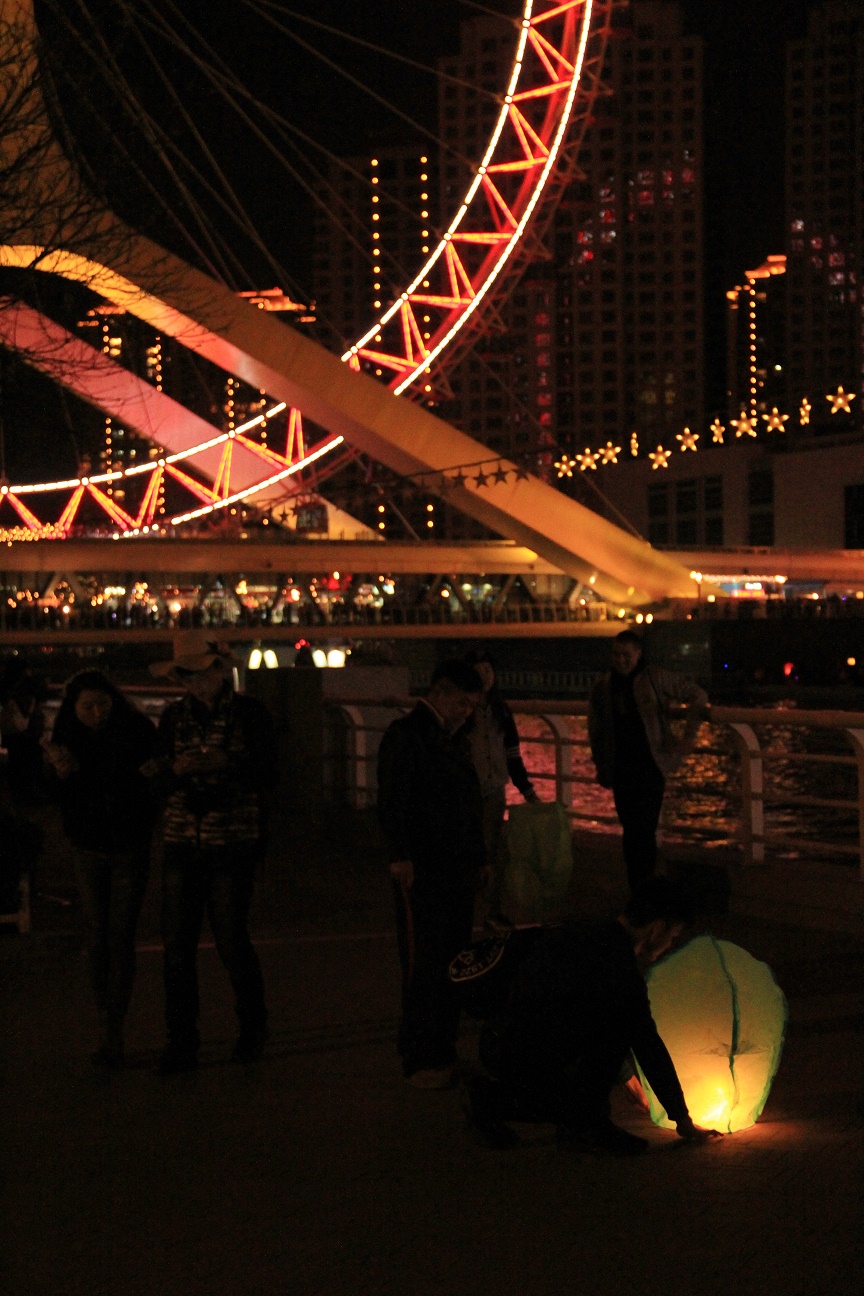
People light lanterns near the Tianjin Eye

Evening celebrators light floating lanterns under the glow of the river-spanning Tianjin Eye, the world’s only Ferris wheel built on top of a bridge.

There’s the 五大道 wudadao (five big avenues) area, lined with blossoming trees and the mansions of former government officials and generals, some of their abodes straight out of 1910 London, others out of Spain.
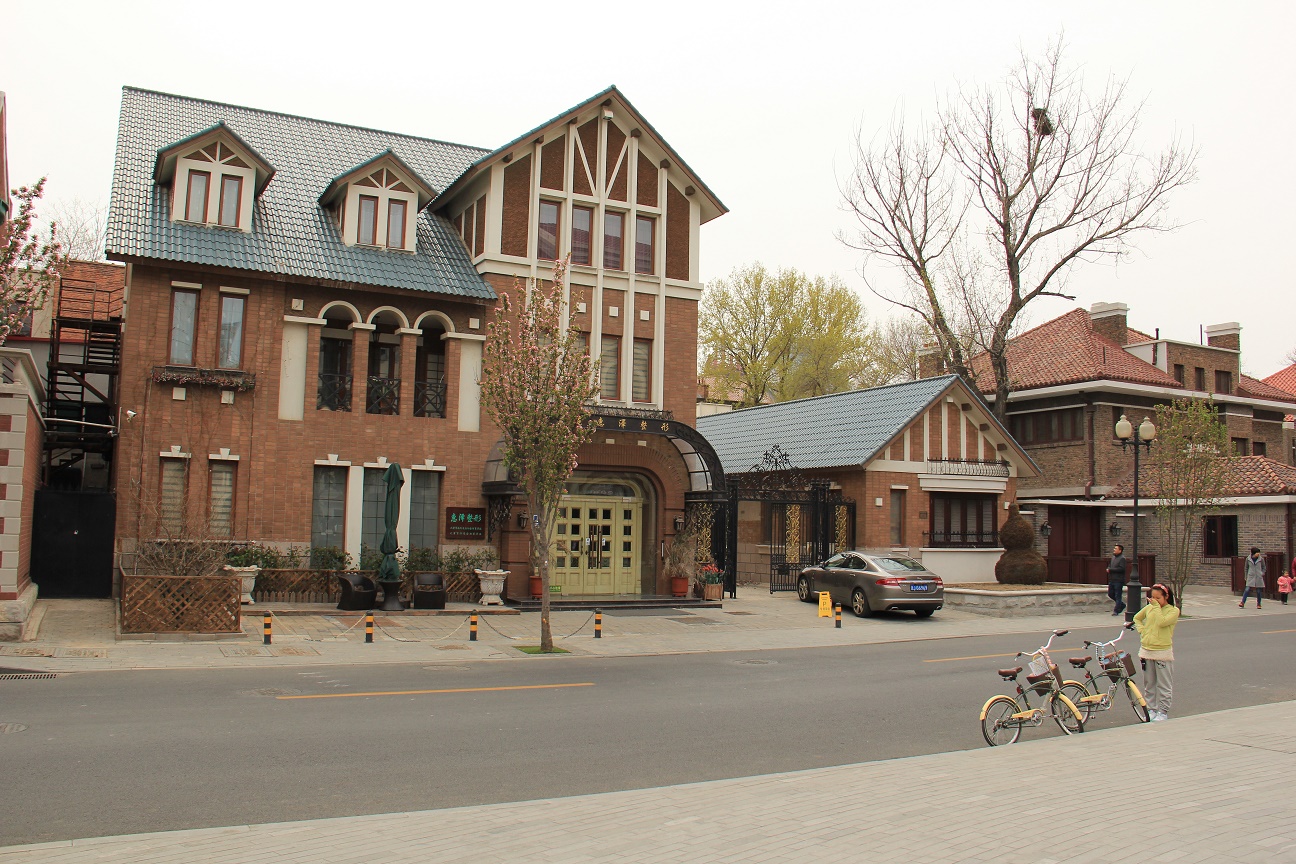
House in wudadao

Houses in the wudadao district certainly don’t look Chinese.

And there’s Tianjin’s biggest shopping avenue, lined with glittering monuments to consumerism and punctuated by the French-built St. Joseph’s cathedral hiding at the very end.
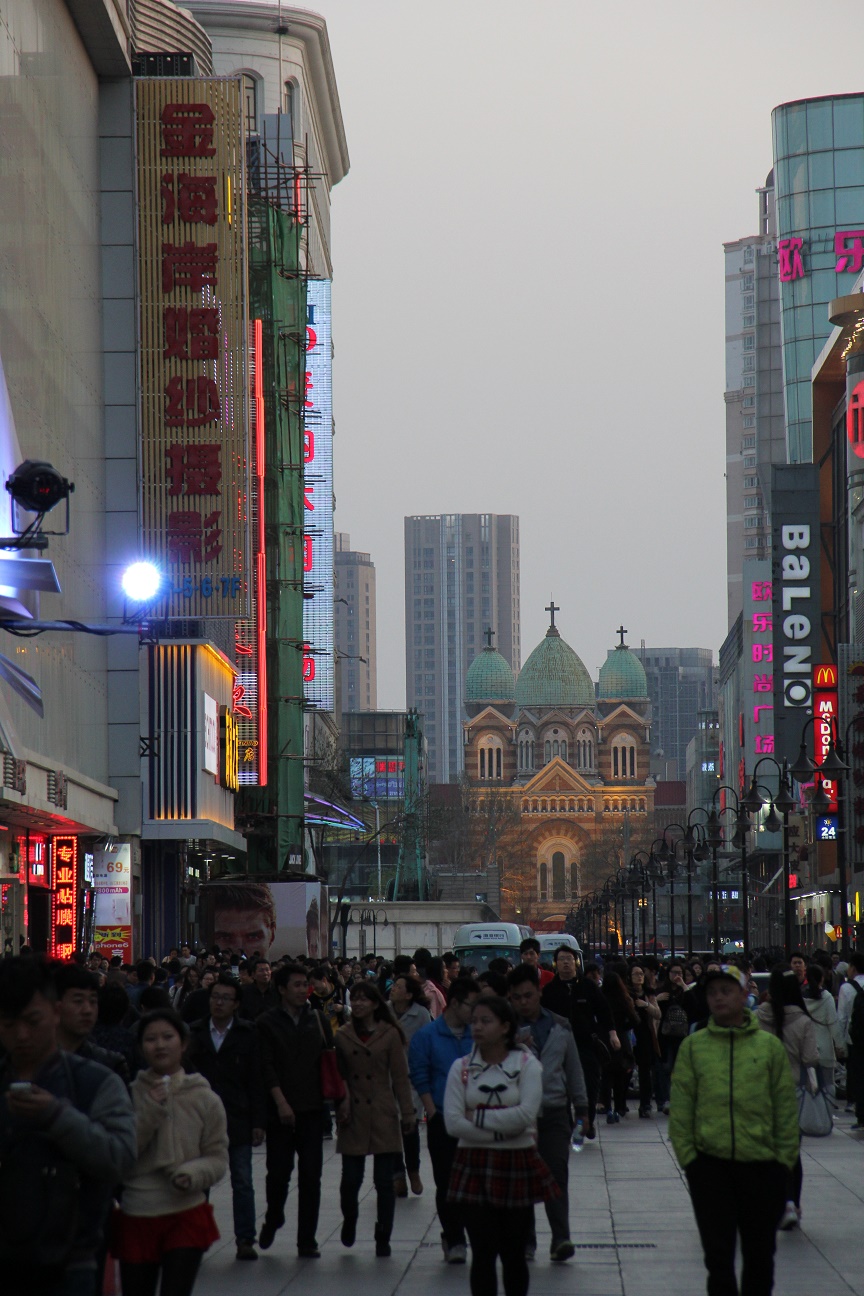
St. Joseph's Cathedral

St. Joseph’s Cathedral is the end point of Tianjin’s biggest shopping street.

For people who liked walking, Tianjin is good for a pair of days well spent.

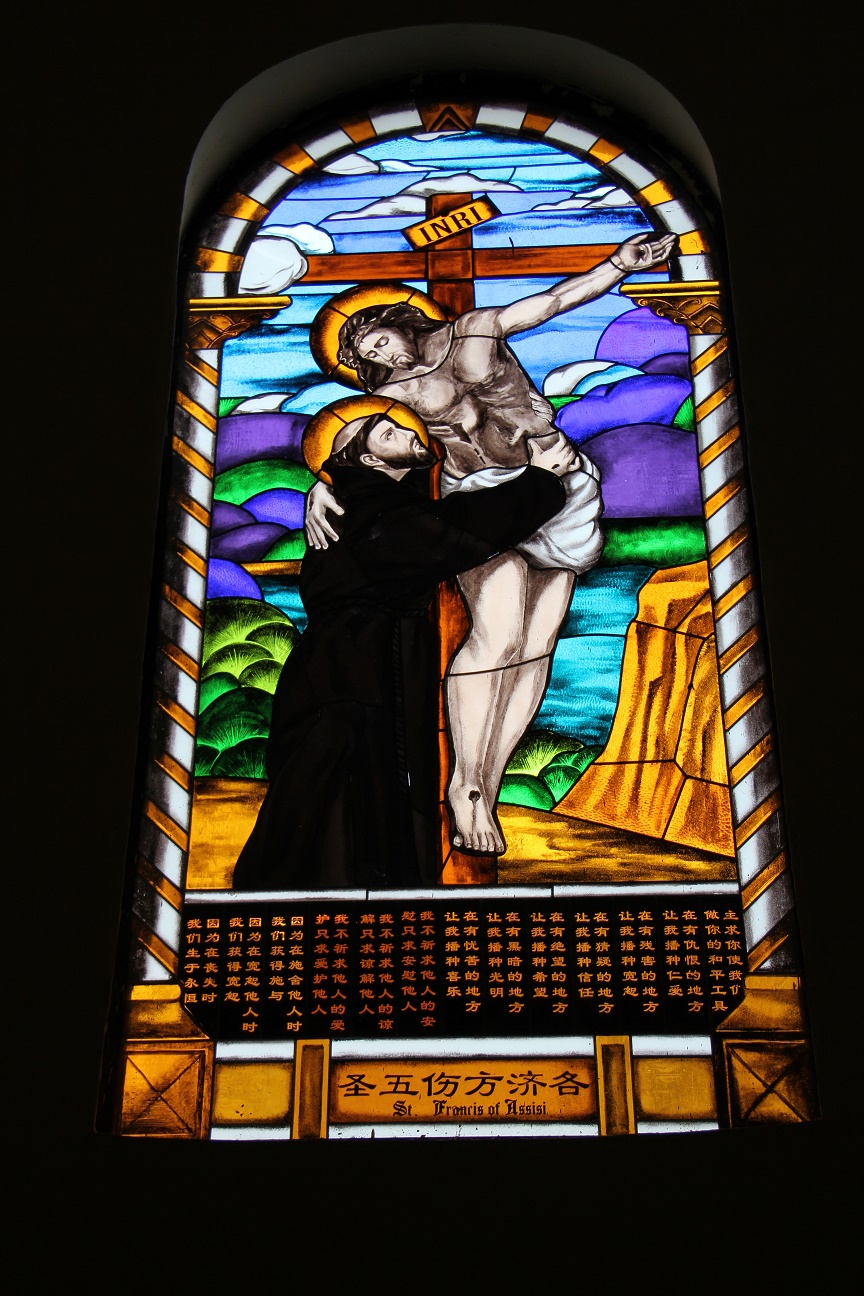
The city is at once much cleaner than Beijing and also more traditional. Its modern streets and streets alike have almost no trace of what one comes to expect as China, save for all the Chinese people as well as the army of food and repair carts posted at many of the intersections. Many of the European-style doorways the traditional red paper characters and door gods pasted on them. And St. Joseph’s Jesus is covered in Chinese writing. The contrast was somewhat disorienting.
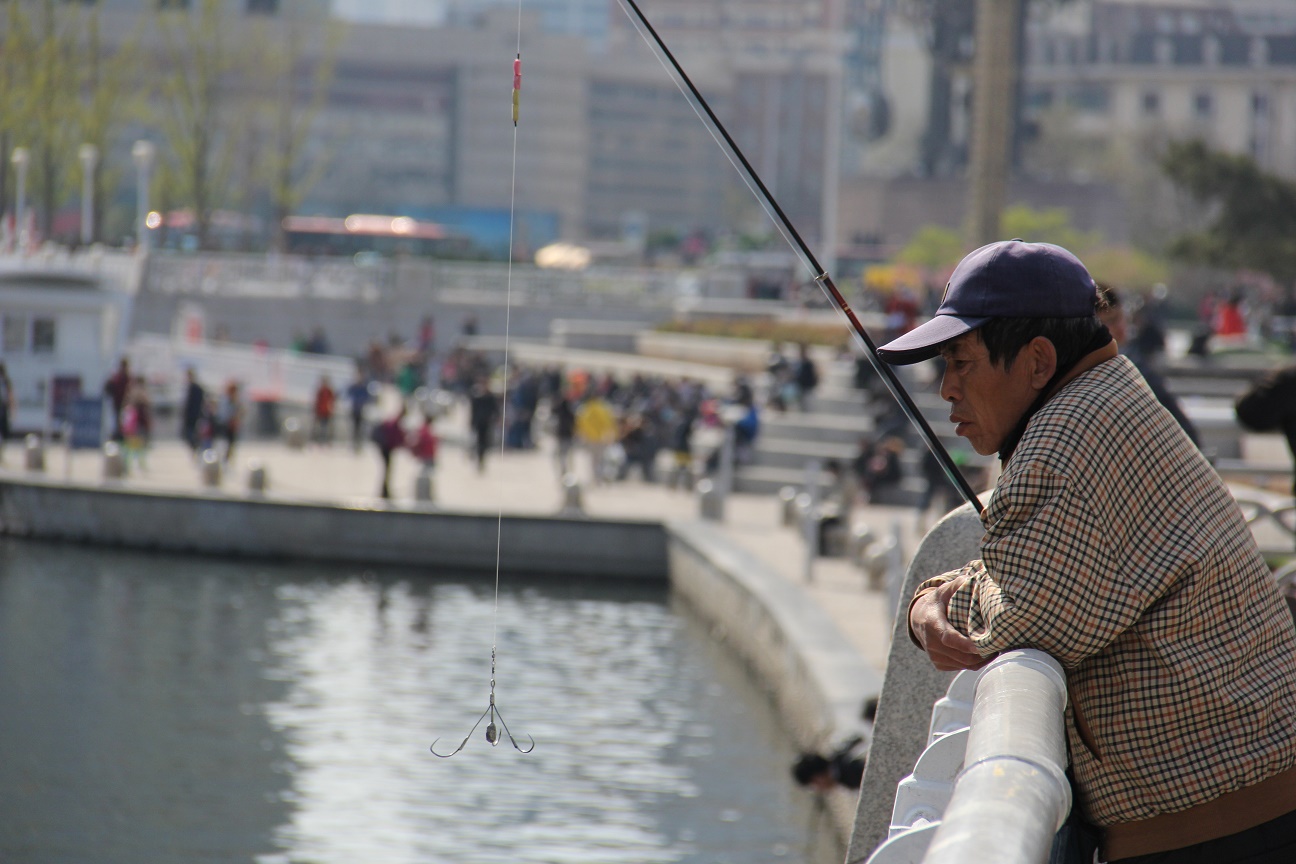
A man takes a break from fishing near the train station.
A man takes a break from fishing near the train station.

Jesus with Chinese characteristics.

Jesus with Chinese characteristics.

Tianjin is also well-known for its snacks, notably jianbing and 狗不理包子 goubuli baozi (translated as Steamed buns that dogs don’t pay attention to).

Jianbing are common in Beijing but originate in Tianjin. They’re basically a crepe, covered in egg and wrapped around cilantro, onion, shrimp crackers (I think), and a spicy sauce. Jordyn loves them so we tried two different styles, one of which made with green peas and fried dough instead of shrimp crackers I’ve never before seen. We decide Tianjin’s jianbing are indeed superior to Beijing’s.

Gobuli is actually the name of Tianjin’s most famous steamed dumping restaurant, which has been open for more than 100 years. More famous Chinese than I care to list have eaten there, and the Empress Cixi called its namesake dumplings the most delicious in China. The strange name (Steamed buns dog doesn’t pay attention to) originates with a villager who came to Tianjin to learn to make dumplings. His name was gou (dog). As he learned, he developed the special style that is Goubuli’s specialty, but would get so absorbed in making his dumplings that people started to say “Dog doesn’t pay attention to people, only to bao zi.” Eventually the saying was shortened to Dog doesn’t pay attention” and the name stuck.

The veggie baozi at Goubuli.

The veggie baozi at Goubuli.

It turns out Goubuli also has a branch in Beijing where Jordyn and I have eaten a few times before, though we didn’t know it until we returned from Tianjin. They are our favorite steamed dumplings. Regardless, we had to eat in Tianjin’s original branch, so for an excessive price – truly – we ordered one set of eight vegetable baozi. They were delicious, but we decided the baozi round goes to Beijing.

Goubuli baozi in Tianjin.
Goubuli baozi in Tianjin.

Walk a 160 miles in my shoes

Jordyn recently got a FitBit as a gift from my mom, and we put it to good use on our Sichuan/Hubei trip. She finally synced it up with the computer today and here’s the breakdown for the two weeks (minus one day she left it in the hotel):

160.24 miles (a day high of 18.95)
380,520 steps
37,223 calories burned

Not bad, I say.

Seeking the Buddha while Keeping One’s Kidneys

Whatever serenity I’d taken away from gazing upon the toenails faded by the time we hit the expressway.

The heat and rumble of the motor made my eyelids droop in the backseat until Jordyn nudged me with her knee. “Don’t fall asleep she,” she mouthed.

The rest of it went unsaid but clear enough: Don’t fall asleep and we might just keep our kidneys.

We really hadn’t come to Leshan on Chinese New Year’s Eve with the intent of embarking on an organ-keeping vigil. We had come to Leshan in the southwest corner of Sichuan to throw ourselves at the feet of the Buddha. And in Leshan, the Buddha has some really big feet.

The Leshan Giant Buddha

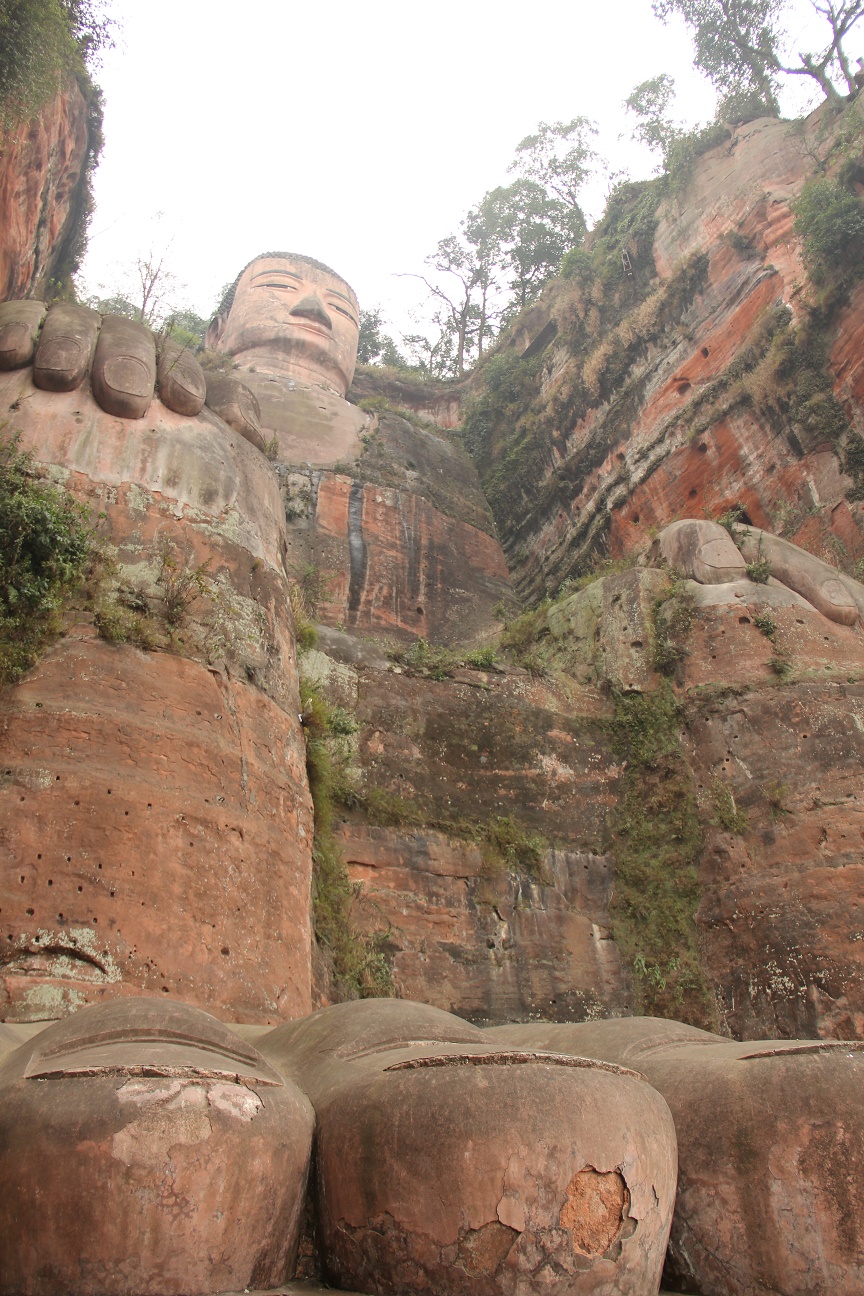
The Leshan Giant Buddha is 71 meters (233 feet) tall, the largest Buddha in the world. I could easily make a chair of one of his toenails.

The Leshan Giant Buddha is the world’s largest Buddha and the world’s tallest premodern statue at 71-meters (233 feet) in height. Commissioned by a local monk in 713 AD during the Tang Dynasty, the Buddha was to be carved out of the cliff face overlooking the confluence of the Dadu and Qingyi rivers. The monk, Haitong, hoped the Buddha would calm the treacherous waters below, making passage safe for ships traveling downriver.

Haitong oversaw construction while living in a cave which still exists near the head of the Buddha. When he died in the middle of the project, construction was halted because of insufficient funds, but his disciples finally finished the Buddha in 803 AD.

Apparently Haitong also got his wish, too. The Buddha calmed the waters. Or rather, the project dumped so much stone into the water below that the river’s turbulent current shifted, making the passage safe for the trading ships plying the waters underneath the new statue’s gaze.

The statue’s majesty isn’t just skin-deep, either: His muscular bulk hides an internal circulatory system of drainage capillaries that to this day pump water through the heart of the Buddha, slowing the effects of weather-aided aging. Sadly, the drainage system hasn’t halted the degradation that has come along with the region’s rapid development and the pollution that in turn has come along with that.

Or so they say. For me, the Buddha was little short of divine.

It’s one thing to read about the Buddha. But it’s another to crest the hill that leads to the statue and catch sight of his curly-haired head, passive staring eyes, and long, straight nose that itself outsizes the human body. And it’s another to wend down the stairs next to his slender, black- and green-stained fingers. And it’s another to stand at his flaking toe, the nail large enough to curl up upon, and gawk up at his hulking form.

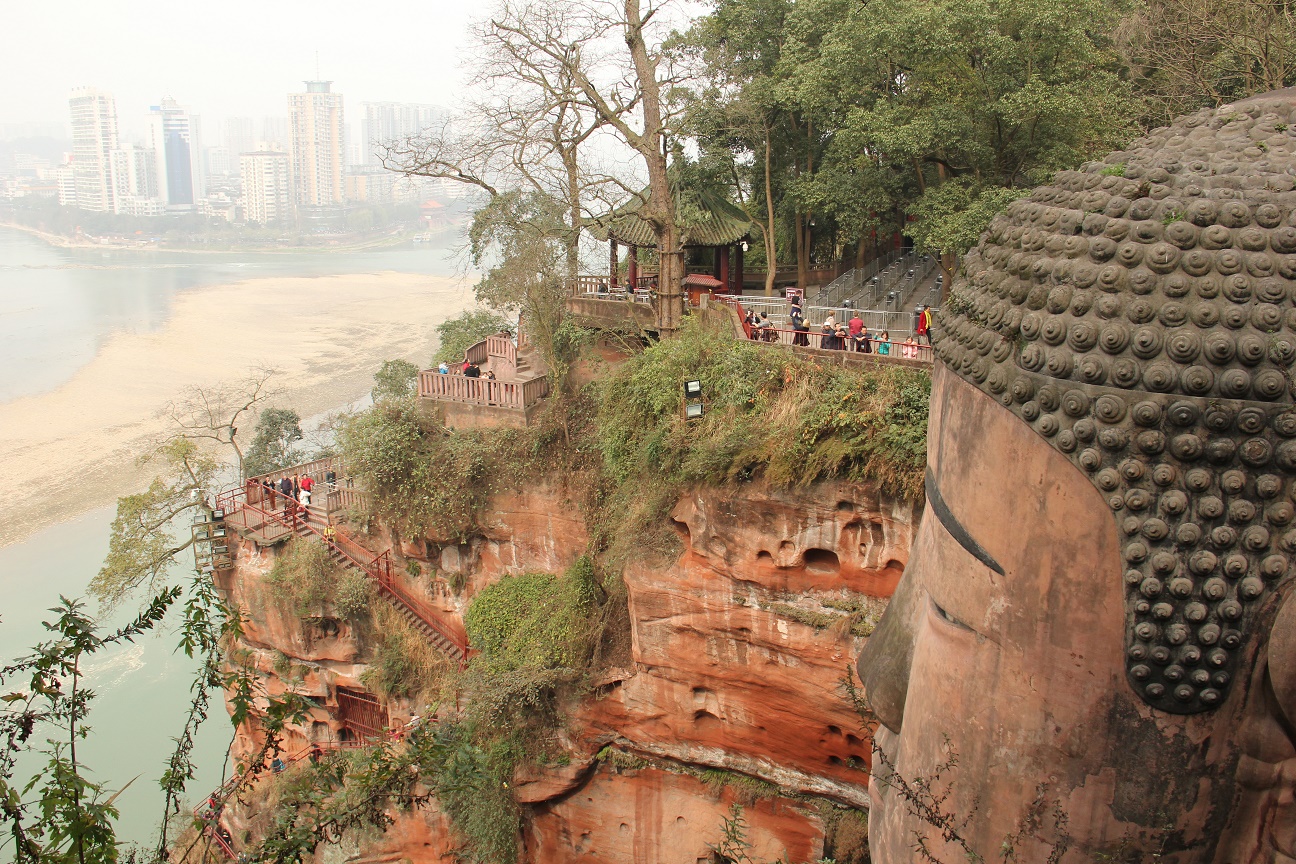
The Leshan Giant Buddha's head

The Buddha was built in the 8th century with the goal of calming the waters of the Dadu River, which he overlooks.

And then it’s another still to ponder the fact that he’s sat there, staring across the river, for nearly 1300 years and witnessed all the changes that have time has swept across his domain as surely as the river below sweeps reeds along its eddies.

Following his gaze today takes your eyes across the river to the skyline of the rapidly developing, 3-million-person Leshan City, where we planned to catch our bus back to Zigong later in the afternoon. But with a couple hours still to spare, we climbed back up from the Buddha’s feet, passing the thousands of crumbling Buddhist figures whittled out of the red sandstone out of which the stairs too are cut, then we wandered the others mountain paths to the smattering of other Buddhist and literary sites nestled among the mountain’s greenery. The bird song that filtered through the trees made it easy to lose track of time, but my guidebook said the last bus to Zigong was scheduled to leave at 6 p.m. so we couldn’t dither too long.

The Leshan Buddha looks at Leshan

Today the Buddha gazes across the river at downtown Leshan, and he’s witnessed plenty of changes in nearly 1300 years.

Buddhist worshipers light incense

Tourists and worshipers alike light incense to honor the Buddha at a temple that stands just behind his massive head.

We said a face-to-giant face goodbye to the Buddha, and caught the city bus back to downtown Leshan, stopping briefly at an outdoor market to sample the street food and get into the New Year’s shopping spirit before the fireworks started later that night.

We arrived at the bus station at about 3:45 — plenty of time to spare. We walked up to the counter and asked for a pair of tickets to Zigong.

“Today no more buses,” the ticket attendant said. “Come back tomorrow.”

As we walked out of the bus station we must have had the “what-to-do?” look well-advertised on our faces. A portly man with rotting lower teeth and a voice like skidding rocks immediately approached us.

“To Zigong?” he asked, then without waiting for an answer launched into a spiel about how it’s New Years Eve and everyone’s with their family and he’s got a private car but its New Years Eve but he can take us anyway but it will be expensive but we don’t have any other choice. He flipped out a business card, but didn’t give me time for a good look at it before jamming it back in his pocket. We talked price. About 60 bucks total to take us the two hours to Zigong. Then he passed us off to his friend who silently led us through the parking lot to a nice-enough silver Chinese sedan. We got in.

As we stop-and-go’ed through the city traffic, the driver made a phone call. I could make out some talk about Zigong and 350 yuan, so I knew he was talking about us, but I the rest of his rapid-fire Sichuanese was lost on me. I knew it was probably normal business talk, but I started to get nervous anyway. Suddenly, carrying two fat envelopes of cash, a camera, and two laptops — not to mention our bodies — into a car with a guy we don’t know in a city we don’t know in a province we don’t know, a place where we’ve got no local contacts and don’t speak the language and have no good way to get help, suddenly that doesn’t feel very well thought out.

Then we were on the expressway. I tried to seek some Buddhist-style inner peace, but my heart pounded with each fork we approached, and I eyed each sign to make sure the driver took the turns toward Zigong. Then I started to nod off. Jordyn woke me up. She started to nod off. I woke her up. I started to nod off. She woke me up. And so on for thirty minutes, then forty, then fifty, and then we were flying through verdant rolling hills brushed yellow with flowering bushes and hadn’t seen another car in some time and there were no houses or buildings in sight.

And then, without a word, our driver pulled to the side of the road and stopped.

My heart stopped with the car. Jordyn turned to me with wide eyes, and my face went purple in the rearview mirror. Nothing happened for a timeless three or four seconds. Then the driver half turned as said:

“I take off my jacket.”

Then we were back on the road. An hour later we arrived in Zigong, paid the man his cash, and walked back to our hotel to eat a fine meal of instant noodles and crackers.

They tasted divine.