High as the Clouds

October 5, 2015 — Huangshan City, Anhui Province

In Chinese, “Qiyun” means “as high as the clouds”. That’s true of Mount Qiyun, but only because the clouds slip down to meet it.

Rising just 585 meters above sea level, Qiyun strains, rather than thrusts, out of the dripping Anhui countryside. From heaven, clouds twist like the fingers of ghostly gods, stroking some of the mountain’s 36 ragged peaks and gripping others in a moist embrace.

For modern tourists, Qiyun is much overshadowed by its larger, far more physically impressive brother – Huangshan, less than 50 kilometers away – but through the passing of ages, the toppling and rebirth of dynasties, the wars that have riven China, Qiyun has stood as the epicenter of Taoism in southern China.

Perhaps it’s the millennia-old carvings of heroes and gods that glower out of Qiyun’s alcoves and caves that provide the air of mystery that have kept pilgrims climbing Qiyun’s steps since the 8th century. Perhaps it’s the natural scenery of the rocky peaks and the lush, river-split valleys below this one of Taoism’s four sacred mountains.

Or maybe it’s just the clouds, the way they wrap the mountain in their chilly fingers and cup peaks in their moist palms, deadening sound and fogging vision and spiriting visitors away from this world and its history, dynasties, wars, and concerns.

I read about Qiyun the evening before my last day in Anhui, and decided I wasn’t yet done punishing my legs. Getting there wasn’t easy, though. It was back to the early-morning bus station for more waiting and wandering and asking and wondering.

After a while, I learned that the same bus I’d taken to Hongcun the day before runs by the village at the base of Qiyun, but it doesn’t stop there. I’d have to ask the driver to make a special stop on the outskirts of town, then walk a couple of kilometers to the village.

I arrived at the crossroads an hour later, and the bus lurched to a stop. Sure enough, the peak to my left was “as high as the clouds”, and rain spit from the heavens.
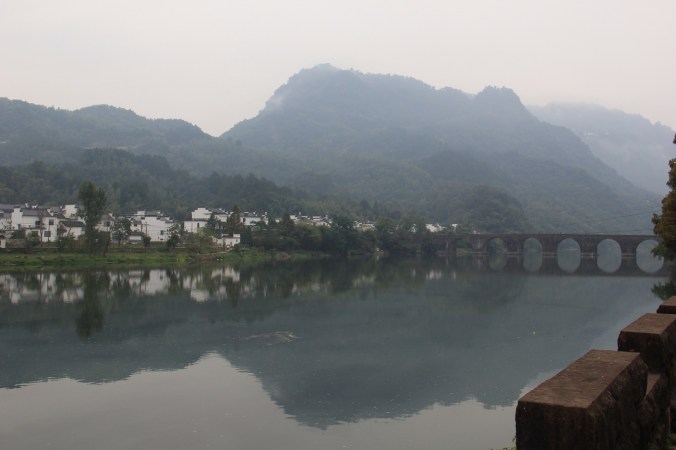
Mount Qiyun is wreathed in clouds above a Huizhou village.

Mount Qiyun is wreathed in clouds above a Huizhou village.

As I walked toward the many-arched bridge that led to the mountain base, I stopped by a baozi shop to pick up some steamed buns and a local pancake filled with beans, peppers, and bean noodles, then promptly burned the skin off the roof of my mouth trying to protect them from the sog.

Compared Huangshan, the climb up Qiyun’s stairs was gentle and short, but in the rain and humidity, my pace left me sopping by the time I climbed to the main gate. From there, Qiyun’s paths wound along the cliff sides and up to its peaks. Everywhere, alcoves hid graves, altars, and shrines to Taoist heroes and gods, and hidden speakers whispered the plucked notes of a guzhen. Here and there out of the trees and rocks rose temples dating from the Song, Ming, and Qing dynasties.

Perhaps the spookiest place on the mountain was a huge, sheltered recess which housed a few dozen statues and carvings. I ducked into one cave, lined on both sides with the crumbling visages of ancient priests. The cave plunged into darkness behind a large altar, and I tip-toed in.

The darkness was encompassing, but in the back reaches of the cave, golds and whites glittered in the dark. As I stood, waiting for my eyes to adjust to the black, bats squealed and shuffled just above me. I began to make out figures in the gloom.

Gods, or demons, many armed and many eyed. Some snarled and brandished weapons. Other just sat and stared. Silence, except for the bats.

I battled a sense of unease that tried to force me back into the light, and tried to take it in. When I turned finally retreated out into the haze of murky daylight, an odd sort of relief washed over me, despite the thickening rain.

Out of the alcove, the path climbed to a plateau upon which sits an ancient village, its walls plastered white and its roofs black in the Huizhou style. The village clung to the cliffs, looking out on the river below which hugged the Anhui hills as it cut through more white-and-black hamlets. A giant yinyang was shaved out of the fields at the foot of the mountain, and all around clouds wreathed the trees.

More ancient temples were scattered among the Huizhou homes, many of which made use of their bottom floors to sell food and beer, souvenirs, or joss sticks for burning in offering to the gods. After clambering down one set of rain slicked stairs, I found some dinosaur footprints alongside a decorative archway that was more than 600 years old.

I spent a couple more hours climbing up and down stairs, squeezing between rocks, and stepping through temple halls before the rain began to fall in earnest. I tucked my camera deep in my bag and ran to the top of the highest peak. From the top I saw nothing but the clouds and heard nothing but the drip of the rain.

Spirited away, just as Qiyun promised.

Without an umbrella or a rain jacket, I ran the paths back to the main gate, then down the stairs to the village below. I only fell once.

I arrived at the crossroads where the bus had left me, and I stood in the drizzle waiting for it to return. I tried in vain to flag down a few passing tourist buses, then finally stuck out my thumb. Only a moment went by before a middle-aged woman pulled up and asked if I needed a lift back to Tunxi. I thanked her profusely and asked how much she wanted.

“Just pay whatever you think is fair,” she said.

As we wound along the country roads I dozed off in the front seat and dreamed of clouds.
A Dolphin God in the Waste

August 7 — Jiayuguan City, Gansu Province

We have bowed before The Dolphin and looked upon his heavenly kingdom.

Like Buddhist pilgrims, we twisted through Jiayuguan’s broad, empty avenues with no sure destination, assured in the knowledge that we’d know what we were looking for when we found it.

A sign: Above the tree tops floated a white globe, gleaming in the sun and impossible to interpret.

Like the three magi, we followed the shine in the sky and found our Lord.

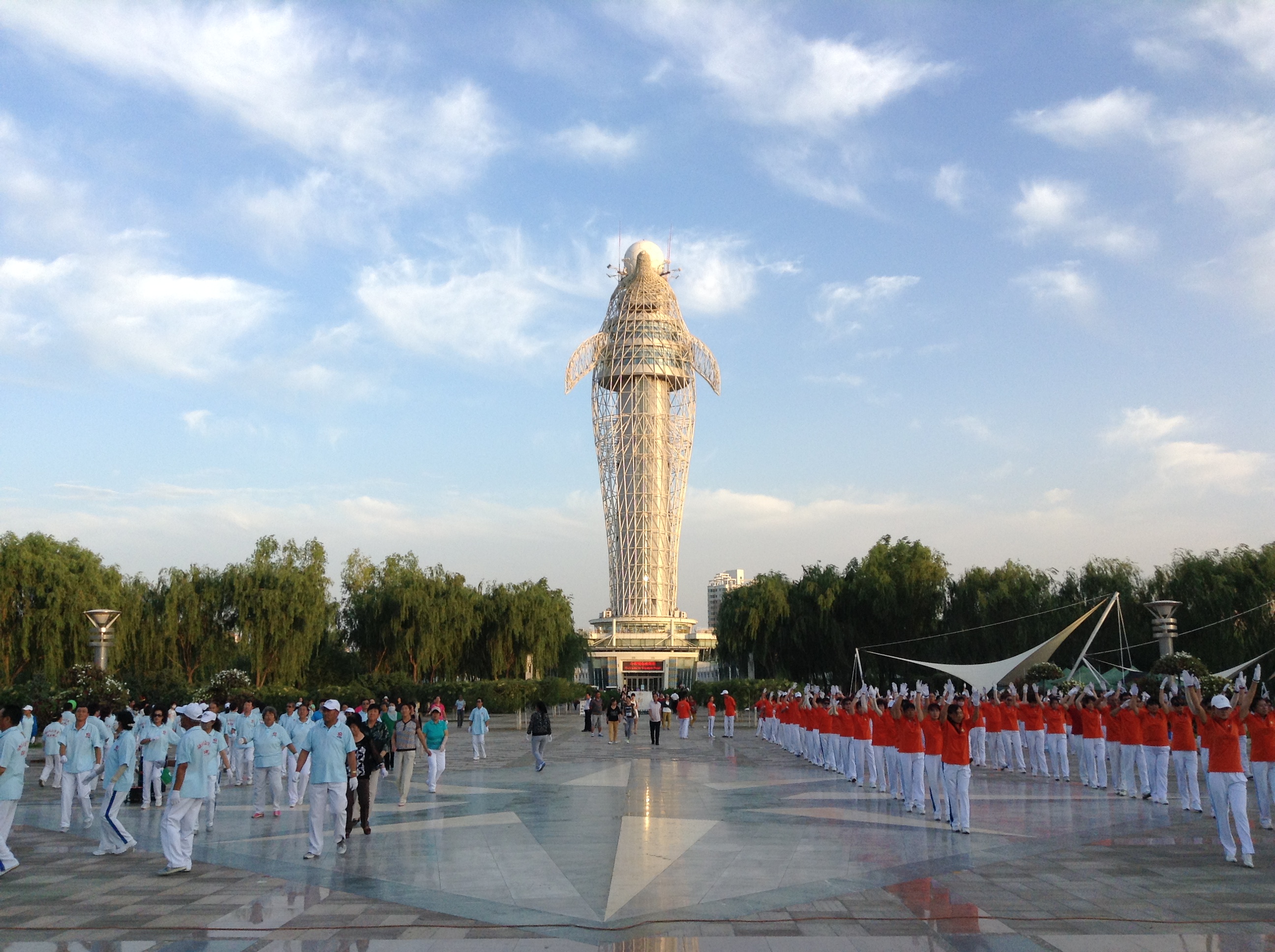
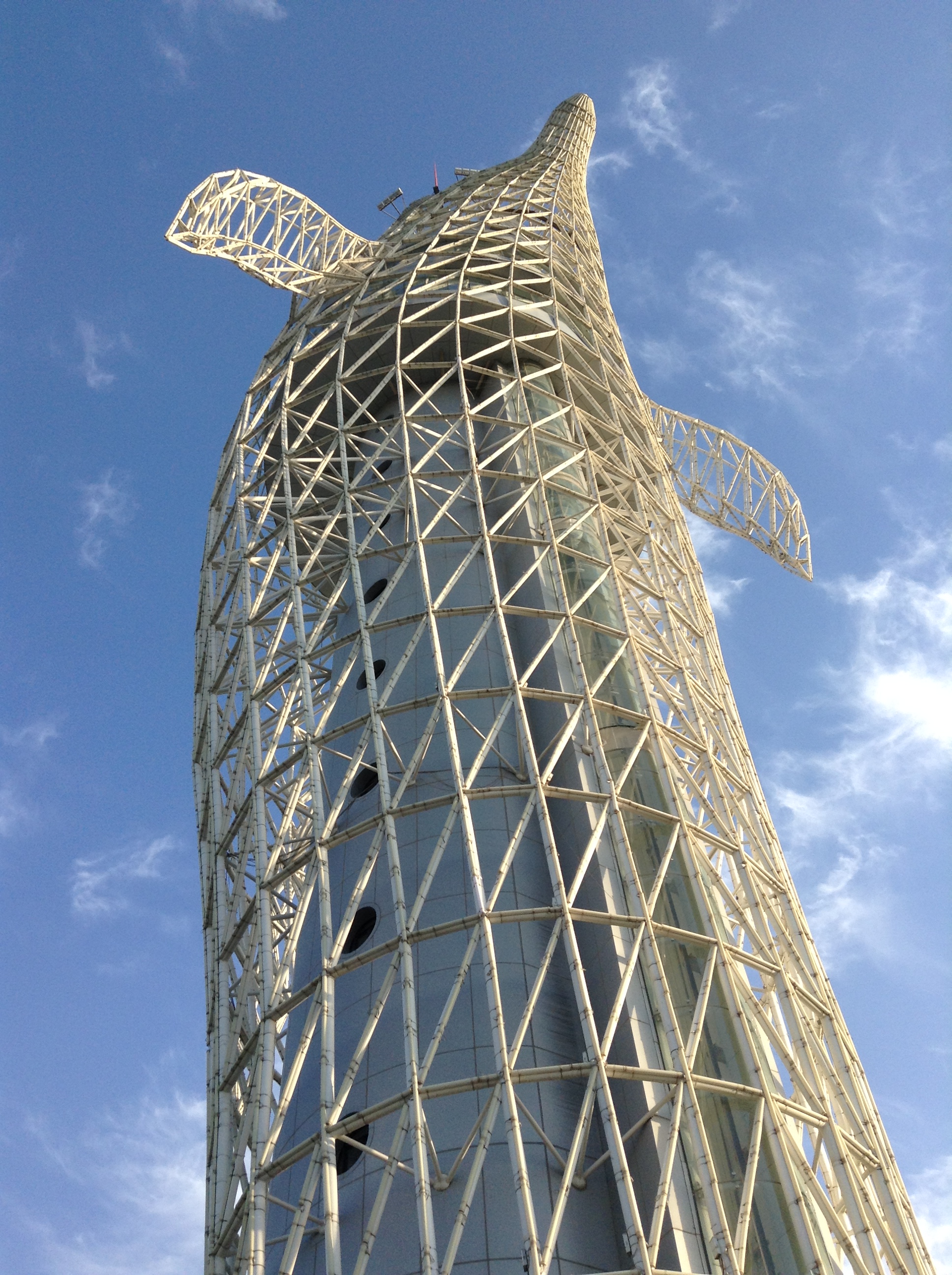
In the middle of a leafy park in the middle of one of the world’s driest and furthest-from-the-ocean cities, The Dolphin rose out of a shallow fountain, perched on its tail fins, looming over all.

The only words we could find were: “What the hell?”

The Dolphin God

The Dolphin God

We approached it with trepidation. Beneath its cracked skin of interlocking white metal beams floated a gut-like atrium and an esophageal elevator.

We made an offering of ourselves.

As it turned out, The Dolphin was actually a gussied-up atmospheric monitoring station. Inside it was a small museum about China’s weather patterns and some exhibits on climate change, plus a collection of photos of the rest of China’s weather stations. Pretty normal stuff.

Atop the elevator, things got weird.

The Dolphin’s head is a 360-degree viewing deck, complete with heavy-duty binoculars. From the top, we could see why we’d had an unshakable feeling that something was amiss in Jiayuguan City.

Jiayuguan has a population of just more than 230,000 people, making it tiny by Chinese standards. But with a Dolphin’s-eye view, we saw the city sprawled out in every direction. Even stranger, it looked like the North Korean utopia realized.

Everywhere apartment blocks of disconcerting suburban sameness rose out of the desert, each red roof capped with its own solar-heated water heater. Tens of thousands of apartments, broken up only by huge, centrally located, hour-glass shaped nuclear cooling towers. Golden, decorative streetlights lining sweeping avenues.

Surrounding The Dolphin – again, in the middle of a desert waste – was a leafy and lush park that must have equaled New York City’s Central Park. It was practically drowning in streams, fountains, and lakes and overgrown in greenery.

And all of it was empty. No people in the apartment clones, no cars on the streets, no commerce anywhere. The infrastructure for perhaps millions, and all of it unused. The only thing that seemed to move at all was the steam drifting out of the nuclear plants. A heaven on earth, desolate.

We found the priests locked in ritualistic competition for their deity’s divine favor.

In the square below two groups danced, one next to the other, a narrow lane in between. Those in one group wore blue polo shirts, the other red. They stood in two blocks made of parallel lines of worshipers. In unison, they shuffled their feet and raised their hands and heads to the sky, keeping pace with the rhythmic, modern tunes that blared from speakers set up among them.

Each group whirled to a different tune, and as we watched, the music spilling forth from each amped up decibel by decibel in an attempt to out-loud the other. They pretended not to notice each other, even as they shot furtive glances scanning for any slip in synchronicity that could signal final victory. On and on it went as we slunk along in gap.

A man, not of that bizarre priesthood, approached me and asked where we were from. After a brief exchange in pleasantries, I told him the huge city looked empty.

“Does anyone actually live here?” I asked.

“No,” he said. “But someday they will come.”

Above, the dolphin reigned — still and omnipresent.

Worshipers compete for the favor of their deity.

Worshipers compete for the favor of their deity.

Shuffling to the West Lake

Someday I will learn not to travel during Chinese holidays. I have not learned this yet.

Thus, I got up at 3:30 this morning after about two hours of sleep to join the mad rush to where it is that people have decided to go for this year’s iteration of the Golden Week National Day travelpalooza. Even at 4:30 this morning, the airport was a line circus.

And so were the streets of Hangzhou, where I’m spending the day before shipping myself into the Anhui mountains tomorrow. See:

Crowds in Hangzhou. This actually is not crowded.

Crowds in Hangzhou. This actually is not crowded.

So you can imagine what the bus station looked like. One of the five bus stations, that is.

It was a day of stumbling through crowds and sitting in seats and standing in aisles with my eyes half open.

But I at last got to lay my half open eyes on the famed West Lake, which really does almost live up to the hype.

Truthfully, I don’t know much about the lake, except that every single Chinese person I’ve ever talked to about it has told me that it’s the most beautiful place in China. Right before they tell me that they’ve never been here. But that’s what the travel ads say, anyway. Maybe I will learn more later.

It’s certainly beautiful, wind whipped waters ringed with shrouded mountains and lotus clusters and plied by those goofy tourism boats. And of course, a horde of people. I made it about halfway around this afternoon, then watched the sun set over the water while the seabirds rode the breeze looking for fish before retiring to a snack street to do some more standing in line and shoving as part of the red-in-tooth-and-claw fight for my own dinner.

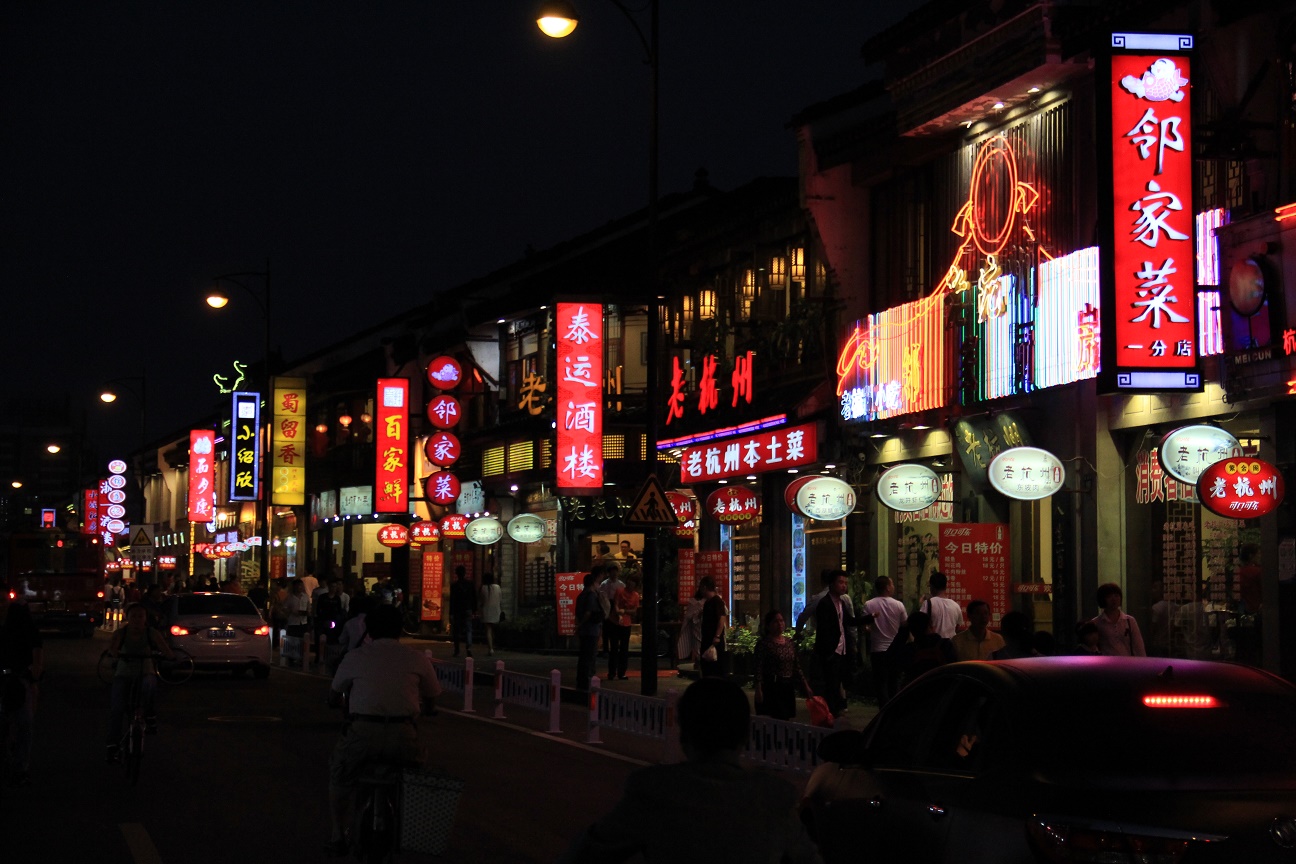
Red in tooth and claw and neon.

Red in tooth and claw and neon.

I’ll be back later this week to wander among the hills and temples on the far side, which I’m excited about. It actually does deserve its place on China’s 1-yuan bill.

Pictures will tell it better than my addled brain at this point, so without further nonsense: Pictures!