Boats in Three Acts: Xiamen

January 22, 2018 – Xiamen, Fujian Province

“You can’t get there from here,” the woman at the ticket window said.

She did not look up at my outstretched arm, pointing across the bay. Nothing in her face moved, except for her lips. I stood for a moment and watched the boat docked “here” fill up with people, then rumble away, the start of a roughly five minute journey to “there”.

I turned back to the ticket woman, who still hadn’t moved her eyes from whatever was just below the window, out of my view, and I started to protest, having seen the boat go exactly where I wanted to go. She cut me off.

“You have to go to a different dock. Cross the street, then get on Bus 58. Go to the other dock.”

I sat down on a ledge not far away from “here”, and watched the cross-bay ferry arrive “there:” Gulangyu Island.

Gulangyu is a tiny, pedestrian-only island across the bay from Xiamen’s old town. The 2-square-kilometer island is a UNESCO World Heritage Site, attracting more than 10 million visitors a year who want to wander the lanes that wind past Victorian-era European-style villas, consulates, police stations and churches, many of them (at least I’m told) now converted into coffee shops and B&Bs.

Gulangyu once was a foreign island among a sea of Chinese. After the Treaty of Nanjing in 1842 that opened up both Fuzhou and Xiamen to foreigners, nationalities from across the world settled on Gulangyu, administering it with an independent governing council. Thirteen countries took part in its administration before Japan took it over entirely during World War 2, and for decades the British Empire’s Sikh police force from India patrolled the settlement.

My plan to take a ferry to an island for a mini vacation had fallen apart, and instead of relaxing anywhere, I’d spent two full days stuffed into the seat of one metal box or another. I had one last chance to make something of my island plan, even if were for only a few hours before we had to catch the train to Fuzhou to catch the bus to the airport to catch the flight to Tianjin to catch the train back to Beijing to catch a cab home.

But “here” I was, sitting on the dock. Again.

I’d been thrilled the night before to discover that our hotel lay just up the street from this dock on the bay, across which, in the dark, a cherubic light illuminated the hilltop church as if it were the painted head of a some medieval saint.

If Gulangyu is a Cavallini, Xiamen’s old city, then, is a Picasso, a jarring and disjointed amalgamation of geometries that together make an almost coherent, maybe beautiful whole.

Xiamen’s newly rebuilt main old town shopping street is a white-blasted assault, European buildings juxtaposed against the international and Chinese brand name stores fitted into their lower levels and people everywhere. But outside this artery, a network of capillaries branches out like spider veins, and it’s in there one can find the lifeblood of the city.
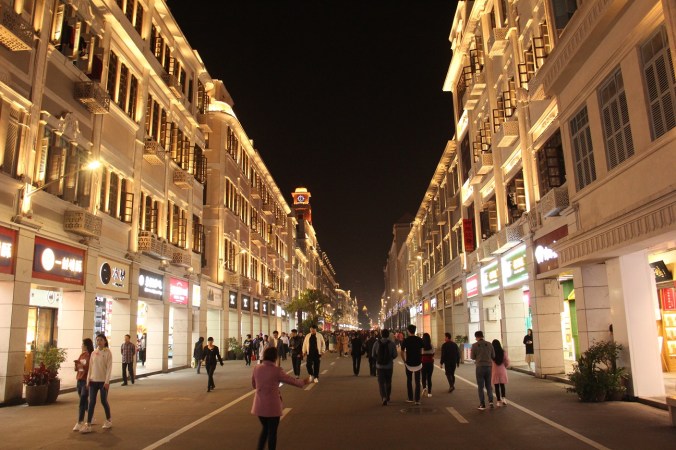
Xiamen Old Town

Xiamen Old Town

These vessels narrow, some to just shoulder width, and overhead, buildings and wires twist upward, competing for space, all of them colonized by moss-like laundry drying slow in the humid air. Open doors face the street, and families laugh over dinner in front of LCD televisions on sterile floors below their loft beds. Up that way, the Buddha’s face shines down the stairs, concealed by a whole garden of plants. Down this way, a man fries noodles for a customer through a cloud of shifting steam and smoke, while his grandfather in the back rustles Mahjong tiles with the neighbors. One doorway leads into a hotel, while another one opens into a convenience store and another into a schoolyard.

Some of these veins pour out into community parks, complete with a stage, a library, some art. Other veins flow back into the arteries, where crowds jostle for seating at Vietnamese restaurants or red-paper shops. Some veins empty into the local seafood market, where vendors shout through cigarette-stuffed lips at passersby, trying to sell one last octopus, crab, or turtle before they pack up their stalls, and sling water into the street to wash up the blood, scales, and guts. By daylight, fresh hauls of shrimp, eels, and shark will fill the street, along with the cacophony and the smell.

We spent the night swimming these lifelines, then biked through the burgeoning art and bar district before settling in to chat with the owner-brewer at Fat Fat Beer Horse about life in Xiamen (he likes it). By the time we biked back it was near 1 a.m., but I still planned to make it to the morning ferry. At least the walk to the dock was short.

Or so I’d thought, before I stumble trudged toward Bus 58, lids heavy, to take it to “the other dock”, wherever that was.

I got off the bus 20 minutes later. I’d seen a sign for “To GulangYu”, and I walked up to the ticket window at an even smaller dock than the first.

“Gulangyu,” I said. “One ticket.”

“Do you have the card?” she asked.

“What card?”

“So you’re a tourist. You can’t take this boat. You have to take the tourist boat. The local boat is 8 yuan. The tourist boat is 50. You can’t take this one. You don’t have the card.”

“But how do I get to the tourist boat?” I asked, after a sigh.

“Take bus 58.”

I wanted to scream. As I pedaled lethargically back to where I started, I was ready to give up.

No more boats for me.

I passed the stop where I’d first boarded Bus 58. I stopped and watched as the bus pulled in. People loaded on.

No, I thought. No more boats.

I looked across the bay at the island, the church high above the trees, tree which hid all but the peaks of those colonial buildings. I imagined walking under those trees gazing at history as I strolled, winding my way up the hill to the church — no bikes, no cars — and looking back toward Xiamen and its skyline. I imagined sipping a black coffee and sitting in the warm winter sun, gazing out over the sea. I ran to catch the bus.

I rode Bus 58 to its last stop. I arrived, finally, at the tourist ferry terminal. The boat tickets were sold out. I turned around and started my day-long journey back to Beijing.

IMG_9777

Being watched at the Xiamen train station.
 

Boats in Three Acts – Fuzhou

Act 1: Fuzhou

Saturday, January 20 – Fuzhou City, Fujian Province

Don’t try to take the boat.

Taking the boat might seem like it will save you time. It might seem like it will save you money. It might even seem like a relaxing trip to a relaxing tropical island. But it won’t be any of those things.

So don’t try to take the boat.

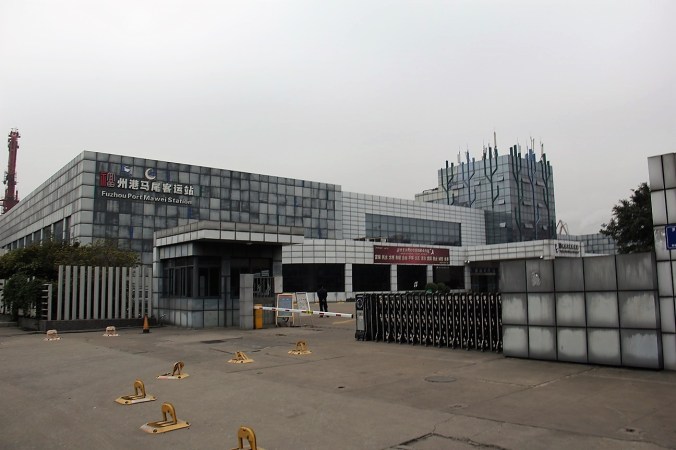
Mawei Port

A boat place in Fuzhou. A place you shouldn’t go.

This past weekend a friend of mine needed to leave China on a visa run: out, stamp, in, stamp, done. Legal for 60 more days.

Flight prices had climbed higher than I’d have liked on the normal visa trips to Seoul or Hong Kong, and the timing of flights to Xiamen (厦门), where tourists and visa-runners alike can take the 45 minute ferry to the outlying Taiwanese island Jinmen (金门) were not so appealing (arriving 2:20 a.m. Sunday, leaving 9 a.m. Monday?). But after a little research, I discovered Taiwan owns another small island just off the Fujian Province (附件省)coast, this one a 1.5-hour boat ride from the provincial capital Fuzhou (福州). I’d not heard anything good about Fuzhou, nor had I heard anything bad, and my Lonely Planet guidebook didn’t have much at all to say about it, which I figured was either good or bad, so I booked a cheap “business” hotel in the port district of the city and a 1000 RMB (150$) plane ticket from Tianjin to Fuzhou and back two days later.

Fuzhou has a long history as a critical port, even serving as the sailing-off point for the most famous of China’s explorers, Admiral (and eunuch) Zheng He (郑和), who in the 15th century sailed several times from Fuzhou to the Indian Ocean and, on a few occasions, even to the African coast. Hundreds of years later after the First Opium War with Britain, the Treaty of Nanjing, which ended the war and humiliated the Chinese, also opened Fuzhou up to foreign trade (read: Western exploration) as one of five treaty ports in China. Fuzhou was open for saving souls and selling stuff to them.

Most relevant, perhaps, in the 1950s Fuzhou was on the front lines of the of war between the communist People’s Liberation Army and the nationalist Guomindang, or KMT, under Chiang Kai-Shek, and KMT aircraft bombed the city frequently after the PLA occupied it in 1949. By then, the KMT had withdrawn to Taiwan. Against the advice of many of his commanders, Chiang brilliantly left a substantial rear-guard force on Mazu Island — where we planned to make our run — to protect the main Taiwanese Island from immediate invasion and to serve as a base for the eventual campaign to retake mainland China. Huge characters in Chiang’s hand foretelling that event, which never happened, still face the mainland. For years, then, Mazu served a pivotal role in preventing the conquest of Taiwan as it was bombarded by big guns from the mainland, and some stories even tell of communist frogmen sneaking across the waters at night to slit the throats and take the ears of KMT guards in the island’s many military bases. Although Mazu still hosts a sizable Taiwanese military presence, hostilities have obviously ceased and those bases, forts, and tunnels serve as some of the main tourist attractions on Mazu, though tourists are warned not to wander far off the roads, into the unmarked minefields or unexploded bomb shells that litter the landscape.

Simple plan, then: Take the 30-minute Saturday morning train from Beijing to Tianjin, fly 2.5 hours, find the ferry port, take the bus downtown for the evening, catch the 9 a.m. ferry to Mazu Island (妈祖), rent a scooter, spend a couple of days exploring those old military fortifications and Taiwanese temples, watch an island sunset from a rooftop, catch the 2 p.m. ferry back to Fuzhou, take a cab to the airport, take the train back to Beijing.

OK, maybe not so simple, but still, it made sense, and for a while, it worked accordingly.

Mawei

We flagged down a cab in the Fuzhou airport and loaded into the back.

“Mawei,” I told the driver.

“Ok. But you have to pay extra to go to Mawei. It’s way out of the way from where I was going. I won’t be able to get any pick ups there. One time I waited five hours,” he said.

“Fine, fine,” I said.

We drove for a while.

“Are you from Fuzhou?” I asked. “Do you like it?”

“Yeah. Fuzhou is a good place. It’s developing fast,” he said we drove past a power plant venting plumes like an underwater volcano and through the skeletal ribs of half-completed highways. “But not Mawei. Nobody likes Mawei.”

Great, I thought. At least it’s near the ferry.

We drove on through construction sites and industrial plants. The driver ranted, flicking his hands around as he took them off the wheel, about foreigners coming to China and making easy money, while Chinese, like his brother, go to America and can’t even find a decent job.

“Why do Chinese go to America? I don’t get it,” he said, turning around to look me in the face. “They should stay here. I really don’t get it.”

He threw up his hands one last time.

IMG_9760

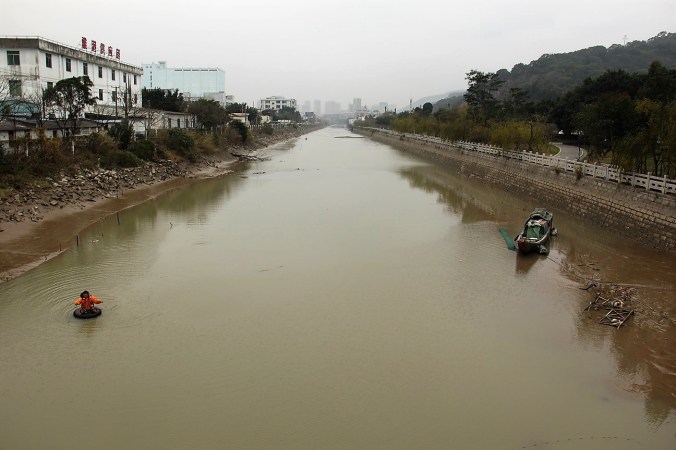
The river near Mawei Port.

IMG_9761

The hills near Mawei Port.

Later that afternoon after checking into the hotel and finding our room with not three but four unplugged floor lamps in a line against the wall, we took a bus up to the ferry terminal to make sure we could find it and also to check the departure times. Then we caught a bus to downtown.

One hour and a half of bouncing over unused train tracks and through unfinished subway zones later, in the dark, we arrived.

The centerpiece of downtown Fuzhou is the “Three Lanes, Seven Alleys” area, which has been revitalized as a touristy slice of Ming/Qing China.  Brand name shops and trinket dealers crowded the main strip, but the murmur of the tourists faded to footsteps in the lantern-lit alleyways where coffee shops added their bright glow to the fire-touched white walls. Just outside the historic district, a canal cut through a restaurant strip, and crowds lounged under the willow tendrils outside fish and hotpot restaurants of varying qualities, most of them out of my price range. Somewhere, a impromptu street band strummed and crooned in the night. Across the river, a man flowed through Tai Chi forms before hopping on his scooter, still in his traditional martial arts clothes, and drove away.


Kisses

We rode bike-share bikes the five kilometers to our next stop: Fuzhou’s lone (maybe?) craft brewery, Pocket Brewing. As we rode nearly kilometer-long bridge across the sandbar speckled Min River, I passed a woman on a motor scooter. She drove, headlight off, earphones in, watching a movie on her phone, which she propped up on the left handlebar.

The taproom was typical, if a little messier (Halloween and Christmas still happening–at the same time!), than the norm (wood tables, exposed metal) but the beer was decent (especially the passion fruit stout). Next to our table, a group of increasingly drunk young businessmen order flight after 20-glass flight (shaped like an airplane, heh), knocking them back like shots while chain smoking and chewing on pickles and pea pods. A bowl of crab claws they left mostly untouched. After a while, the drunkest of them ambled over to our table and started shout-slurring stuff while his friends tried to coax him back. He pounded the table and bellowed something like “Ammerrrca!” over and over glowering crooked at my forehead, then asked if he could kiss my friend. Without waiting for an answer, he pecked her head.

“Bu bu bu bu!” his friends screamed. “No no no no!”

“Mei shi!” he screamed back. “No problem.”

He turned and kissed me on the head. Everyone laughed. He turned back, grabbed her by the face, and kissed her on the mouth.

“Bu bu bu bu bu!” his friends screamed. This time, he didn’t scream back. He just swung around and latched on to my gaping mouth with his spirit soaked lips, writhing like still-glistening worms stranded out on the sidewalk on a warm-but-not-hot summer day. His friends wrenched him off me, undoubtedly waiting for me to take a swing, and tried to drag him from the establishment. He grabbed a shelf showcasing bottles and cans of rare beer. They began to rain down on the table, a dangerous, unforecasted precipitation. At last, three of them together pried his hand off and bulldozed him out of the bar as he shouted “Ammmmercaaaaaaaaaaa!” one final time.

The businessmen left at their table made it up to us with no small amount of beer.

Boats

A morning mist hung over the harbor, slicking the streets with a greasy moisture and blurring the cranes on the horizon to fuzzy orange stickbugs, stabbing at the sky. It looked like the back of my eyes felt.

Still, we were up and stepping off the bus early to catch the 9 a.m. ferry.

The guard at the gate stepped out of his shack.

“You going to Matsu?” he asked.

“Yes,” I said, stepping cheerfully past him.

“It’s not running today,” he said. We stopped and turned.

“It’s not running today?”

“No. It can’t go out today.”

“Why not?”

“It can’t go. It’s not running today. Come back tomorrow,” he said.

Our flight back to Tianjin was “tomorrow”.

“Are there any other ferries to Taiwan?” I asked, The haze cleared from the back of my eyeballs as the hot sun of desperation burned through, and the grease slid sour into the back of my throat.

“Yeah,” he said. “From Huangqi.”

He must have seen my shoulders sag with relief.

“But you can’t take it,” he said. “You’re American.”

The Price

April 30, 2017 – Ningxia Province

The cabbie drove as cabbies across the world do, only this time he was jamming into oncoming traffic, past trains slow-moving tourist cars on a tree-lined, two-lane country road, forcing himself back into the chain of vehicles here and there, muttering to himself, and occasionally offering me some cheerful advice.

It got worse as we got close to the mountains and we hit stretches of road that looked like they’d been washed out — some covered in large rocks, some gone completely and now topped not by blacktop but by backhoes and men with shovels.  When we encountered these, we’d veer off the road onto a gravel path and swerve around the people who seemed to actually care for their vehicles, scaring mountain bikers into the bushes.

Somehow, we made it. And so did everyone around us. I hope.

I bid a hasty farewell and went to check out the 10,000-year-old rock carvings, as well as what my guidebook told me was the “world’s only rock carving museum.”

Emphasis on the “was”. The same flood that had ripped out of the Helan Shan Mountains back in August and destroyed the roads had also destroyed the museum and most of the pathways around the canyon that the carvings call home. Luckily, the park had set up some makeshift plywood walkways so it was still possible to wander the canyon (to a point) and marvel at the carvings.

They cover the rock faces. The twisted human faces, hands, monkeys, horses, and spirals. In some places one or two or three huddle together. Others tell some ancient tale. Goats escaping from a pen. Deer running. People making love.

And others bunch together by the dozens, whole slabs taken up almost entirely by the art of the long-vanished tribes.

Even the Western Xia understood there was something to the place. Next to some of the more significant carvings, other carvings found root: Carvings of Xia characters, these only 1,000-years old, rather than 10,000. The characters the Xia carved pay homage to their ancestors.

Whoever they were.

Up a set of closed stairs a few dozen meters above the canyon floor is the most impressive carving: The Sun God. He radiates out of the rock like some pasta-headed medusa, watching those who walk the ancients paths.

He wasn’t the only watcher, either. At the canyon mouth the remains of a Ming Dynasty (14-15th century) guard town also watch the way from their perch up the canyon wall. The Helan Shan had long been one of China’s most effective barriers against the barbarians of the Mongolian steppe beyond.

The cab ride back to Yinchuan took about an hour. I still had one thing left to see. The city’s West Tower, which is more than 1,000 years old, although it’s been rebuilt a couple of times since. It’s 11 floors worth of dark, wood steps to the top, but the reward is a 360-degree view of Yinchuan, it’s parks, mosques, and endless apartment blocks.

Somewhere out there among them was my hostel, and it was about time to get there. As is too often true, all the things that could tell me the name of my hostel or its location were dead. So I just started walking, deciding that going in the direction the city drum tower was a fine idea. I got there. Then, I wandered around it for a while. I didn’t find my hostel.

Finally, realizing I was never going to find it no matter how many times I walked in a circle around the tower, I stopped in a coffee shop and charged my phone, and computer, and e-book. My hostel was 20 kilometers away on the other side of town. I rode the rush-hour bus for a hour to get there. All I wanted to do was check in.

I’d booked a bed over the internet a couple weeks before, but as I tried to check in, the woman at the desk had no idea what I was talking about. She didn’t even know the website. As I waited in the lobby for her to figure it out – I hoped – a Chinese kid walked downstairs. His eyes lit up when he saw me.

I was tired. So I told him I was from France.

He beamed. Then French flowed forth from his mouth as he dancing from foot to foot. Apparently he was a French major. The only Chinese French major I’ve ever met. I scrambled for an excuse.

“Canada,” I blurted. “French Canadian.”

“You don’t speak French?” he asked.

“Not even a little,” I said.

His face sunk. Then he told me he could show me where to eat, anyway. Now I owed him, I figured, so I left my booking problem to be sorted and followed him a couple of blocks as he skipped around traffic and bumbled through broken English, clearly nervous to be talking to me. He was a Chinese college student from Hunan, travelling through Ningxia. He didn’t know any foreigners where he was from, he said. Alex was his name.

Alex took me into an alleyway, which opened up into one of China’s great open-air food markets. Flames boiled out of dozens of stalls, the smoke carrying the tang of spiced meats and veggies over charcoal – the northwest specialty, barbecue skewers, chuan (串), mostly lamb and beef parts, or so they claimed. In the space between, crowds fought over the plastic stools rimming folding card tables. Those that already owned a table, bickered through mouthfuls of food over who should open which beer as they pulled them out of cases stacked next to the tables. Some of the crowd diced with premade dicing cup sets. Music boomed from karaoke joints set on the corners, and from hawkers trying to convince diners their chuan was the best.

Occasionally, the power would go out across a section of street.

I ordered fried sliced noodles – anther local speciality – skewered potatoes, and barbequed chives. He ordered french fries. We both ordered a bottle of the local swill: Xixia Beer. “Beer for the Northwest Man.”

Afterward, Alex told me maybe it was good I didn’t eat any of the meat. He heard of a foreigner once who ate it some.

He thought for a moment while he sashayed. “Stomach ache,” he said.

As we returned to the hostel, he tried to ask me if I liked a band. I understand the name he was trying to pronounce.

“You know, long hair. And drhudhs.”

“Eh?”

“Drhugds.”

“Sorry, I can’t…”

“D. R. U. G.” he said. “Drhugds. In the 70s.”

“Oh,” I said. “Metal music?”

He started to hum “Hey, Jude.”

“Ah, The Beatles,” I said. “Yeah, long hair, drugs. Hippies.”

“Hippies,” he said, trying the word out. “I like hippies.” He paused. “I’m always thinking about stuff, head is going …” He made a whirring motion with his hand.

“It’s good to think about stuff,” I said.

“No. I drive myself crazy,” he said. “Like when I read about physical. Physics, physics.”

He stopped for a moment.

“It’s like that book, The Stranger, by the guy. The only good question is why we’re here at all.”

We parted at the stairs, and I went up to the third-floor bar to work on this blog. Midway through a karaoke performance by one of the bar staff, a very large, kind of old, very drunk woman stumbled through the door. During each performance, she would start to squeal or scream. I could tell by the way the bar staff handled her, she either had something to do with the bar, or was somebody’s mom, or something of the sort.
This went on for a while, and then her attention turned to me.

She tottered over to the corner where I was writing. She grabbed my arm. She slurred something. She winked at me. She stuck out her tongue and wiggled it around.

I pleaded with her to let me work. Very busy I said. She kept making kissy faces at me. I kept pleading. The bar staff looked on, unsure what to do. Periodically they’d come over and gently try to lead her away. She’d push them away. Hard.

She started stroking my arm hair, grabbing it, pulling it. She moved her hand to the inside of my leg and started grabbing at my crotch. I stood up and started to gather my stuff. She pushed me into the corner, and held me there. I started to flash “help me” eyes at anyone who would look at me. Nobody would.

Then, in quick succession, she punched me in the face, licked me, let me go by, and kicked me in the butt, twice, as I hurried by. As I paid the bill, she blew one more kiss at me.

The bar manager apologized. He still made me pay the whole bill.

I finally got into my bunk, prepared to deal with noise all night from people coming in and out, people locking themselves out and banging on the door until someone opened it, people having conversations, and people watching movies  without headphones. And all those things did happen.

I wasn’t prepared, however, for the knock that came about 1 a.m. from the manager asking for the foreigner. Great.

I got up, pulled on a shirt, and made a face when I saw two other non-Chinese standing with her in the hallway. Turned out, they couldn’t speak any Chinese and she couldn’t speak any English, and she had a great idea: She’d wake up me – and everyone else in the room – so I couldn’t stand in the door shoeless and argue back and forth for both parties, while everyone else looked on.

They were looking for a room and hadn’t been able to find one with a room – or maybe one that felt like dealing with their lack of Chinese – until they stumbled on the hostel.

But the hostel had a room, the desk lady said. They accepted. More people might be added though. They declined. They could rent the whole thing! They accepted. It would be twice the price. They declined.

I’m not sure who looked more embarrassed, me or them, as they slunk back down the hallway. The desk woman didn’t flinch.

And she still made me pay the full price when I checked out five hours later.