Reminiscing in Chengdu

January 29, 2017 – Chengdu, Sichuan Province

Memories fade, that’s for sure.

It’s been two years since I first came to Chengdu (成都) in Sichuan Province (四川省). Some things I remember – the temple vegetarian buffet, the hostel where I’m writing this post, the ear cleaners in People’s Park, Chairman Mao’s open arm, the ever-present clack of Mahjong tiles. Many other things have fuzzed into a haze like the one that’s blanketed the city for the last three days.

I wrote a brief post about Chengdu more than a year and a half ago, struggling to capture the city in words. Though my memory has fogged, after rereading that first post, my impressions this time around are the same and different. I hold to much of what I said then: “the best parts are like the humid fog that rises out of the Sichuan mountain forests and mixes with the humid smog that rises out of its drab concrete forests. It’s languid, hazy, smelly, and not at all what you expected. … By all means, Chengdu should be a miserable place. Actually, it’s pretty lovely. It’s just hard to see why.”

Scratch those last two sentences.

I don’t know if it’s the winter chill, the city closed up for Spring Festival, or the temples and pedestrian streets jammed with holiday travelers, but Chengdu itself is a pretty miserable place. Well, maybe not miserable but definitely not much fun.

For starters, they don’t even do Chinese New Year’s fireworks.

Across all of China at 12 a.m. on New Year’s Day, families tuck into the last of their homemade dumplings; leave behind their children’s’ hongbao (红包) money envelopes; tune out of the annual and hours-long television extravaganza of dancers, singers, comedians, old folk introductions, and communist propaganda; and they spill into the streets, lighters and armories worth of fireworks in hand.

And off the miniature rockets go. Into the sky. Off apartment and car windows. Into powerlines. Under buses. Into doorways.

The sky lights up with burning flowers. The alleys echo with machine gun fire and bomb concussions. Noses burn with acrid smoke. For hours and hours and days and days.

Chengdu, when the plane landed at 8 p.m., was dark, silent, and fresh.
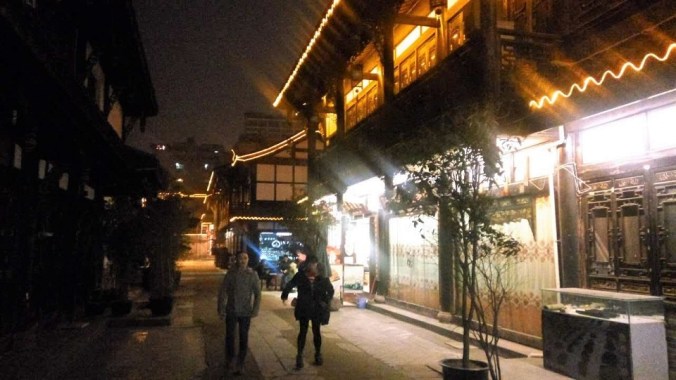
Chengdu alleys.

Chengdu’s streets were quiet on New Year’s Eve.


That was odd, enough. As my fellow traveler, the Swede, and I walked the last kilometer from the metro to our hostel on the north side of downtown, the oddness deepened with the night.

Our walk took us past the Wenshu Monastery (文殊院) with its swooping eaves, incense clouds, and vegetarian restaurant. Those things I remembered, but the scene outside of the ornate entrance gate I hadn’t seen before.
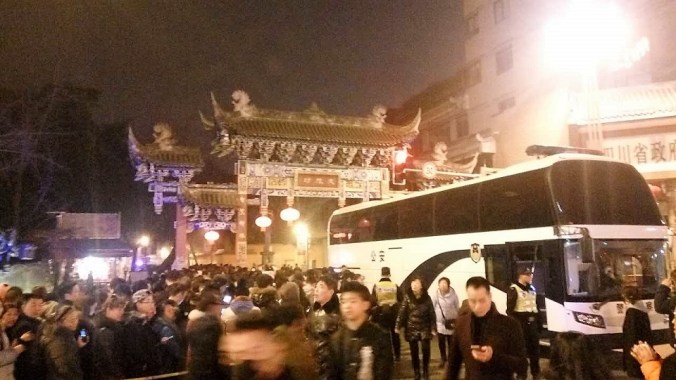
Wenshu Monastery on New Year's Eve

Crowds swarm police cordons outside of Wenshu Monastery trying to get in their new year prayers.

A line of people hundreds of meters long snaked out of the gateway, onto the sidewalk, and up the road. Dozens of police officers guided the pulsing crowd into place, while a police bus served as a central command. That scene – police swarming every corner, heads aswivel – repeated itself to a lesser scale at each intersection up to our hostel, with armed soldiers adding an exclamation point to the to the seriousness of the situation.

I’d picked our hostel in part because of its location near Wenshu Monastery, which I’d read was a prime place for fireworks-watching at the midnight chime.

The Swede and I walked the police-clogged lanes around the temple before settling into an adjacent beer garden to test our Chinese against the New Year’s gala show on a big screen. The show flitted from province to province, showing off not only the country’s impeccable abilities at mass coordination but also some of its oldest citizens, bits of its unique sense of humor, and of course its military.
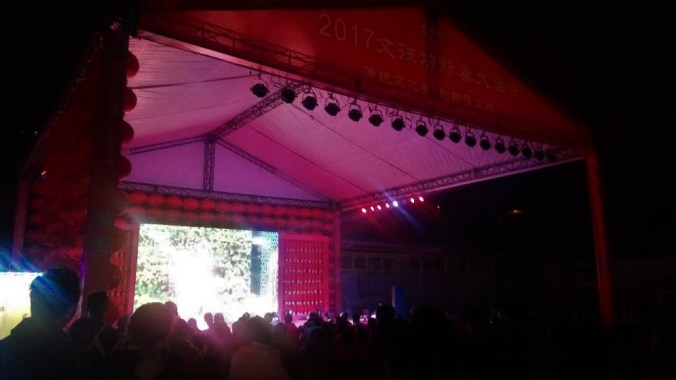
A crowd gathers around a public showing of the annual New Year's gala.

A crowd gathers around a public showing of the annual New Year’s gala.

As the song and dance and nation-worship came to an end, we watched the big clock on stage in Beijing tick down from 10.

3…2…1…

A few people in the crowd raised their glasses. Nobody yelled. And nothing exploded.

The minutes went by. No explosions. No lights in the sky. No burning nostrils. Nothing.

10 minutes gone, we got up and strolled down the emptying streets to the south, passing police cars and vans of all sizes, some of them attempting to hide on lesser-used streets and behind apartment community gates. Police and even military presence at any potential mass event like this has become routine in recent years, especially after a stampede on December 31, 2014 in Shanghai in which dozens of revelers in the 300,000-person crowd died. These sort of things combine the worst of the central government’s fears: ,mass protest, terrorist target, and embarrassing accident.

Maybe that’s why the kibosh had been put on celebrations?

We reached the gate of a military compound and yelled across at one of the soldiers standing guard.

“Why no fireworks? Isn’t it the new year?”

He sauntered over, bulky camo uniform and low-slung rifle adding years to his unlined face. It took me a moment before I realized he couldn’t be older than 19.

“No fireworks in the city this year,” he said. “Too dangerous.”

And the people had actually listened.

China is changing. Chengdu, well, it’s more or less the same.

Bangkok Broiling

January 29, 2016 — Bangkok, Thailand

After five hours on the tarmac – nearly 10 total on the plane – a pair of two-hour delays, and another two hours sitting in the basement of the Bangkok airport waiting for the metro service to start, it was a relief to finally step into the heat-soaked air as morning light began to gray the Thai sky.

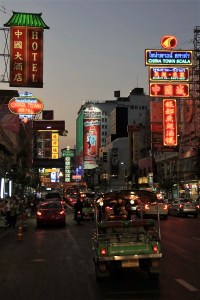
My hostel was situated in the heart of Chinatown – ironic, I know, or maybe comfortable? – and as I stalked half asleep through the streets I got familiar with the defining characteristics of Bangkok: Swelter and bustle.

Packs of motorbikes ripped through the crowded streets alongside gaudy Tuk Tuks, each spewing bluish smog that gave the city a whiff of gasoline and seemed to add to the boiling air. And it was only 7 a.m.

Bangkok is overrun with swarms of motorbikes.

Bangkok is overrun with swarms of motorbikes.

I found my hostel among Chinatown’s twisting alleyways, sandwiched between car-parts shops overflowing with piles greased and rusting gears and rods, and I checked in nearly nine hours late. After a cup of much needed iced coffee on the rooftop terrace overlooking the sound-clogged alley, I passed out under the air conditioning. When I woke in the early afternoon, it was time to explore.

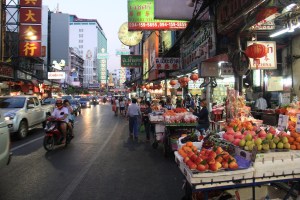
Chinatown is one of the older neighborhoods in Bangkok, with a history of more than 200 years dating to when the Chinese community in the city relocated to the “new” neighborhood to make room for the construction of Bangkok’s Grand Palace on the riverbank.  Part colonial architecture, Chinatown is still a rat-maze of warrens lined with the aforementioned parts shops and makeshift markets selling fruit, flowers, stereo equipment, and pornography.

Dozens if not hundred of Chinese-style temples hide among the porn and parts. Snarling red-and-green Dragons slithering up the gate poles announce their presence.

I spent my first day popping in and out of said temples and wandering the market streets before watching the sun set over the Chao Phraya River, which bisects the city and acts as an artery for both tourist boats and trade.

As the neon lights lit up above me while I ate street-vendor pad thai at a fold out table street-side, I was struck that Chinatown indeed feels like a mini Hong Kong. Only maybe hotter.

Early the next morning I relocated to Bangkok’s famous – or infamous – Khao San Road, long a hive for Southeast Asia’s unwashed backpacker army. The culture of the place was immediately obvious, the street littered with discarded food trash and browned cigarette butts from the night before.

I sought out the cheapest bunk I could find in a hostel three sets of stairs above an Indian restaurant – a creaking metal contraption in a room of 12 others just like it, topped with a stained mattress and no sheets. It wasn’t going to be good sleeping, I knew, but at just over three USD for two nights, at least it was cheap.

I threw my bag down and headed back out, across Ratchadamnoen Road lined with both its massive portraits of the Thai king and the city’s Democracy Monument, and toward the temples that bump up against the river.

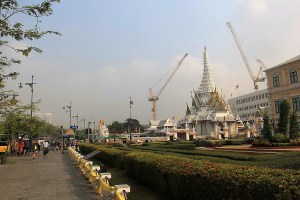
I picked out Wat Pho, one of Bangkok’s oldest and most important temples.

Despite their shared Buddhist focus, Thai temples and Chinese temples could hardly be much different in style. Wat Pho is a collection of glittery, bright spires and halls under the watch of fierce-faced stone Chinese guardians. Built sometime in the late 1600s, before King Rama I established Bangkok as the kingdom’s capital, the wat is home to Thailand’s largest collection of Buddhist images – more than 1,000 – and a 46-meter long reclining Buddha.

After a couple of hours wandering the various halls, removing my shoes at the entrance of each to walk barefoot as is the Thai requirement at holy sites, I walked back along the river to Khao San to find the street transformed. Vendors selling  mostly t-shirts, but also jewelry, DVDs, and fake IDs of all kinds had billowed out into the street. The bars and restaurants were already bumping.

I walked the adjoining streets, trying to find a cheap towel and marveling at the sheer variety of tattoos and dreadlocks that covered the areas short- and long-term denizens, then pushed my way back through the crowds of revelers dancing in the street as the restaurants transformed into open-air nightclubs blasting hip-hop and electronica into the thick night air.

When I finally returned to my bunk room, I found that despite the two rotating fans rattling on the ceiling, the place was hotter inside than out. I crawled into my bunk, trying not to pull the whole thing down along the way or make more noise than necessary, stripped to my shorts, rolled those up as high as they could go, and positioned myself at the very edge of the bed where every 10 seconds or so I could catch a quick blast of the fan.

Sometime in the next couple of hours, I feel asleep in a soggy nest of my own sweat. Sometime in the next next couple of hours, a group of other backpackers filed in. The hostel management finally deemed it appropriate to turn on the air conditioning – at the lowest possible temperature. My sweat turned to ice. I pulled out every item of clothing I’d brought, including my coat, and spent the rest of the night shivering anyway.

“Just three dollars” I kept telling myself. It didn’t seem well spent. I’d never again be so happy to walk out into the Bangkok sun.

Goat’s Head Soup

August 12, 2015 — Kashgar, Xinjiang Province

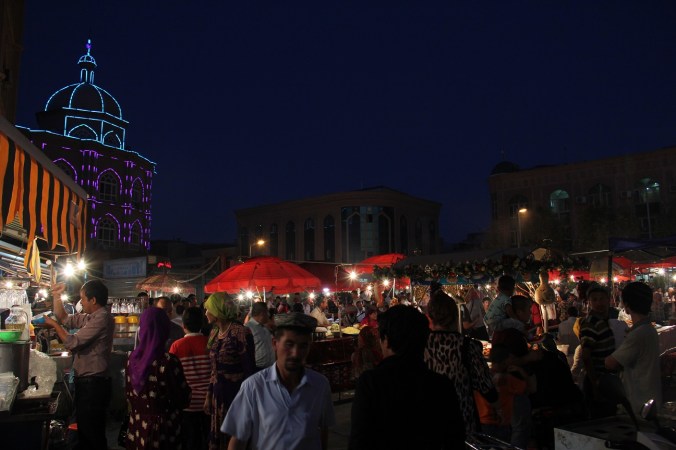
As darkness fell, the night market ignited.

Backlit by the multicolored neon trim of nearby buildings, the square across from the mosque sparked into action. Grills were pulled from alleyways. Vats of entrails were put to a boil. Noodles were pulled long. Legs and livers were skewered. Potatoes were sauteed. Fruits were arranged. Breads were baked. People came.

Kashgar's Night Market

Kashgar’s night market.

We came for the goat’s head soup.

The smoke from multitude of grills choked the night as we walked out of the tunnel underneath the street separating the market from Id Kah, finally managing to dodge the Hungarian guy who’d wanted nothing more than to hang out with us and make sexist jokes.

Music bumped from the restaurants around the square as every cart vendor vied for attention and people crowded onto stools to eat. We stopped here and there for noodles, dumplings, or skewers.

Twice someone tried to pickpocket Dave. He spun on the second one, slapping his hand away. The middle aged man shouted at Dave in Uyghur, slapping the bottom of his shoe and acting offended as he blended back into the crowd. A woman grabbed Dave’s attention and made hand motions, trying to explain to him what had happened and suggest we be careful.

We all checked our pockets and shifted some stuff around. Then we found the goat heads.

Boiled goat heads. Stripped of their fur, left with just the meat clinging to the skull, the brain and eyeballs still encased. Matt had been drooling over the prospect since Beijing. He ordered one from the kid at the stall.

Goat Heads

The goat heads are ready to go into the soup.

The kid grabbed a head with a pair of tongs and dropped it into the boiling broth. After a few moments of waiting, he ladled it back out onto a plate and handed Matt at pair of chopsticks.

He dug in, yanking the sagging skin from the skull and stretching it toward his mouth. Next, he shoveled a lump of white, cottage cheese-like brain out of the anterior.

“It’s not bad, man,” he said and handed the chopsticks to me.

I dug out a pea-sized lump and placed it on my tongue.

The congealed blob split apart as I chewed. I can’t recall the taste, except that it tasted like nothing and also awful at all once. I forced myself to swallow the chewy, slimy bit, gagging all the way, and rushed for something to drink.

Matt laughed, then went for the eye. He wrenched it out of the socket, skin and nerves hanging on, and popped it into his mouth. The smirk faded with each chomp. He wretched and wretched again, forcing the whole twisted chunk down his throat.

“That was pretty bad.”