China’s little Europe

This weekend Jordyn and I took a trip to England. And Italy. And Germany. And the whole time, we stayed in China.

Tianjin is one of those places that all the foreigners in Beijing say they’re planning to go to, eventually. Even though it’s only 30 minutes away by bullet train, most of them never do. We finally did.

At 14 million people, Tianjin is the fourth largest city in China behind Shanghai, Beijing, and Guangzhou and is one of the country’s four direct-controlled municipalities along with Shanghai, Beijing, and Chongqing. It’s location on the Bohai Gulf as well as on the banks of the Hai River, which connects northern China to the Yangtze River via the Grand Canal, also made it one of the most important ports in China, especially after it was forcibly opened to French and British trade by the Treaty of Tianjin, which was signed in 1860 following China’s defeat in the Second Opium War. Over the following decades, Great Britain and France were joined by Japan, Austria-Hungary, Italy, and Belgium in establishing self-administered foreign concession areas in Tianjin, each with its own government buildings, public facilities, and neighborhoods.

That’s what makes Tianjin so interesting: The city is a patchwork of early-20th-century European buildings and avenues that trumpet the cities colonial past and steel-and-glass skyscrapers that announce its intent to own the future. And underneath it all scoot the overstuffed electric tricycles ubiquitous to China.

Sunday was Qingming festival, or Tomb Sweeping Day, so I was off work. Jordyn also had Monday off, so we decided it was time to take the trip. We’d tried to do the same with Toby on the same weekend last year but showed up to the train station too late and didn’t have time to make the trip. This time we planned ahead and bought tickets a few days before.

Tianjin is a walking city.

There’s the old downtown, lined with European-turned-Chinese banks of the columned variety, most of them (of course) webbed by renovation scaffolding during our visit.
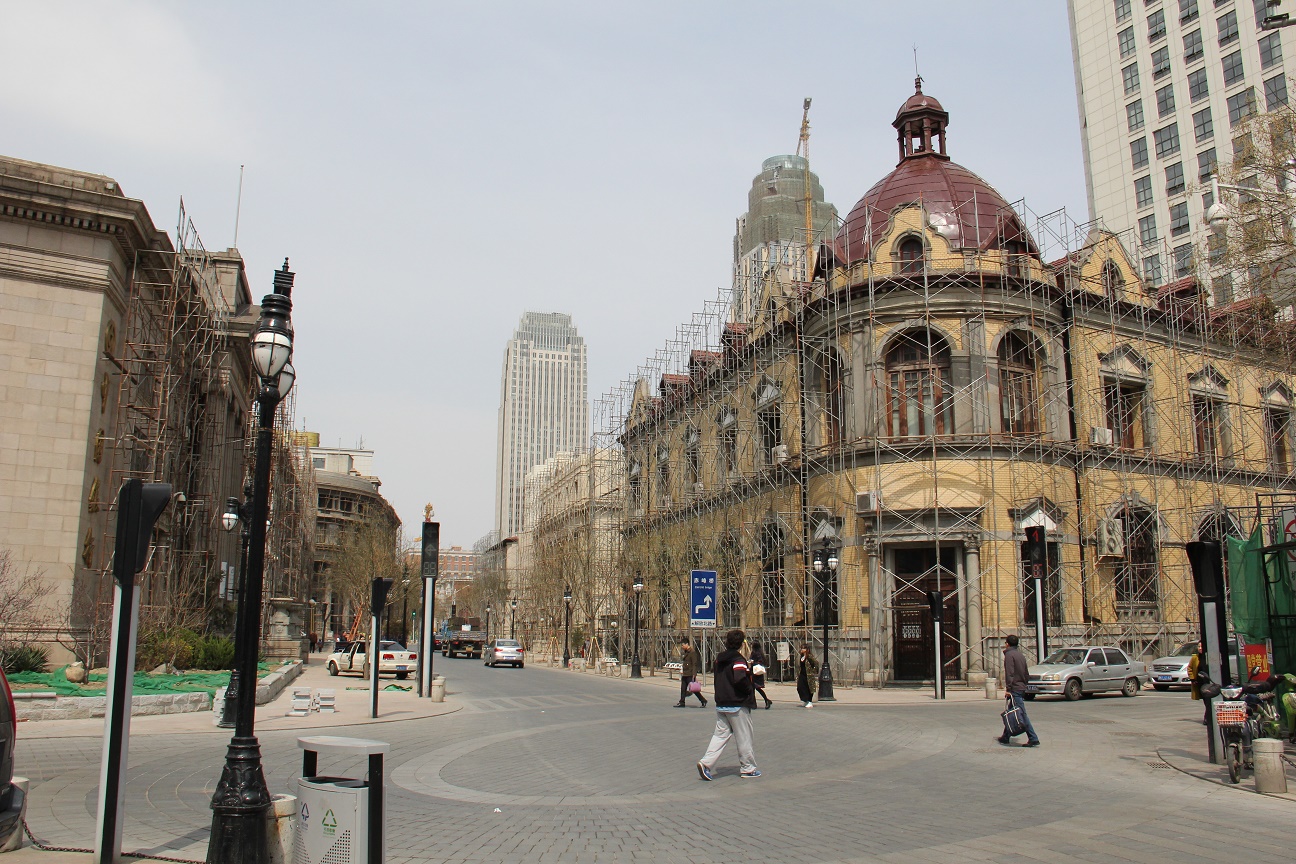
Banks in Tianjin's downtown

Tianjin’s downtown is mostly banks built during the early 20th century to house European companies. These days they are mostly Chinese banks.

There’s the riverside parks, lined first across from the train station and a giant clock with the old British treaty port, then with fishermen, then with the skyscrapers.
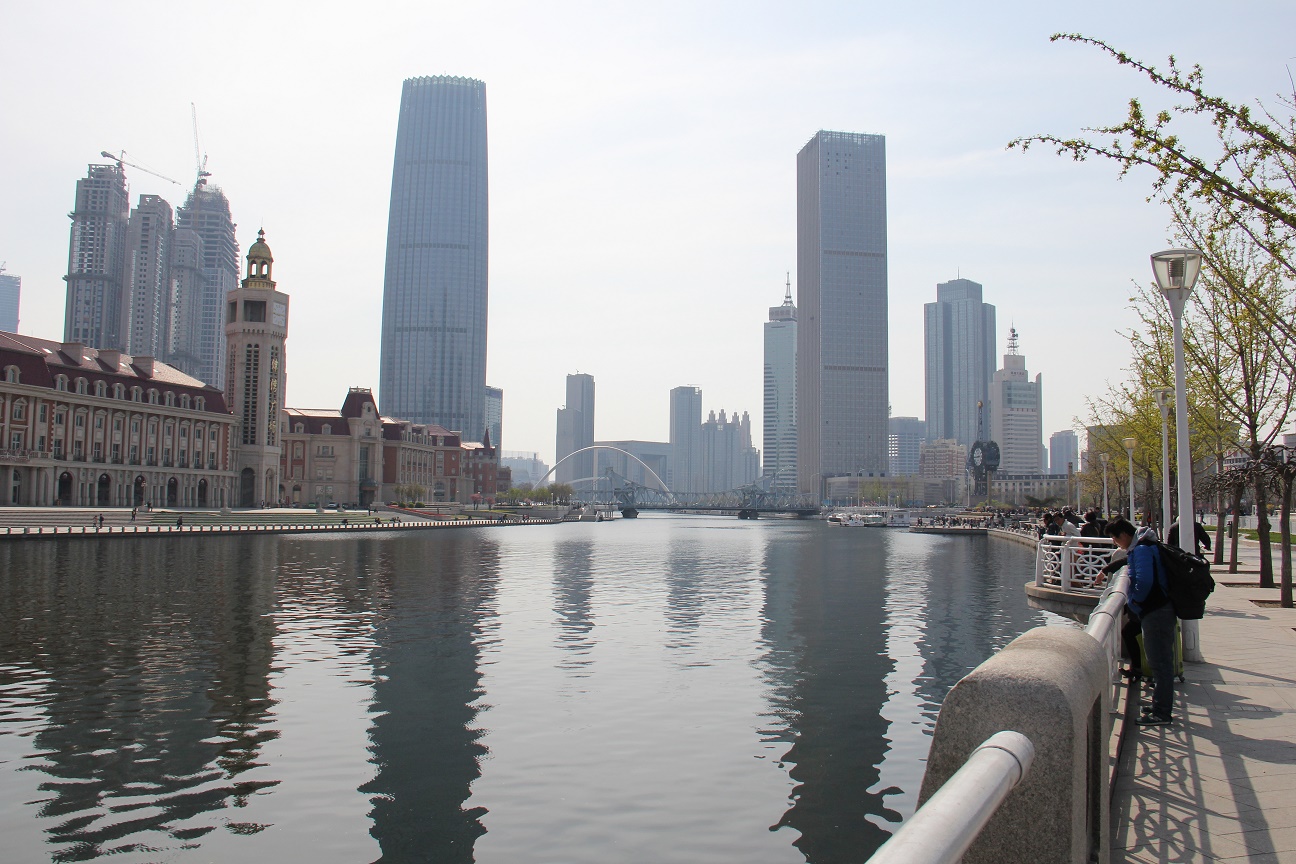
Tianjin

The treaty port sits on the river across from Tianjin’s train station. Past the bridges down the river, the city’s skyscrapers project a different attitude.

There’s the Italian Concession, Tianjin’s version of Little Italy, lined with Italian villas and European-style restaurants and souvenir shops catering to the domestic crowd.
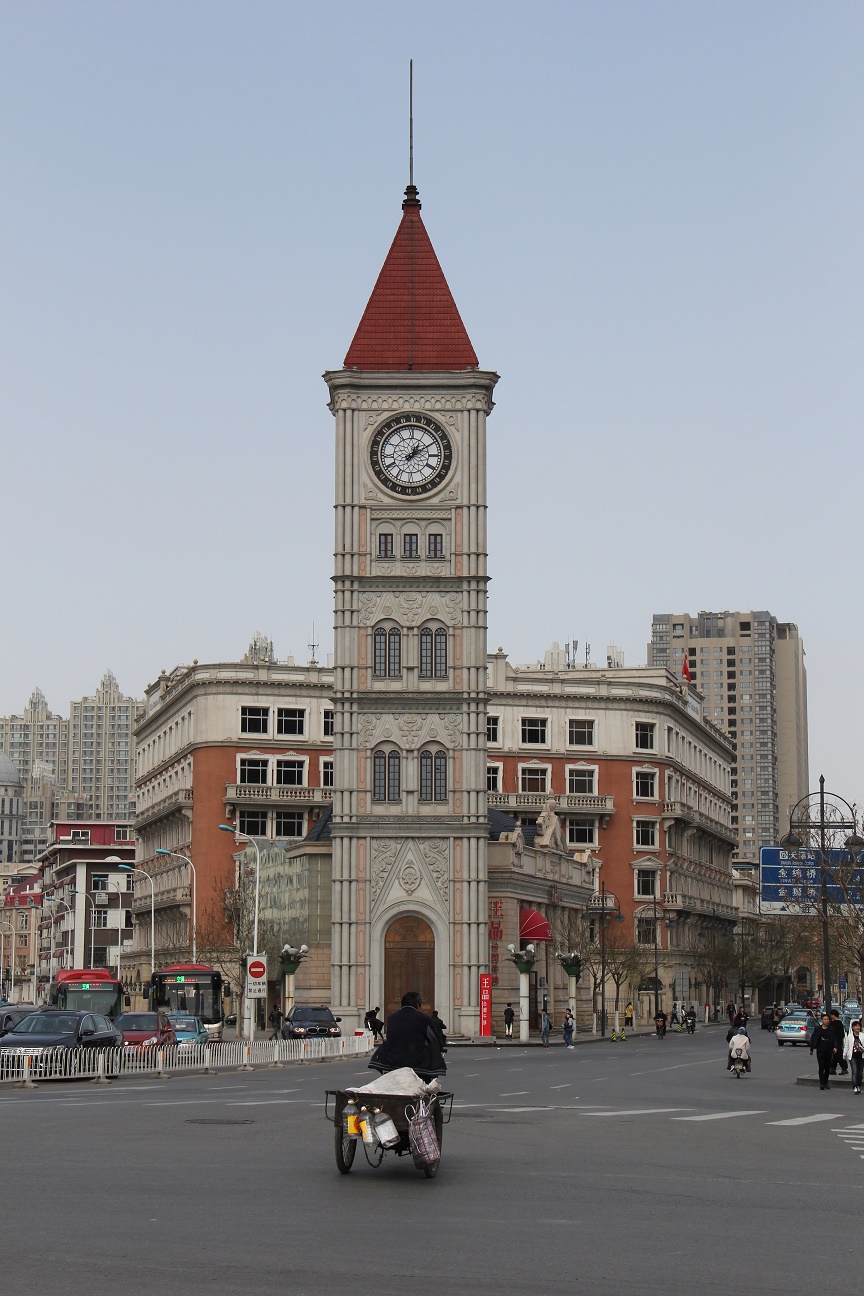
Tianjin's Italian concession

This clock tower marks the entrance to Tianjin’s Italian concession, complete with gold statues, fountains, and lots of cheesy Italian (and German?) restaurants.

There’s the ancient town street, lined with traditional Chinese craft shops that look like they’ve seen better days.

There’s the creepy China house, a house lined with tourists and constructed entirely of concrete and vases or pieces of vases.
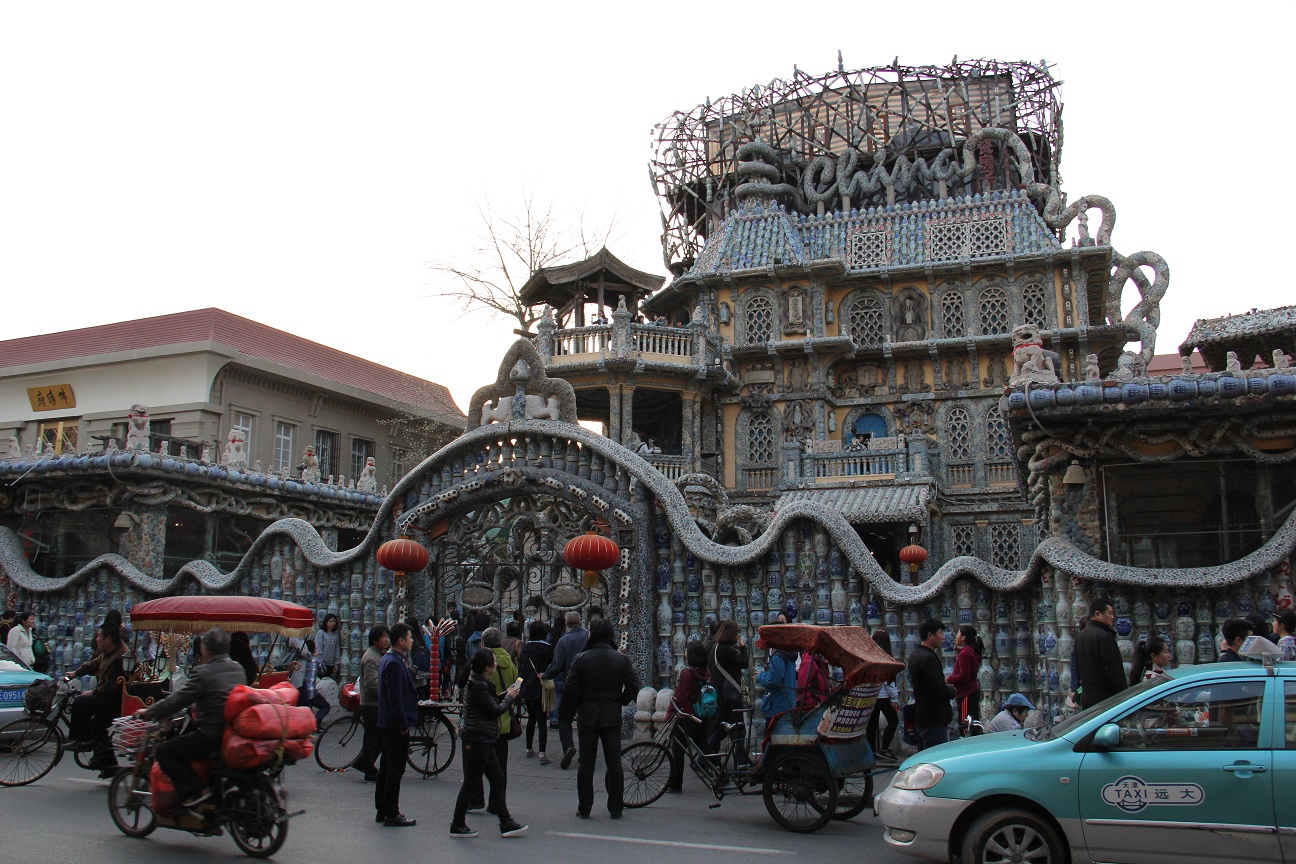
Tianjin's China house.

Tianjin’s China house.

There’s the wide avenues, lined with buses and cars and where, on Qingming, you might catch a man burning piles of paper money for his ancestors in the middle of an intersection or a group of people trying to keep the grass from catching on fire when their paper money takes off with the wind.
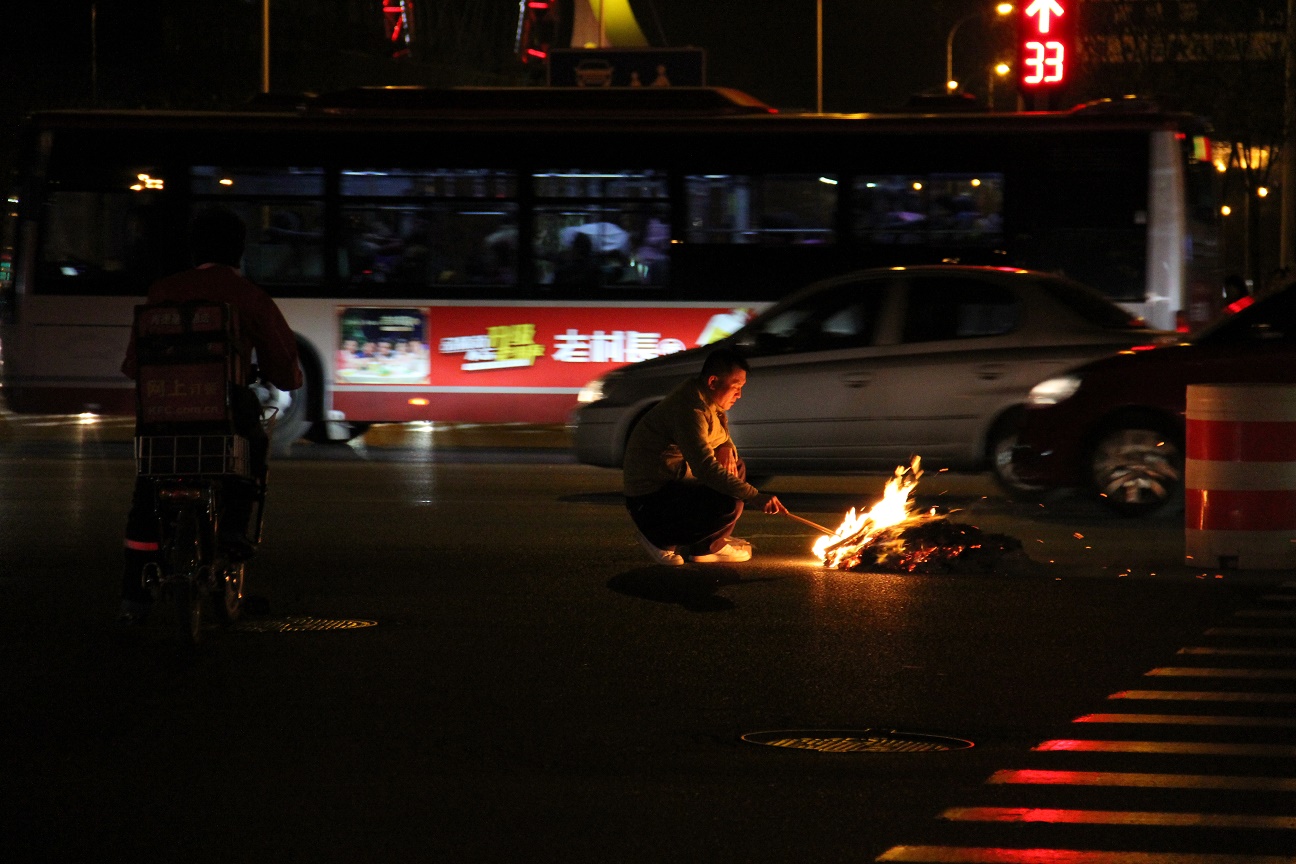
A man burns paper money in Tianjin

On Qingming, people burn paper money as well as iPhones and other gadgets, for their ancestors to use in the afterlife.

There’s the Yongle Bridge, topped with the Tianjin Eye, the world’s only Ferris wheel ( (120-meters) built on top of a bridge, and lined by a riverwalk where revelers launch flaming lanterns into the night.
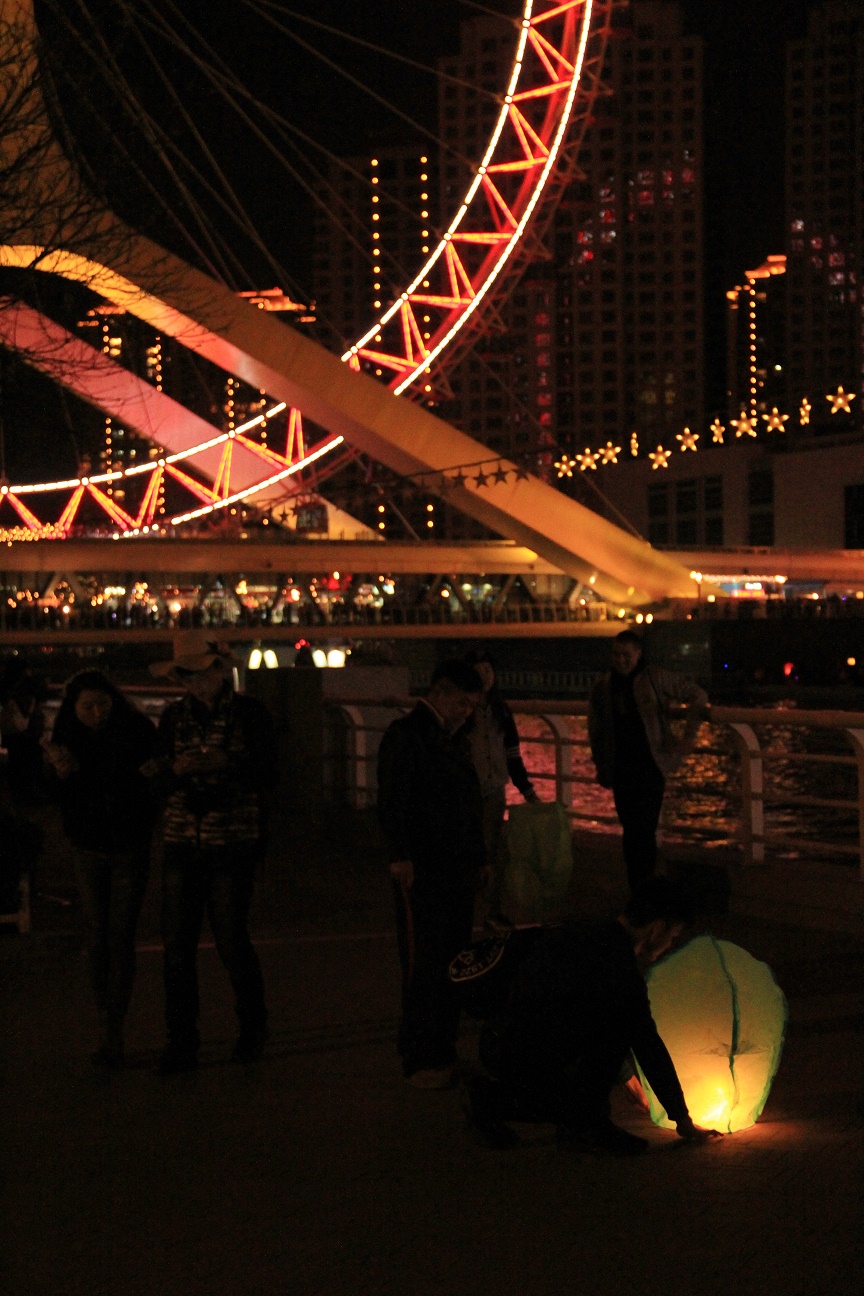
People light lanterns near the Tianjin Eye

Evening celebrators light floating lanterns under the glow of the river-spanning Tianjin Eye, the world’s only Ferris wheel built on top of a bridge.

There’s the 五大道 wudadao (five big avenues) area, lined with blossoming trees and the mansions of former government officials and generals, some of their abodes straight out of 1910 London, others out of Spain.
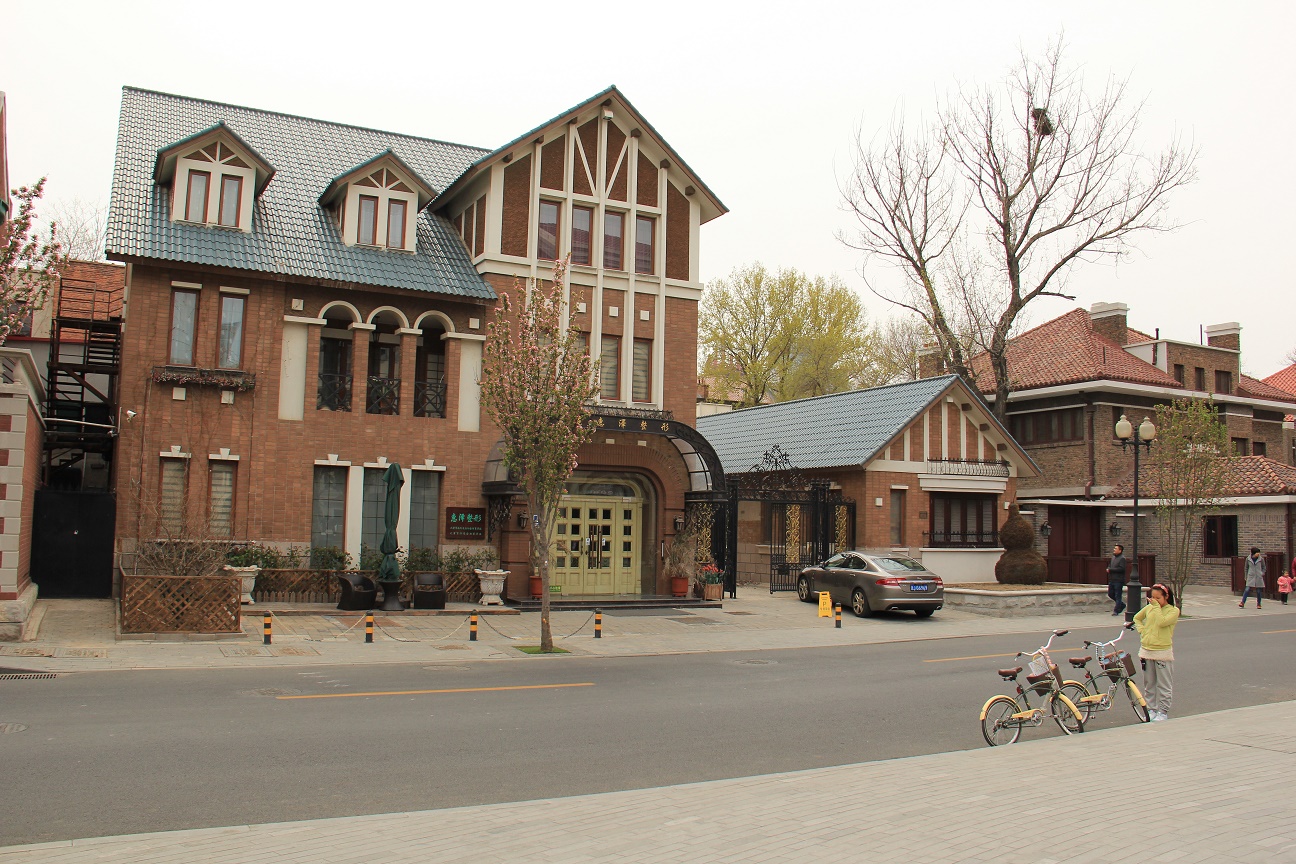
House in wudadao

Houses in the wudadao district certainly don’t look Chinese.

And there’s Tianjin’s biggest shopping avenue, lined with glittering monuments to consumerism and punctuated by the French-built St. Joseph’s cathedral hiding at the very end.
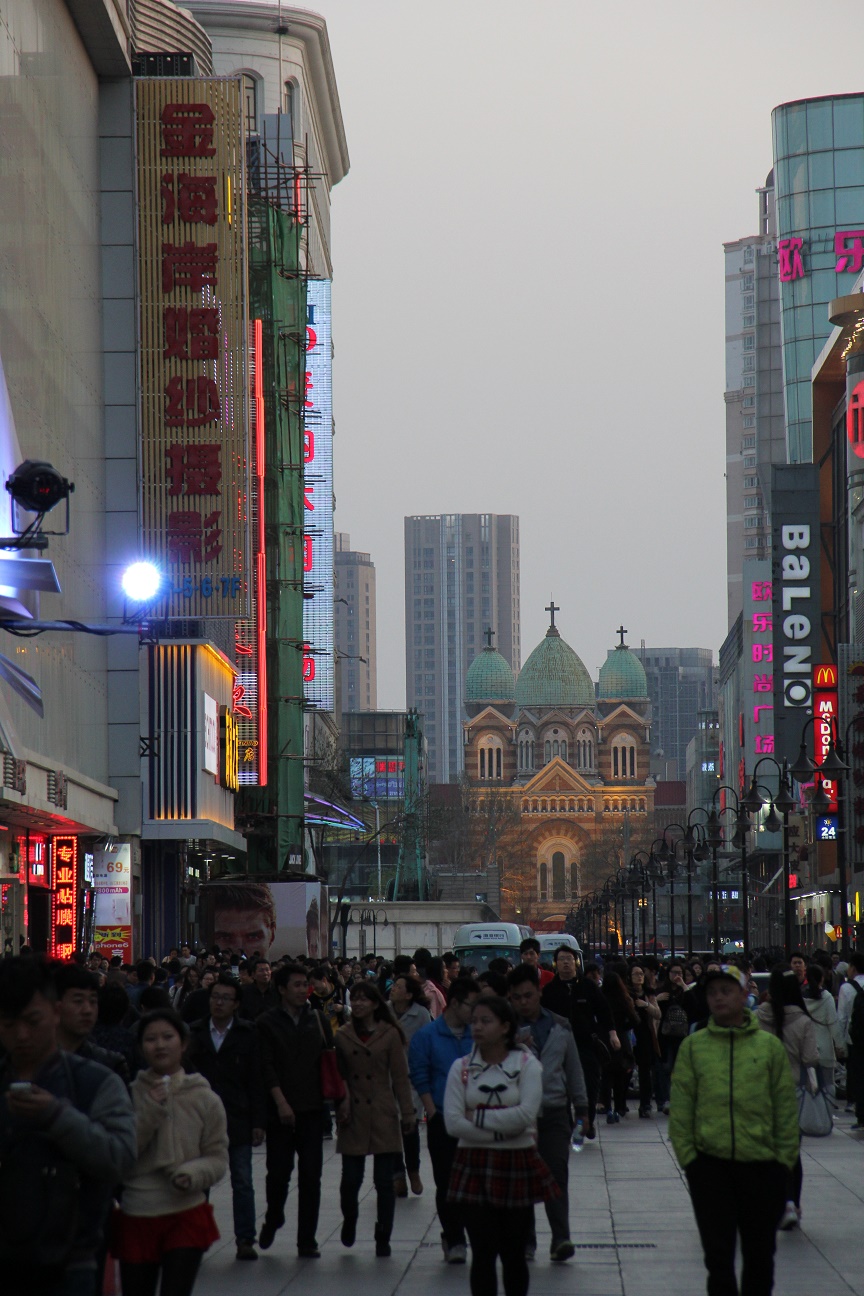
St. Joseph's Cathedral

St. Joseph’s Cathedral is the end point of Tianjin’s biggest shopping street.

For people who liked walking, Tianjin is good for a pair of days well spent.

The city is at once much cleaner than Beijing and also more traditional. Its modern streets and streets alike have almost no trace of what one comes to expect as China, save for all the Chinese people as well as the army of food and repair carts posted at many of the intersections. Many of the European-style doorways the traditional red paper characters and door gods pasted on them. And St. Joseph’s Jesus is covered in Chinese writing. The contrast was somewhat disorienting.
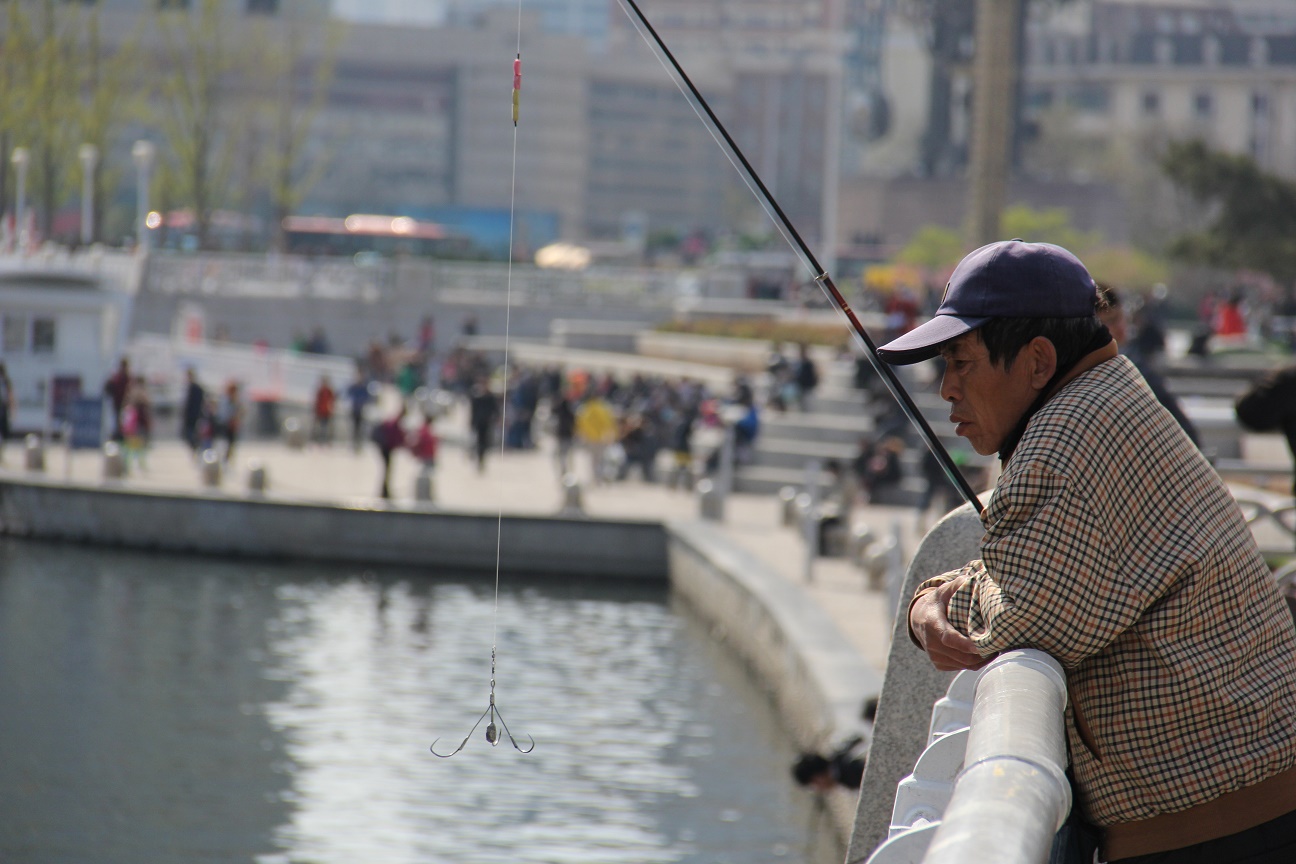
A man takes a break from fishing near the train station.

A man takes a break from fishing near the train station.

Jesus with Chinese characteristics.

Jesus with Chinese characteristics.

Tianjin is also well-known for its snacks, notably jianbing and 狗不理包子 goubuli baozi (translated as Steamed buns that dogs don’t pay attention to).

Jianbing are common in Beijing but originate in Tianjin. They’re basically a crepe, covered in egg and wrapped around cilantro, onion, shrimp crackers (I think), and a spicy sauce. Jordyn loves them so we tried two different styles, one of which made with green peas and fried dough instead of shrimp crackers I’ve never before seen. We decide Tianjin’s jianbing are indeed superior to Beijing’s.

Gobuli is actually the name of Tianjin’s most famous steamed dumping restaurant, which has been open for more than 100 years. More famous Chinese than I care to list have eaten there, and the Empress Cixi called its namesake dumplings the most delicious in China. The strange name (Steamed buns dog doesn’t pay attention to) originates with a villager who came to Tianjin to learn to make dumplings. His name was gou (dog). As he learned, he developed the special style that is Goubuli’s specialty, but would get so absorbed in making his dumplings that people started to say “Dog doesn’t pay attention to people, only to bao zi.” Eventually the saying was shortened to Dog doesn’t pay attention” and the name stuck.

The veggie baozi at Goubuli.

The veggie baozi at Goubuli.

It turns out Goubuli also has a branch in Beijing where Jordyn and I have eaten a few times before, though we didn’t know it until we returned from Tianjin. They are our favorite steamed dumplings. Regardless, we had to eat in Tianjin’s original branch, so for an excessive price – truly – we ordered one set of eight vegetable baozi. They were delicious, but we decided the baozi round goes to Beijing.

Goubuli baozi in Tianjin.

Goubuli baozi in Tianjin.

The Noodle Joint

Just outside of the gate of the apartments where I teach was a noodle joint.

At least three days a week for the last 18 months, I have gone to this noodle restaurant. I have ordered a bowl of tomato and egg noodles from the manager, a pretty and alacritous women who spat words like they were a snare drum solo and slung noodles almost as fast. I have sometimes ordered a bowl of tofu soup, too.

I have learned how to order noodles, how to order soup, how to ask for them to go, how to ask what else they’ve got but never order it. I have learned how to have a conversation in Chinese.

I have seen the price of a bowl of tomato and egg noodles go from 10 to 11 yuan. I have quit having to actually order, smiled and said thank you, and just handed over the money, again and again and again. I have become a regular.

I have sat at one of the four plastic stools that surrounded each of the 20-odd wooden tables that ran down the sides of its long and narrow interior, shivering far from the closed doors in winter and sweating next to them in summer.

I have pulled the brown plastic chopsticks from the metal can on the table. I have used them to mix, then eat my sticky, chewy, gravy-slathered noodles. I have struggled to learn how to eat noodles with chopsticks, and I have forgotten how hard it used to be. I have shaken my head at the noodle juice splattered on my sweater. I have picked up the bowl with two hands and slurped down the last bit of cooling tomato slurry sprinkled with cilantro leaves and chives. I have watched myself do this in the half-length mirror that ran down the left side of the plain white walls.

I have listened to the Chinese customers bicker and spit and cry and joke and lecture and laugh and live.

I have studied Chinese characters during my lunch and dinner breaks with the spring-blue sky and the pink plum blossoms waiting outside. I chatted with friends about Beijing while hiding from the dark and smoggy night. I have sat with Jordyn when she was a fellow teacher and sat alone when she wasn’t anymore.

I have read a book and tried to take a deep breath on days when teaching threatened to overwhelm me, or when my relationships got rocky, or when it was just hard to be in China and I wanted to be home.

And now without even a prior hint, I have seen the interior go dark, the voices quiet, the pretty manager disappear, and the tables and stools and chopsticks and cans and half-lengthen mirror ripped out and tossed to the curb.

Eighteen months. One more change. But sometimes a noodle joint is more than a noodle joint.

Fixing my (T)Rusty Steed

My bike is a decades old, famous-China-brand Flying Pigeon, which is the steel horse that clogged Beijing’s streets following World War 2. When you think of 9 Million Bicycles in Beijing, think of the Flying Pigeon. Mine used to be black but has faded in many places to rust or gray. It’s a massive bike, cruiser-style, so I sit straight up to ride it, sorta tilted back behind the far-protruding front wheel like a hog. I bought it at the only licensed used bike store in Beijing, near the Lama Temple a little more than an hour ride from my home. The flying pigeon reputation for sturdiness means bike weighs about 50 pounds so its tough to get moving. The brakes don’t often work well, I have to pump up the rear tire every other day, and I need to get my seat to stop moving around somehow. But I love it.

I love sitting straight up, dweeb-like, and cruising through the Beijing night, through the hutongs and past the gate towers .

Once in a while, the bike even gets me compliments from the locals. One day riding to work, I cut across on intersection more or less in front of a turning car. The driver pulled up next to me and rolled down the window. I expected to see an angry face. Instead, the middle-aged man had a toothy grin spread across his face.

“You are so good!” he yelled, giving me a thumbs up. “So good!”

He drove along side me for 10 seconds or so yelling, “You are so good!” over and over again, his thumb stuck up the whole time.

Anyway, I ride it pretty hard, and last week on the way to work, something finally broke. My pedals jammed up in the middle of the road. I could pedal backward a few turns, then forward again a few turns to keep moving, but once I got to work and took a look at it, I knew something was wrong. I really didn’t want to walk home from work and lose the time to go to the gym, so I set out on my dinner break to find a guy to fix me up.

There’s no Performance Bike Shop in Beijing. At least not one that I know of. In fact for the most part there isn’t any “shop” at which to get a bike repaired at all. Instead, you walk around with your bike until you find somebody with a cardboard sign — usually red lettering on white board — and a cart full of grease-covered tools. This is your shifu. He is usually balding. He is usually wearing a green, military surplus coat. He is usually sitting on a wooden, child-sized portable stool. He is usually smoking a cigarette. And he will try to fix your bike.

This particular fix took four shifus. It’s still not all the way fixed.

The first shifu, across from a nearby primary school, beat it with a wrench, tried to force the pedals around, then gave up and told me it was a problem with my crankshaft. As he was a variety shifu — key-making, shoe-improving, bike-fixing, and more — he didn’t have the parts to fix it. This cost me 2 yuan.

The second, a younger bike specialist down the road behind some apartments, told me it was a problem with my rear flywheel. He scrounged through his cart for a new one, then as the sun sank and we chatted about the NBA, he took apart the rear axle, beat some stuff with a hammer, scattered metal parts everywhere, replaced some stuff, and put it all back together. It didn’t fix the grinding sound, and before I got home, the whole thing was jammed up again and the chain fell off the gear. I nearly made it all the way home. This cost me 35 yuan. At least I got a brand new flywheel out of it.

The next day, the third shifu, this one totally bald with a shop at the bus station, took one look at the chain laying jammed inside the single-speed drivetrain and waved me off with a “can’t fix it”. This cost me 0 yuan.

Just around the corner, practically in the middle of the narrow street, the fourth shifu was a balding man with a tiny stool, a green coat. and a cigarette. He fiddled with the jammed bike chain for 20 minutes before he finally got it back on the gears. For a while, he chatted with another customer who was sprawled out in a reclining chair with a newspaper. Then he changed gears to complain about the state of my old bike while trying to sell me one of his newer used bikes. Eventually he gave up and decided the real problem was with my crankshaft and told me to come back at 5. I wasn’t off work till 6. We argued for a few minutes about whether this was an acceptable time.

“Just don’t be late,” he said, tugging at his coat. “I’m going home at six. Don’t be late.”

I came back at 4. He watched me stroll all the way down the street with a slight smile twisting the corner of his mouth. When I arrived, he didn’t say anything, he just held up his black, gunk-covered hands.

“My god. So dirty,” I said.

“Errrggg,” he said. “Old bikes are no good. Too hard to fix. You should buy a new one.”

“I like these old bikes,” I said. “Very Chinese.”

“Yes, very Chinese,” he grumbled. “Very Chinese.”

He gave me my bike. I gave him 40 yuan.

On the way home, the pedals started to wobble, then the crank went limp. I pedaled home with one foot as best I could. The next morning I saw that while the shifu had indeed fixed my crankshaft, he’d forgotten (or lost, given the way shifus are apt to throw parts all over the ground) the screw for the pin that holds the pedals together so they turn the gears in tandem. I pushed on the pin with my shoe, and it went back in.

All the way to work the next morning, the pedals would start to clunk, then go limp. I’d hold them parallel with one foot and push the pin back in with the other, ride a few dozen meters, then do it again. On the way home it was more of the same.

When I got home I beat the pin with a wrench until it seemed to stick. Then I put some tape on it.

That’s the shifu way. So far, so good.