The Ratio of Success

One of my friends, who has lived in Beijing for the last five years or so, likes to talk about what he calls “The Ratio of Success”. By that he means, in any given system or society, when an individual sets out to accomplish a task, how often do they succeed. Usually this task is something like paying the water bill or, more typically, finding an item you want to buy or even the place where you want to buy it.

In America, the ratio of success is pretty high: The systems and culture make it easy to know what to expect when you try to get something done and generally make getting that thing done pretty seamless. Places are open when they say they’ll be open. They don’t usually disappear without warning. They usually have the things you expect them to have. It’s easy to find information on the internet. Maps and addresses are accurate. Customer service is good.

In China, the ratio of success is much lower. It’s one of those things that can either been somewhat endearing or damningly frustrating, depending on your personality and mood.

Monday was a typical, if mild, example.

My friend CH accompanied me on a much-less-wandery-than-usual trip to find a coffee shop somewhere in town where we could study and actually study. I often try this kind of thing on my days off. And I often walk around for three or four hours having passed on every coffee shop I pass only to somehow — regardless of which side of town I began my walking in — turn a corner to find myself at Great Leap Brewing’s hutong location. Then I often convince myself that even though it’s only 2 p.m., I can manage a beer or two while writing Chinese characters. That often ends with me spending three hours wagging my jaws with some British businessmen before wandering bleary eyed into the setting sun already sporting a headache. Often, I get very little actual studying done. If I do, I can’t read anything I’ve written.

But Monday was going to be different, even though I still didn’t even pick a neighborhood until we sort of ambled whichever subway train arrived first at Xizhimen Station. In the end, after only one wrongly chosen train and 15 minutes of walking, near the Confucian temple we found a nice enough place, which had the standard pairing of too many cats and too-expensive coffee. But the lighting and location were nice so we hung out for a few hours.

CH really likes studying languages. He can speak about 10 to some degree or another, but he also seems to have trouble really settling in to learn one. He’s studied at least five in the seven months I’ve known him, only one of them Chinese. (Japanese, Korean, German and some Slavic language make up the other four, but I’m sure the list is longer). In similar style, he’s always trying to find new, more effective methods of language learning by buying trunkfulls of books and scouring internet forums. If any of his preferred methods have anything in common, though, its their near absolute reliance on notecards. You know, the cardstock, flashcardy ones that I’m pretty sure you can buy in 100-packs at any gas station, craft store, Walmart, K-Mart, Office Max, Office Depot, King Soopers, Safeway, Albertsons, or wherever.

Well, as far as I knew, China just doesn’t have them. Jordyn spent half a year looking.

Well, the lack of flashcards had really been grinding CH’s gears so at the coffee shop he spent some time using the wifi to try to find a place in Beijing that sells notecards. Short of that, he started looking for Staples-like stores around the city, settling on one called “O’Mart”, which said it’s website sells all sorts of American-style office supplies. Despite the cold, CH really wanted to try to find it. Notecards on the brain. So off we set.

We knew the store was near the Liangmaqiao subway station, but that was it. The only English-language information we could find was just that: “In the Lufthansa Center Area.” We also were able to find the Chinese address. With that we set out, making the best use of maps and people we could manage. Addresses are notoriously difficult to pin down in Beijing. Streets run for kilometers upon kilometers and sometimes many different streets share the same name.

We couldn’t find the street on the map. No one seemed to know where we wanted to go. One lady who worked at the information desk in the Lufthansa Center, simply wrote a number on a piece of paper, pointed at it, and refused to say any words. When it was clear we didn’t understand, she just pointed at the paper and shook her head. The number was the address of the Lufthansa Center. We already knew this.

To add to the confusion, the address we had from the internet had two different numbers. We walked up the road from the Lufthansa Center in one direction and the numbers shrank. One of the numbers in our address was larger, the other smaller. We decided to try the larger one first — that direction had more businesses — and set off. After about forty minutes, we felt no closer to finding our store.

(We did find Great Leap Brewing’s newest location. What did I tell you?)

Finally we hailed a cab. He didn’t understand where we wanted to go. “Two numbers,” he said, pointing at CH’s phone. “Go to the small one,” we said. Soon we passed the Lufthansa Center again. Then we stopped at a stoplight. A minute went by. Two. Suddenly, the cab driver announced: “It’s right there,” gesturing nebulously toward a building corner the 2 o’clock position. (Nebulous handwaving is standard practice in China’s ratio-of-success puzzles, but that’s for another post.) He asked if we saw it. I stupidly said that I did. We got out in the middle of the street.

Upon reaching the corner that was the object of the nebulous waving, we came to see that the number of the corner building was nothing in the ballpark of the number we’re looking for. 42. We wanted 33. But he told us it was over there before he took our money, so we strolled down the side street, shivering. The numbers started climbing again. The street name changed too.

We eventually asked a parking attendant if he knew where we wanted to go. He looked at the address.

“You’re on the wrong street,” he said, then pointed back where we came from confirming our suspicions. “That’s the street you want.” We walked back to the corner and started walking the way our money-fattened cabbie would’ve kept driving.

A block and a half later we spotted it: A sign on the other side of the road that looked like newspaper left too long in the back window of a Subaru. “O’Mart”, CH said it said on the peeling canvas. There were also some pictures that looked vaguely like they might have been copy machines or something.

We crossed the street, and started back the other way, murmuring all the while about how dark it looked inside and how it was already just after 6 p.m. CH grumbled something about suicide if the place is closed after all this time. Or if doesn’t have notecards. But no, the lights, however dim, were definitely on.

Then as we started up the ramp, a man walked out of the store. He grabbed a loud, blocky thing grumbling along just out of the entrance way. A generator. Off it went. Off went the lights. Out came a pair of women. Six p.m. closing time said the paper sign taped to the door. “F**k f**k f**k f**k f**k f**k f**k f**k f**k,” yelled CH, hopping up and down and thrusting his finger at me as. The women spared him a glance, kind of. The man, who I believe was the manager, did not. We turned around and walked away.

I don’t think it would’ve mattered. The place was about as big as a kitchen and most of its selves were at least half empty. Maybe it was better to get locked out than to get in, spend another half hour looking and still walk away without notecards. Still, after three full hours of failure, it was something of a blow to CH.

In the end it worked out: he found his notecards at a local shop the next day, and I didn’t care anyway. I just like wandering.
Better dead than red? Chinese officials say: ‘Too bad’

I was aware that the Chinese government controls a lot of things. I was not aware it also controls the cycle of death and rebirth.

The Dalai Lama, now 79, recently speculated that he might not reincarnate, ending the spiritual line of Tibetain Buddhism’s most important leader and thus monkey-wrenching the Chinese Communist Party’s plan to anoint a successor who would support China’s policies in Tibet.

That upset Party officials at their annual “two meetings” legislative gathering, and one of those officials, Zhu Weiqun,pulled back to curtain to let us have a peak at just how much authority the Chinese government has.

From The New York Times:

“Decision-making power over the reincarnation of the Dalai Lama, and over the end or survival of this lineage, resides in the central government of China,” said Mr. Zhu.

Forget about karma. With friends like these…

Update:

Chinese state television (CCTV) has more, calling the Dalai Lama’s speculation a “dual betrayal”:

“The reincarnation of the Dalai Lama has to be endorsed by the central government, not by any other sides including the Dalai Lama himself,” said Zhu.

“Politically speaking, he has betrayed his homeland,” Zhu said. “The reincarnation of the Dalai Lama must be approved by the central government. Without the central government’s approval, all would be illegitimate.”

Seeking the Buddha while Keeping One’s Kidneys

Whatever serenity I’d taken away from gazing upon the toenails faded by the time we hit the expressway.

The heat and rumble of the motor made my eyelids droop in the backseat until Jordyn nudged me with her knee. “Don’t fall asleep she,” she mouthed.

The rest of it went unsaid but clear enough: Don’t fall asleep and we might just keep our kidneys.

We really hadn’t come to Leshan on Chinese New Year’s Eve with the intent of embarking on an organ-keeping vigil. We had come to Leshan in the southwest corner of Sichuan to throw ourselves at the feet of the Buddha. And in Leshan, the Buddha has some really big feet.

The Leshan Giant Buddha

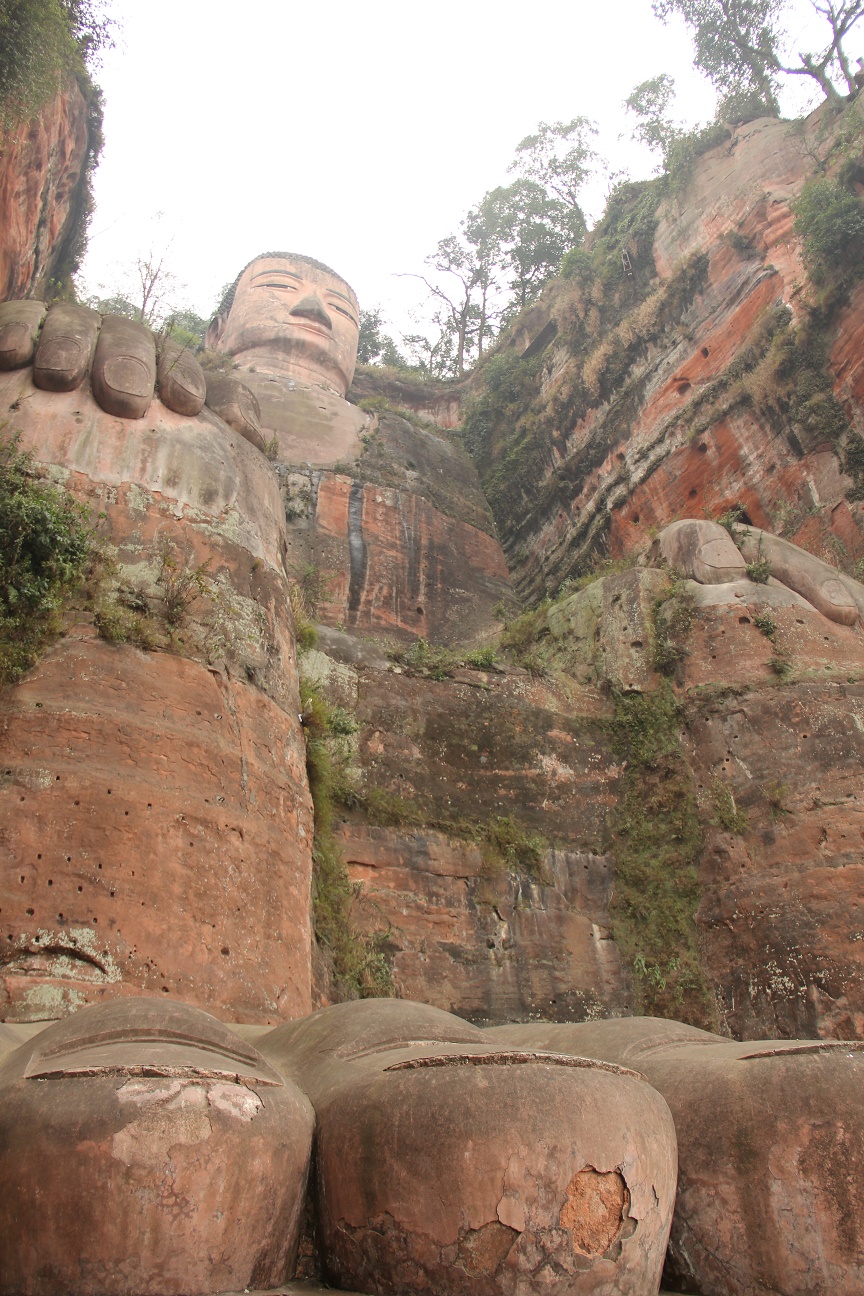
The Leshan Giant Buddha is 71 meters (233 feet) tall, the largest Buddha in the world. I could easily make a chair of one of his toenails.

The Leshan Giant Buddha is the world’s largest Buddha and the world’s tallest premodern statue at 71-meters (233 feet) in height. Commissioned by a local monk in 713 AD during the Tang Dynasty, the Buddha was to be carved out of the cliff face overlooking the confluence of the Dadu and Qingyi rivers. The monk, Haitong, hoped the Buddha would calm the treacherous waters below, making passage safe for ships traveling downriver.

Haitong oversaw construction while living in a cave which still exists near the head of the Buddha. When he died in the middle of the project, construction was halted because of insufficient funds, but his disciples finally finished the Buddha in 803 AD.

Apparently Haitong also got his wish, too. The Buddha calmed the waters. Or rather, the project dumped so much stone into the water below that the river’s turbulent current shifted, making the passage safe for the trading ships plying the waters underneath the new statue’s gaze.

The statue’s majesty isn’t just skin-deep, either: His muscular bulk hides an internal circulatory system of drainage capillaries that to this day pump water through the heart of the Buddha, slowing the effects of weather-aided aging. Sadly, the drainage system hasn’t halted the degradation that has come along with the region’s rapid development and the pollution that in turn has come along with that.

Or so they say. For me, the Buddha was little short of divine.

It’s one thing to read about the Buddha. But it’s another to crest the hill that leads to the statue and catch sight of his curly-haired head, passive staring eyes, and long, straight nose that itself outsizes the human body. And it’s another to wend down the stairs next to his slender, black- and green-stained fingers. And it’s another to stand at his flaking toe, the nail large enough to curl up upon, and gawk up at his hulking form.

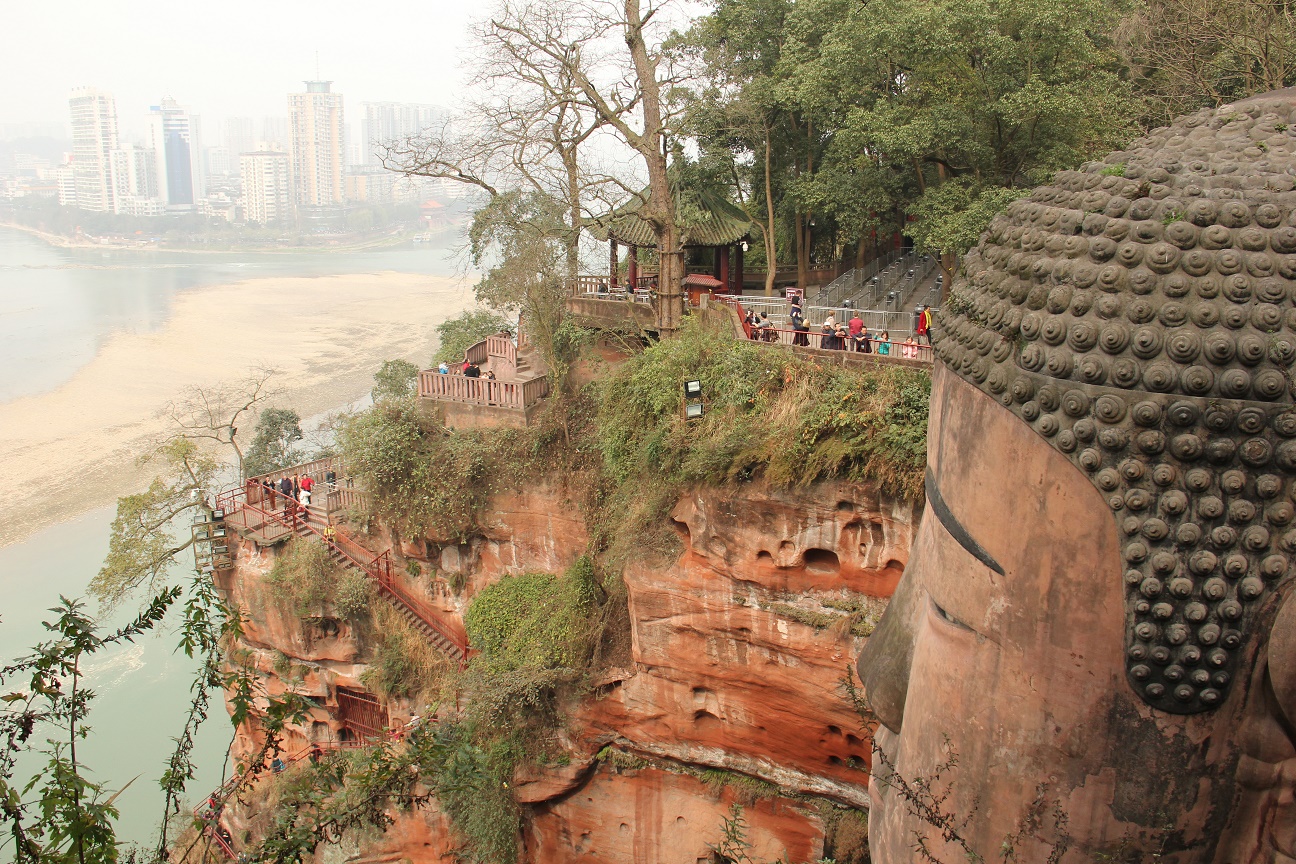
The Leshan Giant Buddha's head

The Buddha was built in the 8th century with the goal of calming the waters of the Dadu River, which he overlooks.

And then it’s another still to ponder the fact that he’s sat there, staring across the river, for nearly 1300 years and witnessed all the changes that have time has swept across his domain as surely as the river below sweeps reeds along its eddies.

Following his gaze today takes your eyes across the river to the skyline of the rapidly developing, 3-million-person Leshan City, where we planned to catch our bus back to Zigong later in the afternoon. But with a couple hours still to spare, we climbed back up from the Buddha’s feet, passing the thousands of crumbling Buddhist figures whittled out of the red sandstone out of which the stairs too are cut, then we wandered the others mountain paths to the smattering of other Buddhist and literary sites nestled among the mountain’s greenery. The bird song that filtered through the trees made it easy to lose track of time, but my guidebook said the last bus to Zigong was scheduled to leave at 6 p.m. so we couldn’t dither too long.

The Leshan Buddha looks at Leshan

Today the Buddha gazes across the river at downtown Leshan, and he’s witnessed plenty of changes in nearly 1300 years.

Buddhist worshipers light incense

Tourists and worshipers alike light incense to honor the Buddha at a temple that stands just behind his massive head.

We said a face-to-giant face goodbye to the Buddha, and caught the city bus back to downtown Leshan, stopping briefly at an outdoor market to sample the street food and get into the New Year’s shopping spirit before the fireworks started later that night.

We arrived at the bus station at about 3:45 — plenty of time to spare. We walked up to the counter and asked for a pair of tickets to Zigong.

“Today no more buses,” the ticket attendant said. “Come back tomorrow.”

As we walked out of the bus station we must have had the “what-to-do?” look well-advertised on our faces. A portly man with rotting lower teeth and a voice like skidding rocks immediately approached us.

“To Zigong?” he asked, then without waiting for an answer launched into a spiel about how it’s New Years Eve and everyone’s with their family and he’s got a private car but its New Years Eve but he can take us anyway but it will be expensive but we don’t have any other choice. He flipped out a business card, but didn’t give me time for a good look at it before jamming it back in his pocket. We talked price. About 60 bucks total to take us the two hours to Zigong. Then he passed us off to his friend who silently led us through the parking lot to a nice-enough silver Chinese sedan. We got in.

As we stop-and-go’ed through the city traffic, the driver made a phone call. I could make out some talk about Zigong and 350 yuan, so I knew he was talking about us, but I the rest of his rapid-fire Sichuanese was lost on me. I knew it was probably normal business talk, but I started to get nervous anyway. Suddenly, carrying two fat envelopes of cash, a camera, and two laptops — not to mention our bodies — into a car with a guy we don’t know in a city we don’t know in a province we don’t know, a place where we’ve got no local contacts and don’t speak the language and have no good way to get help, suddenly that doesn’t feel very well thought out.

Then we were on the expressway. I tried to seek some Buddhist-style inner peace, but my heart pounded with each fork we approached, and I eyed each sign to make sure the driver took the turns toward Zigong. Then I started to nod off. Jordyn woke me up. She started to nod off. I woke her up. I started to nod off. She woke me up. And so on for thirty minutes, then forty, then fifty, and then we were flying through verdant rolling hills brushed yellow with flowering bushes and hadn’t seen another car in some time and there were no houses or buildings in sight.

And then, without a word, our driver pulled to the side of the road and stopped.

My heart stopped with the car. Jordyn turned to me with wide eyes, and my face went purple in the rearview mirror. Nothing happened for a timeless three or four seconds. Then the driver half turned as said:

“I take off my jacket.”

Then we were back on the road. An hour later we arrived in Zigong, paid the man his cash, and walked back to our hotel to eat a fine meal of instant noodles and crackers.

They tasted divine.