June 30 — Gangmencun, Dongfang, Hainan
In the heat of midday, the only things that move are the few brave chickens darting between car undercarriages and the liver-spotted hands of the old women as they mend fishing nets in the shadows of second-floor balconies.
Round and round those hands go, unspooling and tugging and wrapping, readying their lines and nets for another night’s work.
By now, the small crowd that had gathered at the folding tables and plastic stools in front of Gangmen Village’s lone restaurant has dispersed, though a few stragglers hang on, shirtless, to drink the dregs of teapots and smoke the last of their cigarettes. The convenience store is open, though nothing moves inside except for the compressors pumping cold air into refrigerators full of tea and beer. Out front, next to the rack of rainbow-colored brooms, some women in middle age sell fruit from the bed of a cart. Most of the fruits are unknown to me, but the greens, pinks, and purples pop against the scorching, whitewashed walls of the village houses, and they catch my eye.
As the garbage truck — a converted military vehicle, its vintage long passed — trundles down the lane, the women fan dust from their faces.
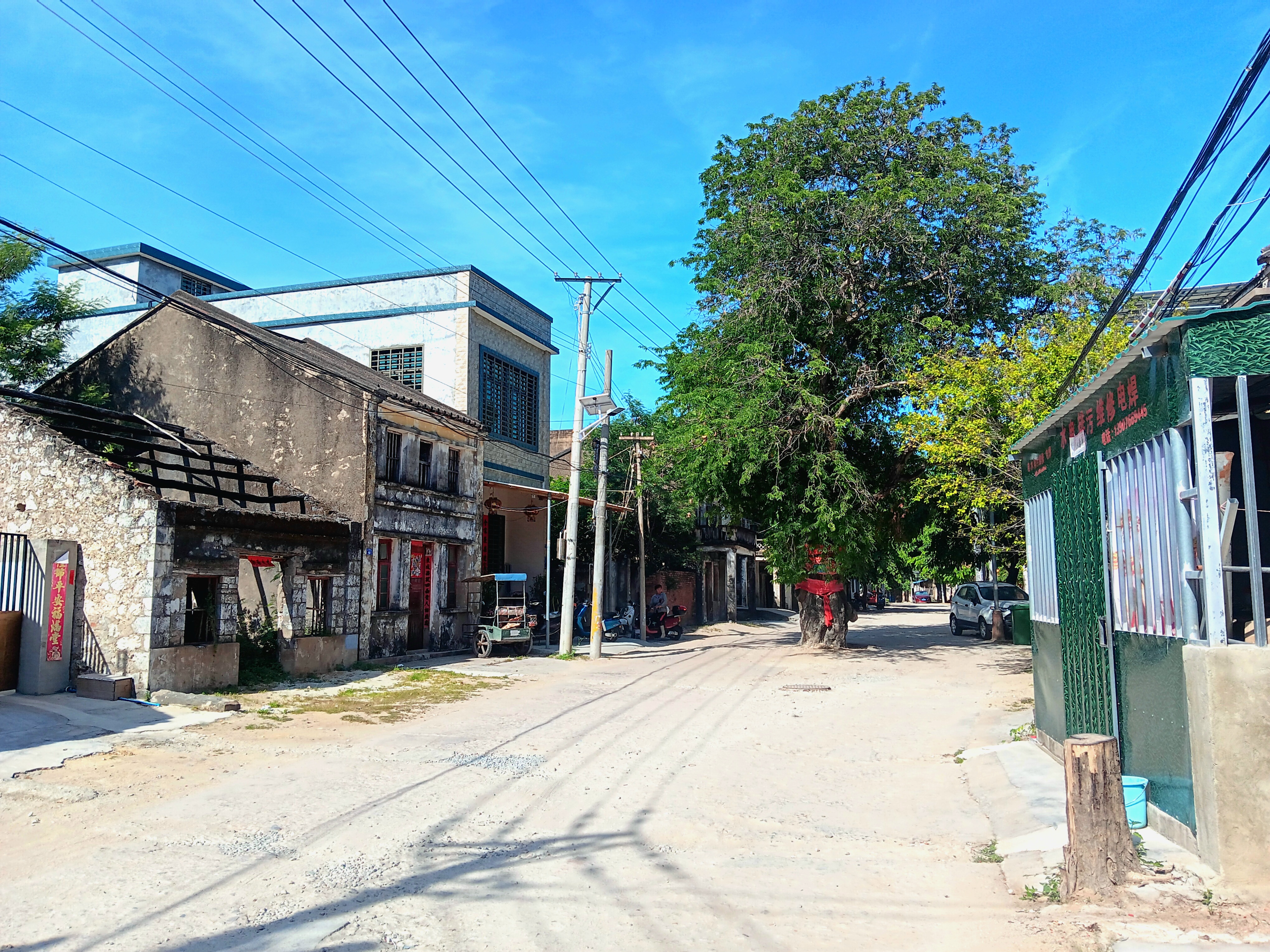



Not much changes here as the shadows grow long enough to make the walk down the half-dirt, half-concrete street that serves as Gangmen’s main artery more tolerable. The drone of TVs switched on and set to volumes meant for old ears, though, adds a new sound to the darkening streets.
Whether the house is one of the old ones –mortared stone and brick with peeling wooden doors, glassless windows, and dirt floors, the second stories often long-abandoned — or whether it is one of the new ones — two or three levels of gleaming porcelain tile and metal railings, doors solid and windows sealed — the TVs are the same, and they are ubiquitous. As ubiquitous the posters of the door god plastered onto the entryways, new and old alike. As ubiquitous as the ancestral shrines, the centerpiece peaking through each open door, portraits of now-gone relatives framed by electric red candles and set on mantles below giant calligraphic representations of the character for spirits, 神.
These are missing only in those scattered houses that have crumbled under the ever-growing weight of centuries. And sometimes not even there.
On the beach there is no one. Only the dying remnants of giant jellyfish, picked at by curious fingers and by birds and now half-melted in the blast of the sun.


It is not like this, come winter time, an old man tells me, gesturing at the sweep of rock and sand after emerging from the shrubs and cacti that line the upper part of the sea wall and separate the village from the shore. Every piece of this beach and every crook of these rocks will be covered with people, he tells me, nearly all of them from China’s northeast, escaping the winter chill. These houniao, as they’re called, or “migratory birds,” descend in February, filling the extra rooms of the village homes and guesthouses, before flying back north by the end of April. It’s a boon to the local economy, another old man later tells me, even if not all of the younger ones have as much culture as the old folks. And with their thick northeastern Mandarin and dongbei turns of phrase, they’re not always easy to understand.
But they bring money. Money that isn’t pulled from the sea, anyway. And like them or not, come winter time, they come, one way or the other.
What, really, can you do?
As I walk back along the beach, a Yanjing beer from the now-bustling convenience store in hand, the last rays of the sun unfold and expand like a giant pink fan above the coal tankers floating on the horizon, waiting for their turn at the port. The sun disappears somewhere over there, across the water and then, somewhere beyond it, Vietnam.

And the village, so quiet all day, has come to life. Villagers, most of them young men, scramble to load flat-bottomed boats and traps the size of mattresses down off the seawall and into the upcoming tide. One hands a boat motor down to another, struggling with its weight. All of them, to the last, have a cigarette hanging from the side of their mouth, the lit tobacco bobbing in the gloom like so many fireflies in the North Carolina summer.
“Hello!” one yells to me.
“Lu oh,” I reply in Hainanese.
“Yes yes yes!” he shouts and everyone laughs. Then they return, with urgency, to the boats and to the traps before they head out into the black ocean as the buoys and wind turbines blink in the distance and the last bits of light fade.
Overhead, a shooting star streaks across the sky.




 Sojourns