April 4, 2017 – Shenyang, Liaoning Province
I went to Shenyang because I knew it was a place no one would go with me. It has a reputation.
I’ll admit, it wasn’t my first choice, either. In fact, when I decided Sunday night that I needed to get out of Beijing for a couple of days, it was the only reasonable place to which train tickets were still available. Which tells one something.
Like I said, a reputation.
A reputation for being a dust-and-smoke-choked concrete slab strapped with ropes of unmoving cars. For being a frozen waste and a sweltering sweat-sink. For being a Dickensian hole, full of rusting and oil-painted factories and “satanic mills”.
And in the end, it was some of those things. I had a blast.

Dusty.
Shenyang (沈阳), like most places in China, is old. Archaeological evidence puts human settlement on the yang (阳)side of the Shen River (now the Hun river, and yes, “yang” as in “yin yang”) as far back as 8,000 years ago, but the city itself dates back to about 300 BCE during China’s Warring States period. It grew in importance over the centuries, eventually becoming a militarized settlement during the Ming Dynasty — one of the most important “guard town” strongholds beyond the Great Wall’s Shanhai (山海) pass wedged between the ocean and the mountains and blocking the way to Peking.
In 1625, horse-riding nomads from the Manchurian steppe took Shenyang. Within 20 years, the Manchu would breach Shanhai Pass and sweep into China proper. The Ming would fall and the “barbarians” would establish the last of China’s dynasties, a foreign one at that. The Qing Dynasty would rule all of China until the last of the emperors, the boy king Puyi, abdicated the throne in 1912 and ended Imperial China’s 2,000-year-long hold on history.
But in 1625, the Manchu had yet to move their capital to Beijing or adopt the full trappings and authority that Han Chinese culture and language would grant them from the Pacific to the Himalayas, and they renamed Shenyang to Shengjing (盛京) or Mukden (in Manchurian), meaning “rising capital”. Then they built a palace and later a tombs, and even after the Manchu ruled all of the Middle Kingdom, Shenyang would remain a secondary capital and a spiritual homeland, a place to keep their treasures and the bodies of their kings.
History wasn’t finished with Shenyang, or Puyi, for that matter. As the clouds of World War gathered over the Pacific Rim, Japan slipped iron tentacles into northeastern China. Then, they pretended to hack one off.
On September 18, 1931, a bit of dynamite exploded near a Japanese-owned rail line just outside of Shenyang. The explosion was so weak it failed to so much as damage the rail line. Nonetheless, the Imperial Japanese Army blamed Chinese dissidents and used the incident as a pretext for a invasion. But the explosion was a ruse: The Japanese military officers, likely without the knowledge of Tokyo, set the false flag, and soon Japan occupied all of northeast China, setting up Puyi as the puppet emperor of a puppet state. Less than two years later, Japan withdrew from the League of Nations.
Surprisingly, perhaps, evidence of all that history and more still stands in Shenyang despite its wasteland-like reputation, scattered through leafy parks and grand museums. Most of Shenyang indeed does feel like developing China: Broad dusty streets crushed with cars and hemmed with unappealing shops blaring advertisements from tinny speakers. But not all of it.
Downtown, the Qing imperial city still stands amid the skyscrapers, and in the city’s lake-spotted northern park, one of the Qing kings still lies under a hill of dirt, surrounded by moldering gate towers and a circular wall.
Those were for later,though. Shenyang is linked to Beijing by two high speed rail lines so the four-hour journey between cities starts or ends at one of two stations. I arrived at the main station and would leave from the north station before dawn two dance hence, so I’d booked a room (about 8 USD a night) at the state-owned China Post Hotel next to the north station square.
I resolved to walk from the main station to the north one in order to get a feel for Shenyang and hit a couple of the city landmarks along the way, starting with Chairman Mao.
I’ve got a thing for statues of communist leaders. And this one was supposed to be particularly interesting – the largest Mao statue sculpted during the Great Proletarian Cultural Revolution.
From the train station, it was a straight shot, and after a couple of blocks I could see him there, unblocked by buildings, arm outstretched, eyes locked on what would turn out to be a disastrous future. He stands in the middle of a barren traffic roundabout, surrounded by steroidal workers, scholars, and Red Army soldiers, all of whom grimace while they brandish stuff. If you were to look closely, you’d notice that many of these figures held one hand above their head, thumb and pointer finger nearly touching in a pinching gesture. When the sculpture was completed during the height of the Cultural Revolution in the 1960s, these hands all held Mao’s Little Red Book, required reading and required carrying for the legions of red guards – and ordinary people who did the best to avoid those gangs – for that decade.

Mao.

Workers of the world.
All of those books were later disappeared, lost much like so many of the details – and lives, for that matter – from that decade of ideological insanity and murderous anarchy.
After Mao it was a slog of block after block of soon-to-open malls and closed-for-the-holiday stores, broken up only by one street leaning toward artsy with some new, western-style bars and cafes (an American BBQ joint) and some odd statues of girls reading books or men playing accordions and even a “Gutenberg’s Bookstore” styled – sort of – like a European book house.
Eventually I found the north train station, mostly on accident, and also my hotel.
The receptionist there would hardly talk to me, let alone look at me, and I began to get the feeling that things weren’t going to go as I’d planned. When I checked into my room, the first thing I noticed was the horrifying way the bad florescent light gave the room a nightmare, things-are-not-quite-real-nor-are-they-quite-right kind of sheen. It was hard to look at anything, as if everything shimmered just enough to throw me off balance.
The second thing I noticed was there wasn’t a bathroom.
The price-point, if not the actual furniture, was starting to come into focus.
I walked out of the room. The bathroom was next door. Communal. Urinals. Squatters. No showers. Floor covered with cigarette butts. I went back to my room and sat down on the shimmering bed. There was a plastic tub on the shelf in the corner of the room above the complimentary flip flop shoes. It was the kind of tub I’d seen before in Beijing’s hutongs and in villages next to rivers, the kind of tub people fill with water and use to wash themselves when they don’t have a shower. Great.
It took me a few minutes to get used to the idea. Well, at least it’s cheap, I thought. Then, before I could think for much longer, I left to go find a dead king.
I spent that afternoon walking around the lakes and visiting the Qing tomb. The tomb complex itself is a cluster of buildings encircled by a wall. At the very back is a giant, nearly treeless mound of dirt topped by a single leafless tree. The king is under there. I walked the wall around the place and looked at the mound for a while, then out, where in the evening sky hundreds of kites fluttered above the trees. And above the massive iceberg floating next to the boat dock. And just above the heads of seniors. And sometimes they simply fluttered right into those heads.

The tomb complex.

There’s a dead guy under that tree.

Tomb wall.

Animals hold their vigil.

The park was empty.

A dragon screen.

Kites fly above the Manchurian king.
Exiting the park, I spent twilight walking through stall-lined night markets, trying to find one of the city’s bar streets. I walked one area for a couple of hours, coming up empty handed, then took a cab to another part of the city. I ended in the wrong area but found a craft beer bar, charged my perpetually dead phone, and set out again on foot. The kilometers slipped by and I still hadn’t found the place I was looking for, the Fat Dragon Ale house. I stumbled upon another beer bar, this one’s walls covered in fake grass and plants, charged my phone again, and set back out.
Being Tomb Sweeping Festival, there were plenty of fires in the streets, people burning paper money and cardboard phones and such for their dead relatives, but still no Fat Dragon. I’d been looking for hours and was about to give up hope when I turned the corner to see a Fat, stubby-winged dragon hanging from the side of the building.
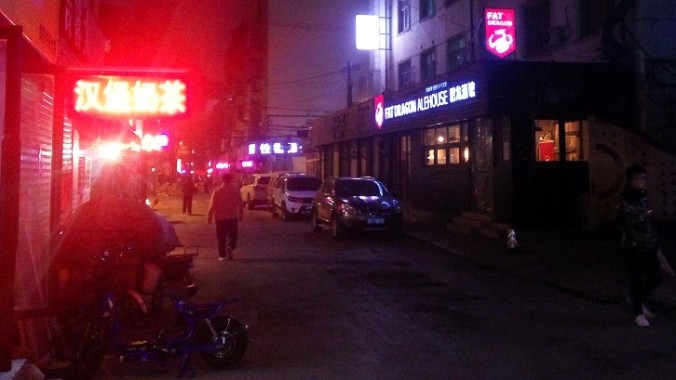
The Fat Dragon.
I spent a few hours there drinking various craft beers from around China chatting with the bartender about Shenyang, about the sights and the climate and about beer. Then I talked to a pair of Chinese girls on holiday from university in Haerbin for a while longer. Then I went back to my hotel, watched some more people burn stuff in the streets, ate some 1-am hotpot, and then slept like the dead.
The next morning, I took the gleaming subway a few stops to the oldest section of the city where the Shenyang’s Imperial Palace still stands. A UNESCO World Heritage Site, the Mukden Palace was constructed in 1625 to resemble Beijing’s Forbidden City, but the Mudken version also includes a variety of Manchurian and Tibetian architectural styles not found in Beijing. It’s also significantly smaller than the one in Beijing, so instead of an 8-hour slog, it’s easy enough to check out the halls and their exhibits on daily life, Manchurian military strategy, and the history of Manchurian craftsmanship in a handful of hours.

Outside the Shenyang Palace.

The reconstructed city gates.

The main hall.

Dragons.

Inside the Palace.

Spring.
By early afternoon, I’d wrapped up my tour and exited onto Shenyang’s most famous shopping street, where I planned to eat at Shenyang’s most famous dumpling restaurant. Located in a hotel of the same name, Laobian Dumplings looks out over the shopping street. It’s one of the oldest restaurants in Shenyang, too, having first opened in 1829.
I took the stairs to the second floor and walked into something that felt vaguely like a hotel and also vaguely like a cafeteria, then seated myself and ordered a couple of baskets. Dumplings are one of northeast China’s specialties, and these were no exemption. Steamed in pale bamboo baskets, their sticky, paper thin skins peeled apart in the mouth a bit slower than those I’ve eaten anywhere else. Combined with white vinegar instead of the common brown stuff, and Laobian was something of a unique dumpling dining experience, which isn’t something I can often say.

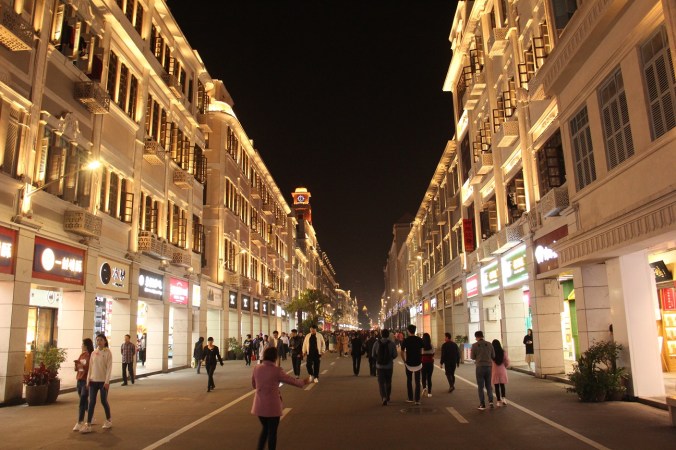
Shenyang’s main shopping drag.

Laobian dumplings.
With a few hours of light left to kill, I decided to walk the banks of Hun river opposite downtown. I caught a bus through downtown to the far side where I was dropped off next to the largest plastic surgery hospital I’ve ever seen. It was shaped like an ocean liner. And as big as one. The way to the river seemed to be blocked, however, until I found a rotting stairwell in a tunnel that once seem to have played host to some condemned drinking holes. It led onto a roof, which led to the the banks of the river. From there, I strolled under the just-budding willows. From there, I crossed the bridge to the business district, where I walked underneath fancy hotels and Lamborghini dealerships, past the angular and sod-covered city library.
I finally stopped on the city’s bar street where I settled into a Swiss chalet run by a real Swiss woman. Down the way – next to a sex shop vending machine – a red, white, and blue sign called customers to come in to an American-owned restaurant for “Los Angeles-style” Chinese wraps. And across the street little a bar named “Crawlers”; the flashing neon sign called it a “reptile-themed bar”.

Library.

Swiss chalet.
I couldn’t get too comfortable, though. I had one place left to visit: “Little Seoul”.
Near the western white pagoda, a banner strung across the highway welcomes visitors in two sets of characters, and then the Chinese melts into Korean. For a few blocks in each direction, waitress in traditional Korean dress beckon customers to sup on kimchi and Korean stews. Soju bottles line the walls. Bar television blast out K-pop hits. Shady hotels advertise Korean “massages”.

The West Pagoda.

K-town.

Kimchi.
I found a small restaurant in a back alleyway and decided to have Korean dinner in China. Only one waitress spoke good Chinese, and she led me to the back room, where to my horror I remembered three things, and realized one.
One: I’d walked nearly 40 kilometers in the last two days.
Two: My hotel didn’t have a shower.
Three: It’s typical at Korean restaurants to sit on the floor. And guests must take off their shoes.
One: The tiny room had two tables. The other one was occupied by a couple.
I slid my shoes off and looked down at my feet. My socks were crusted and shredded around the toes and heels. I walked quickly to the low table and covered my feet with a jacket. The odor wafting up from underneath it was making me suppress a gag. The couple hadn’t seemed to notice yet.
In Shenyang, it’s still legal, or least permissible, to smoke, literally, anywhere. I think that fact may have saved my dignity, and their dinner.
I ate fast. And each time one of my poor dining companions finished a cigarette, I prayed they’d soon light another.




 Sojourns