Village at the Port’s Gate

June 30 — Gangmencun, Dongfang, Hainan

In the heat of midday, the only things that move are the few brave chickens darting between car undercarriages and the liver-spotted hands of the old women as they mend fishing nets in the shadows of second-floor balconies.

Round and round those hands go, unspooling and tugging and wrapping, readying their lines and nets for another night’s work.

By now, the small crowd that had gathered at the folding tables and plastic stools in front of Gangmen Village’s lone restaurant has dispersed, though a few stragglers hang on, shirtless, to drink the dregs of teapots and smoke the last of their cigarettes. The convenience store is open, though nothing moves inside except for the compressors pumping cold air into refrigerators full of tea and beer. Out front, next to the rack of rainbow-colored brooms, some women in middle age sell fruit from the bed of a cart. Most of the fruits are unknown to me, but the greens, pinks, and purples pop against the scorching, whitewashed walls of the village houses, and they catch my eye.

As the garbage truck — a converted military vehicle, its vintage long passed — trundles down the lane, the women fan dust from their faces.
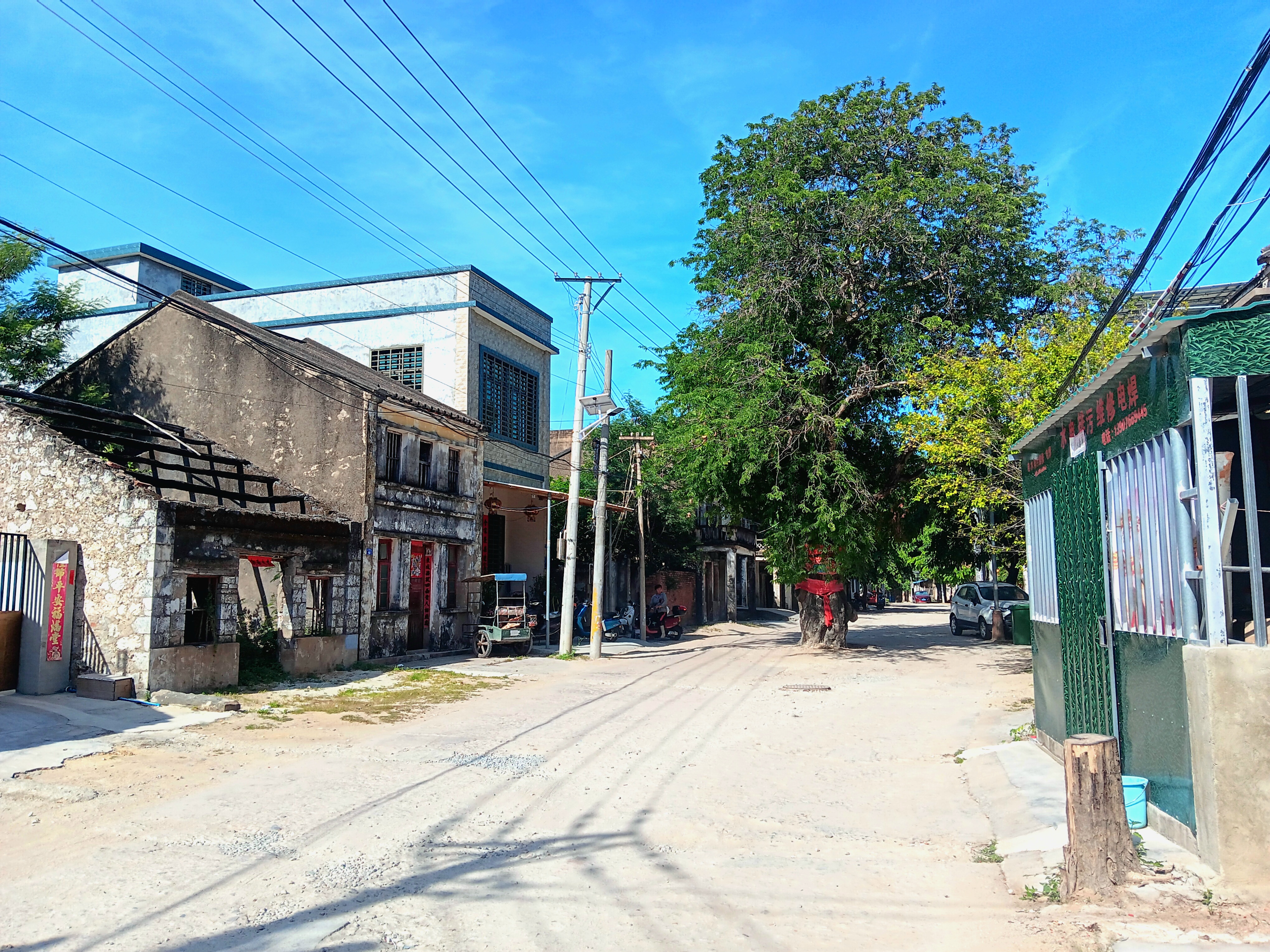
Not much changes here as the shadows grow long enough to make the walk down the half-dirt, half-concrete street that serves as Gangmen’s main artery more tolerable. The drone of TVs switched on and set to volumes meant for old ears, though, adds a new sound to the darkening streets.

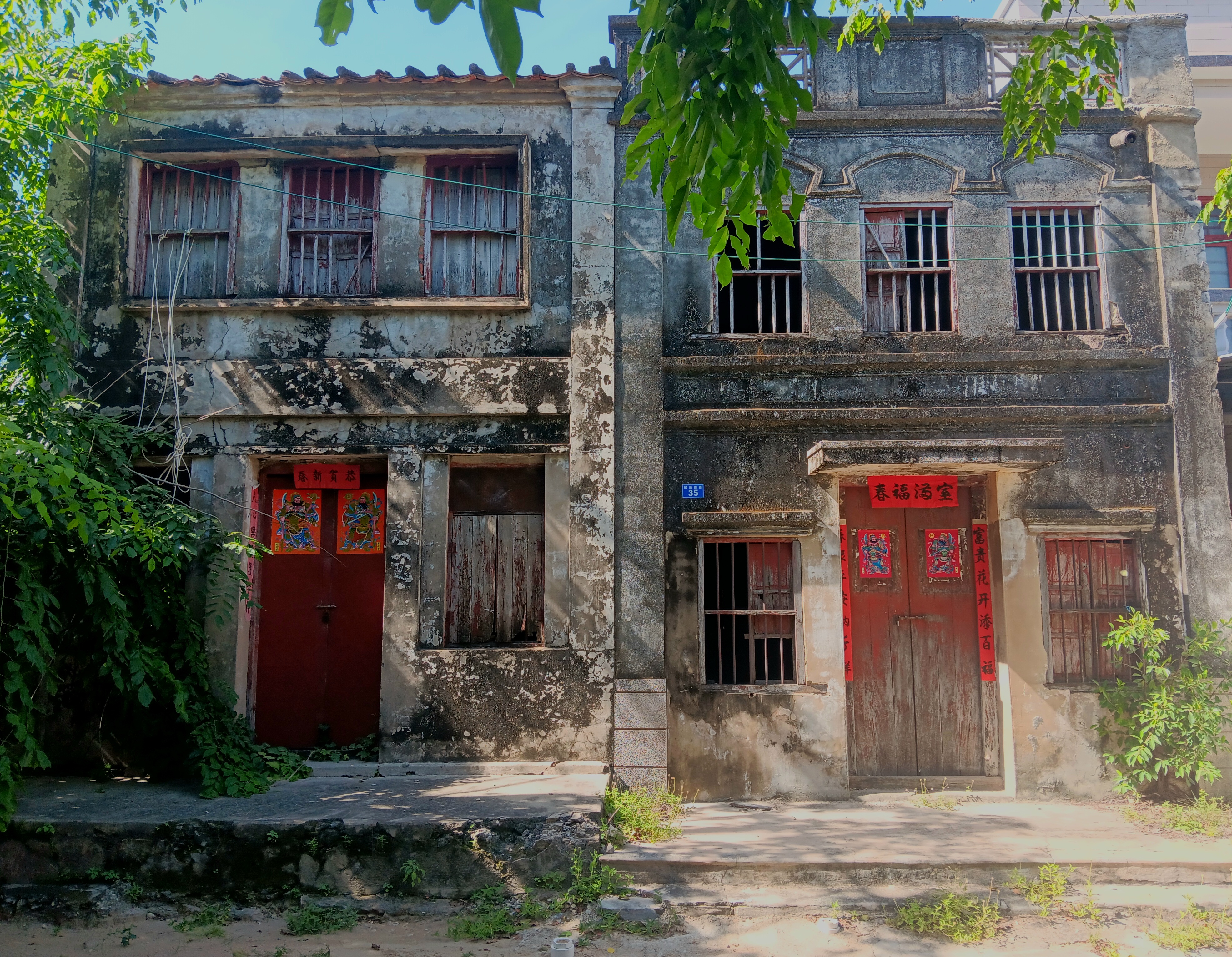
Whether the house is one of the old ones –mortared stone and brick with peeling wooden doors, glassless windows, and dirt floors, the second stories often long-abandoned — or whether it is one of the new ones — two or three levels of gleaming porcelain tile and metal railings, doors solid and windows sealed — the TVs are the same, and they are ubiquitous. As ubiquitous the posters of the door god plastered onto the entryways, new and old alike. As ubiquitous as the ancestral shrines, the centerpiece peaking through each open door, portraits of now-gone relatives framed by electric red candles and set on mantles below giant calligraphic representations of the character for spirits, 神.

These are missing only in those scattered houses that have crumbled under the ever-growing weight of centuries. And sometimes not even there.

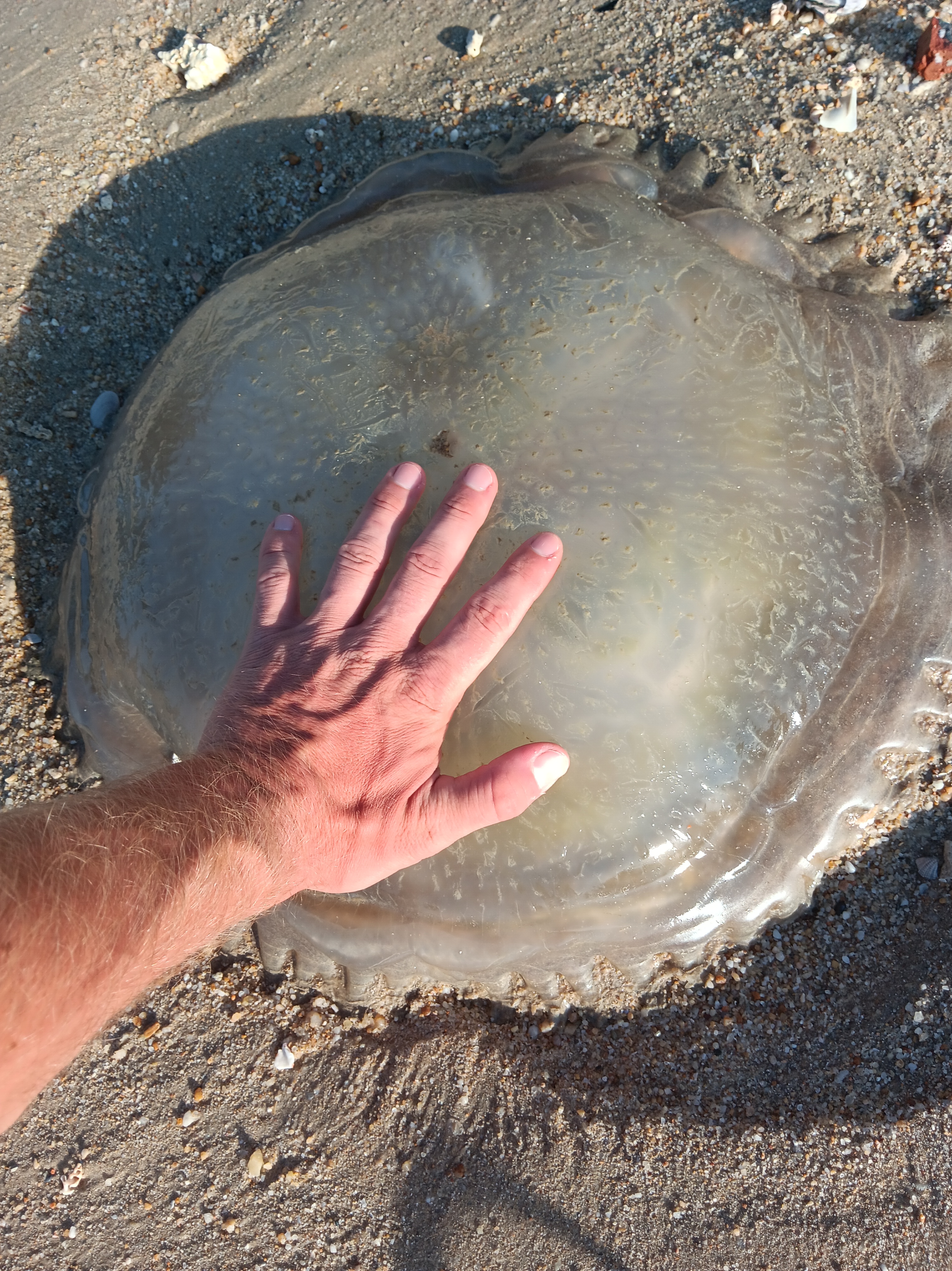
On the beach there is no one. Only the dying remnants of giant jellyfish, picked at by curious fingers and by birds and now half-melted in the blast of the sun.
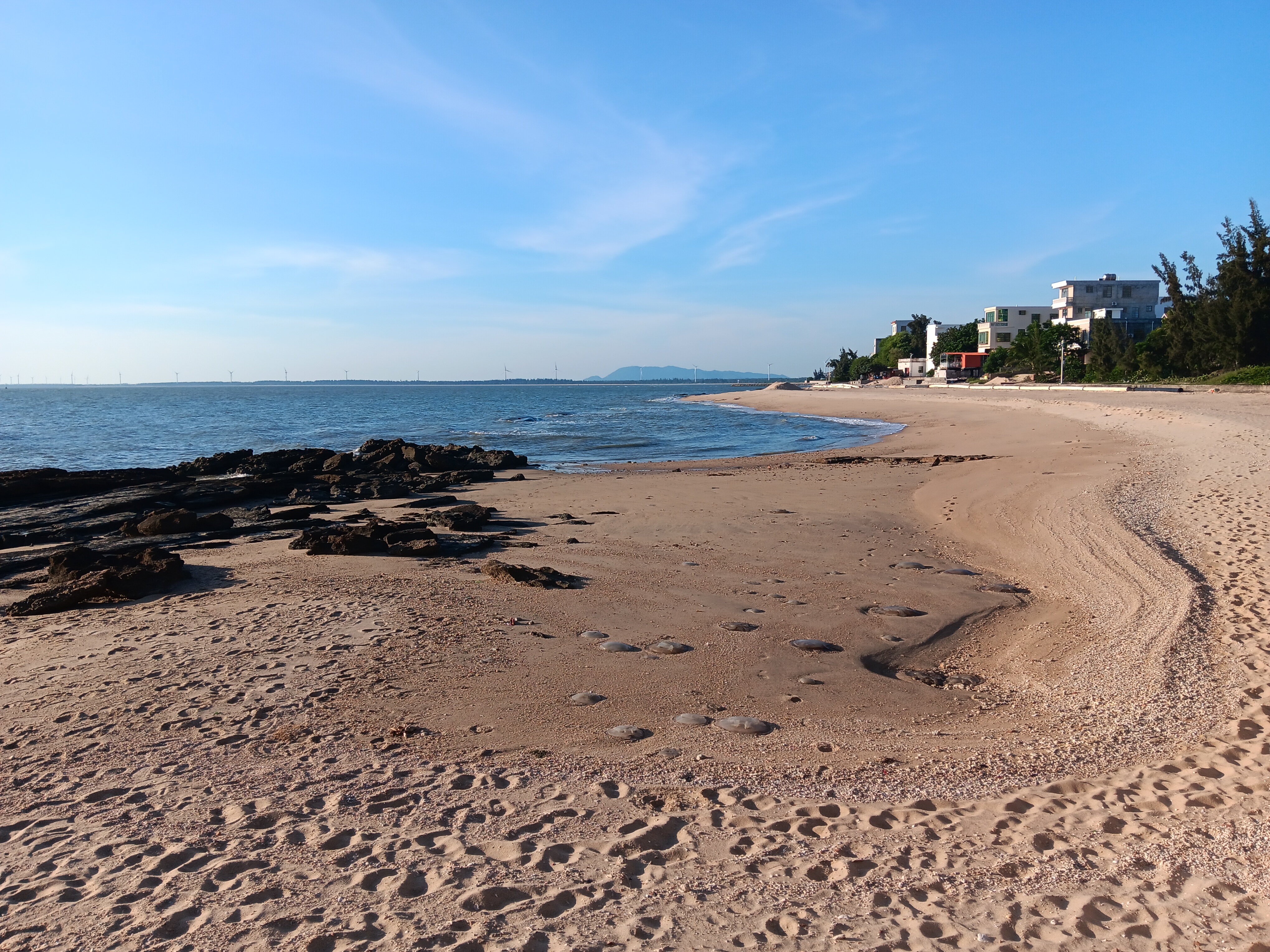
It is not like this, come winter time, an old man tells me, gesturing at the sweep of rock and sand after emerging from the shrubs and cacti that line the upper part of the sea wall and separate the village from the shore. Every piece of this beach and every crook of these rocks will be covered with people, he tells me, nearly all of them from China’s northeast, escaping the winter chill. These houniao, as they’re called, or “migratory birds,” descend in February, filling the extra rooms of the village homes and guesthouses, before flying back north by the end of April. It’s a boon to the local economy, another old man later tells me, even if not all of the younger ones have as much culture as the old folks. And with their thick northeastern Mandarin and dongbei turns of phrase, they’re not always easy to understand. 

But they bring money. Money that isn’t pulled from the sea, anyway. And like them or not, come winter time, they come, one way or the other. 

What, really, can you do?

As I walk back along the beach, a Yanjing beer from the now-bustling convenience store in hand, the last rays of the sun unfold and expand like a giant pink fan above the coal tankers floating on the horizon, waiting for their turn at the port. The sun disappears somewhere over there, across the water and then, somewhere beyond it, Vietnam. 

And the village, so quiet all day, has come to life. Villagers, most of them young men, scramble to load flat-bottomed boats and traps the size of mattresses down off the seawall and into the upcoming tide. One hands a boat motor down to another, struggling with its weight. All of them, to the last, have a cigarette hanging from the side of their mouth, the lit tobacco bobbing in the gloom like so many fireflies in the North Carolina summer.

“Hello!” one yells to me. 

“Lu oh,” I reply in Hainanese. 

“Yes yes yes!” he shouts and everyone laughs. Then they return, with urgency, to the boats and to the traps before they head out into the black ocean as the buoys and wind turbines blink in the distance and the last bits of light fade.

Overhead, a shooting star streaks across the sky.

Migrations

June 8 — Guangzhou

First, I was to test the bed.

“Slower. Slower! Lightly, lightly, lightly!” the old man, shirtless in the sweltering bunk room, yelled as I hauled myself up a loose ladder onto the top bunk.

“Now, lay down. Carefully,” he said. “Carefully!”

I leaned back as slowly and carefully as I could until my head touched the plywood and waited as the old man examined the underside of the bed. He grunted.

“I think it’s fine,” I said.

“How much do you weigh?” he asked.

“Let me think. I know it in American,” I said, unhelpfully.

His eyes narrowed.

“You weigh the same no matter where you are,” he said. “What are you talking about.”

I didn’t bother replying while I did the conversion on my phone. “About 71 kilograms,” I said.

The old man sucked on his teeth. Reaching behind him he produced a bent aluminum bar.

“This is what happens when you’re too heavy. Or not careful,” he said, eyeing me. “Just move lightly and it’ll probably be okay.”

By now, I must have looked doubtful because one of my new roommates spoke up to tell the old man that the bottom bunk across the way in this ten-person room had been vacated earlier that day.

“Ah, perfect!” The old man said. He transferred my mattress from top bunk to the bottom.

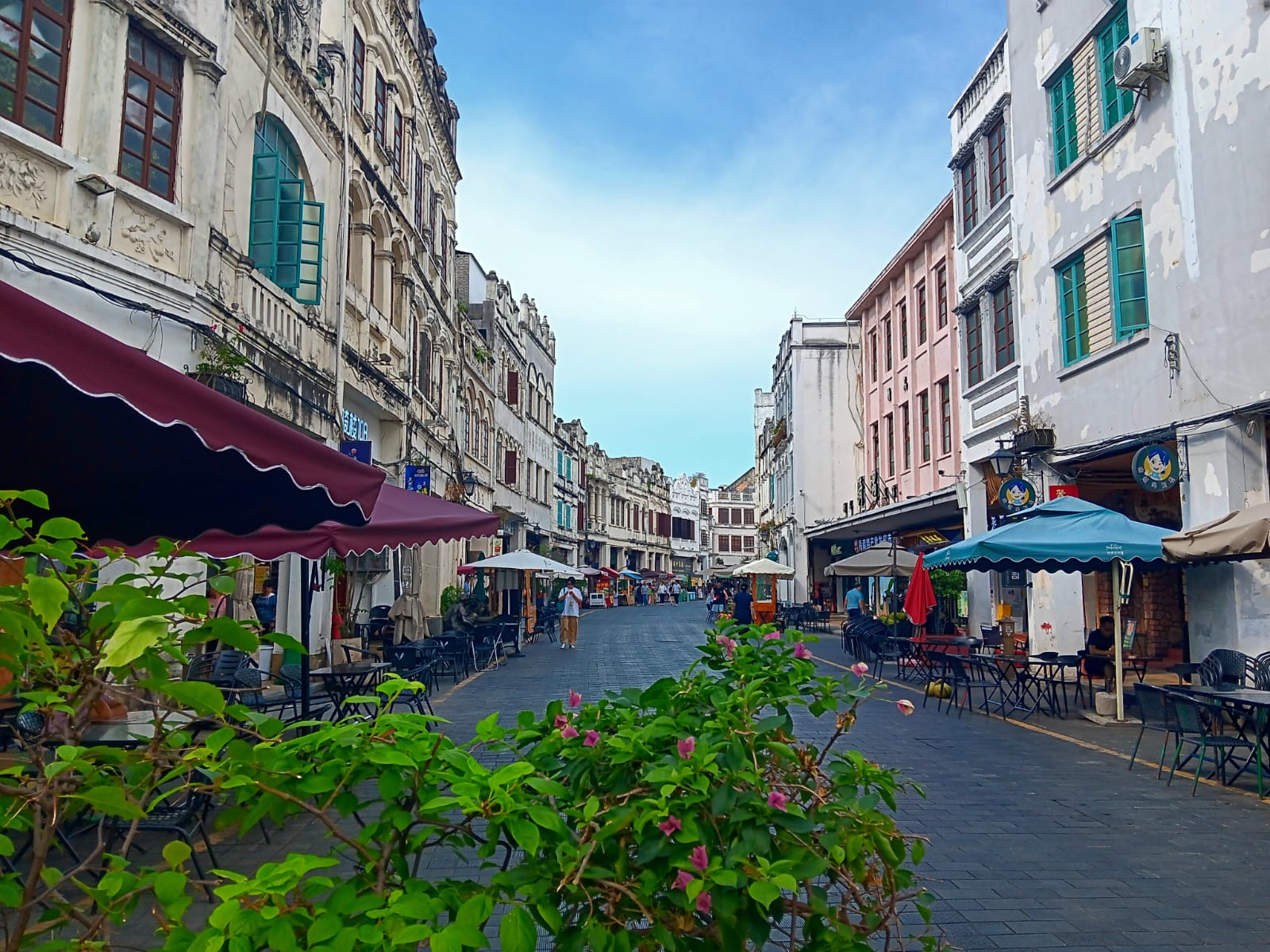
Haikou’s Qilou Old Street.

I sat down and looked around. Across the way a heavyset man with a whispy beard stared at his hand. He would continue this way for the next ten or 15 minutes as I quietly unpacked my bag. Above me a shirtless twenty-something watched a Chinese drama at full volume on his phone. Across the room a stick-thin man with silvered hair and a clothed only in a tiny pair of underwear wrote number after number on a practice pad for Chinese characters. When he got up moments later to go to the shared bathroom in the hallway, he put on his uniform–a blue collared shirt, black slacks, and shiny black shoes. When he returned, he took it all back off and went back to writing.

Before long, the bigger bearded man stood up and turned to stare at the wall.

I walked out onto the balcony, where several persons worth of laundry hung on various lines. A half dozen trunks lay stacked in a corner. One planter was full of cigarette butts and a banana peel. On all the railings had been scrawled, in rough handwriting and permanent marker: “Dangerous!”

I went back inside. In the middle of the five rickety bunks was a card table, on which was strewn a variety of shower products and half drank bottles of tea and soda. Sandals of various colors and wear, some matched, lay strewn about the room. Mosquitoes bounced off the ceiling.

It dawned on me that at two dollars a night, I’d booked myself into a migrant laborer bunk room — fitting, in a way. That realization was confirmed moments later when a beaming face slunk through the door.

“Hello,” the face ventured.

“Hello,” I replied.

“I saw you earlier,” he said. “But I was too shy to say anything. You’re staying here?”

“I am,” I said.

We talked, as we would would the next day and the next as far as our mismatched language skills would take us. He was from a village on the far southern end of the Qiongzhou Penninsula, here in Haikou for a construction job after several years in Zhuhai, near Macao and Hong Kong, so his native language was Cantonese, Mandarin a second and in the tongueless southern style. And my Mandarin, after five years away, has gotten rusty.

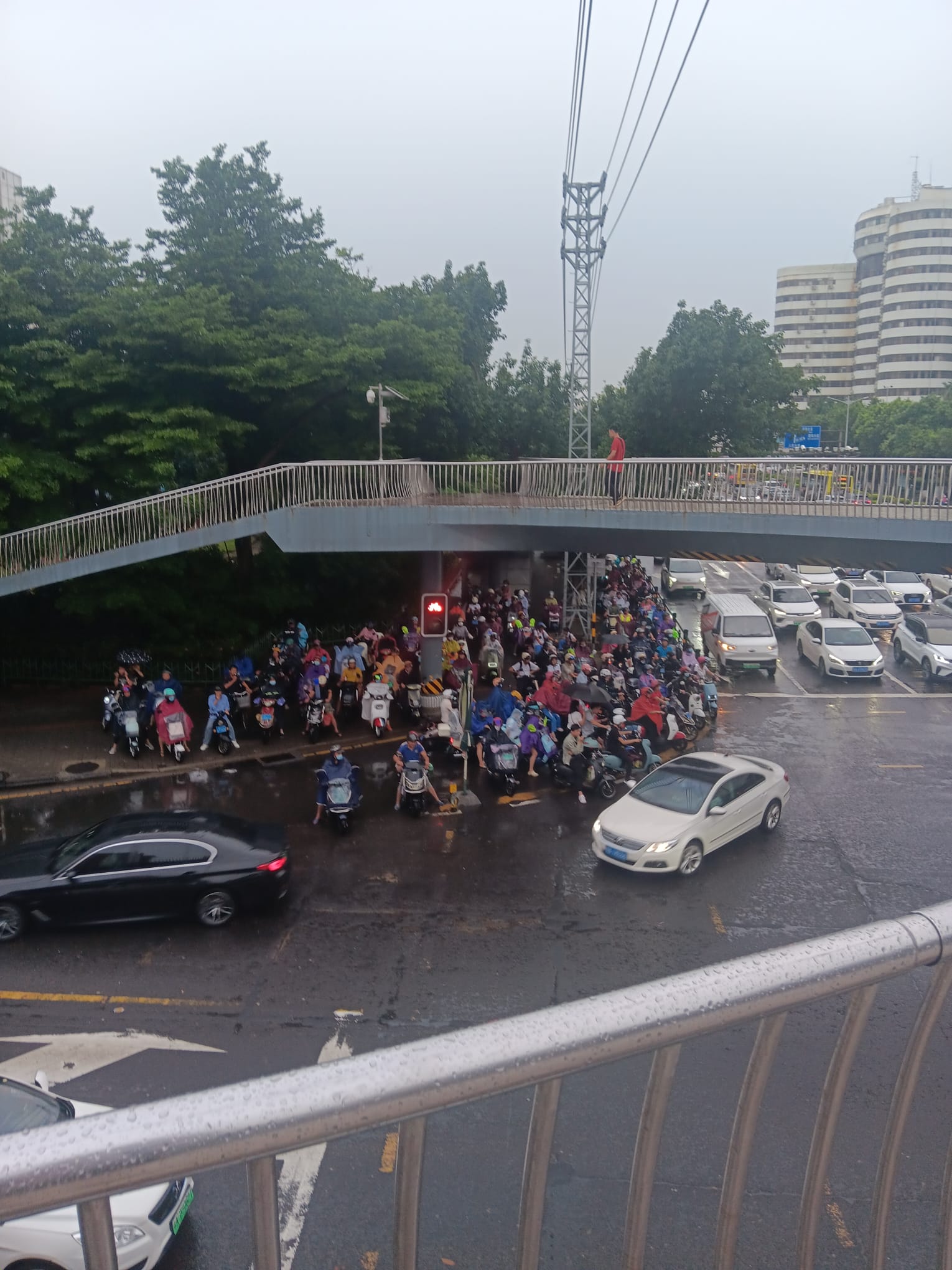
Still, he was patient and easier to understand than the rest, who interjected loudly and often with their own thoughts and queries in their own dialects, which we would all struggle to make sense of. My new friend had just gotten a good job, higher up in the construction company and was waiting on medical approval, necessary for a “formal” job higher up than the informal itinerant laborers. The old man was a doorman, studying numbers with hopes of moving up in the world even at his advancing age. One of the kids was had done various odd jobs but was looking for something more permanent — anything would be better, after all, than the army of food delivery scootermen who now clog the streets of Haikou, Hainan Island’s capital city of two million, racing to scrape together a meager living against the unforgiving clock.

The heavyset man, meanwhile, interject English words here and there. But had just suffered a bad head injury on the job. That’s why he stared, he said apologetically, and why he couldn’t remember the right words.

As the night wore on, the conversation died down. The old man went back to his numbers. The kid back to his phone. The heavyset man back to staring. My new friend brought me a bottle of Coke.

“Thank you,” I said.

“Don’t thank me,” he said. “In China, our foreign friends shouldn’t pay for anything.”

I started to say something, but he cut me off.

“No, no, no,” he said.

It’s been a long time.

Conquering the Koguryo

Ji’an, Jilin Province, China

I know what Murong Huang’s soldiers felt when they sacked the Wandu Mountain City in 342 A.D. I’ve felt the pain of the mountain roads and the savored the taste of victory. Or at least, I savored the taste of free entry.

Wandu: The once capital of the Korean Koguryo Kingdom. Born in 37 B.C., the Koguryo survived some seven centuries of war before an allied force of China’s Tang Dynasty and the rival Korean kingdom Silla destroyed it at Pyongyang in 667 C.E. The Koguryo capital Wandu was founded in 3 A.D. along the riverbanks and mountain slopes that surround the contemporary Chinese city of Ji’an on the North Korean border. By the fourth century, the Koguryo dominated much of the Korean peninsula and northeastern China and were well-known for their skills in both arts – gilded jewelry and sculptures, and especially its dancing culture – and warfare. But it was in that century that the Chinese commander Murong Huang attacked the fortress city through the mountains from both the north and the south, captured it, and burned it to the ground. The fleeing Koguryo left their ruined city to the wild.

When I set off from Ji’an – perhaps the most beautiful city in China with its streams, parks, clean streets, polite populace, and river views of North Korea – for the few-kilometers walk up to the Wandu site, I did not intend to follow in Murong Huang’s footsteps. The path I’d mapped took me out of the mountain-hemmed city, along the river, and through a picturesque village that gave way to an idyllic countryside of farmhouses and cornfields in which birds flitted and chirped and insects chittered in the thick vegetation.

The path soon turned up a small valley carved by a creek. The creek, home to countless frogs both dull and bright, gurgled over rocks as it slipped out of the near-vertical, tree shrouded mountains above. At first, the path cut clearly through the bushes, an easy hike up the gully. I giggled as I walked, glorying in the sunlight and the water and the trees. Soon, though, the going got steeper and the way got murkier. In the trees above the narrow valley, I heard the ominous clanging of bells.

My steps, and my breath, quickened. Cows. I hate cows. I fear cows.

I climbed over a ramshackle wooden fence just as the path disappeared. My giggling stopped and smile drooped. I began to worry that I’d gone the wrong way.  But the bells still followed.

And then, there ahead around a bend, four bovine monsters lay in the grass. Beyond them, too, stood a bull, his nose ring tied to a horn by a series of menacing. makeshift rusty metal links. He eyed me and stomped the ground. But the bells behind me still hadn’t stopped. As I stood, petrified, the clanking grew closer, and at last, another handful of cows trundled out of the trees and blocked my escape.

There was but one possible path forward. Walking in the middle of the stream, I could wind past the cows, keeping a few spans between us. I started forward speaking softly and slowly waving my hands. The laying cows watched me and chewed the grass, swatting at swarms of midges and mosquitoes with their ears  and tossing their heads. I should’ve paid more attention to the swarms – a prophecy of things to come – but I had eyes for only the bull. He’d lowered his head and turned to follow me as I edged around. He snorted and stomped. When I pulled parallel with him, he came for me.

I took off up the creek, stumbling over rocks, not daring to look back. I tripped, picked myself up, and kept running. Locusts and frogs bounded out of my path, plunking off of my bare legs and hips. Suddenly something squirmed under my foot. I glanced down to see a snake writhing half under my shoe and half under the rocks, seemingly stuck between trying to flee and trying to lash out at its tormentor. I skipped to the side, kept running up the ever-steepening hill and reminded myself to pay more attention to the path under my feet; I had no idea what kinds of animals lived in this forest.

Soon, I could only hear the blood pounding in my ears and my ragged breath. I’d left the bull, and those horrible bells, behind. The bull and the bells, but not the bugs. I staggered to a halt to catch my breath, and as my bodily sounds faded, the buzzing closed in. Hundreds of insects swarmed my head and naked shoulders.  No time to breathe, I started running again. The swarm pursued.

Before long, the valley came to an end. The only choice was up — on all fours. I slipped and slid on broken rocks covered by a skin of dead leaves. Whenever I tried to tack horizontal, I found myself trapped by thorned and stinging plants which shredded my calves and forearms. When the Koguryo climbed these hills, they’d used spiked boots to keep their balance. I did not have those. For every meter I crawled up the slope, grabbing rotten tree limbs for balance, I slid half as far back down. Bulbous gray spiders skittered in every direction and bouncing grasshoppers crackled in rage and terror. The swarm did not relent.

A lovely walk in the woods had turned into my personal Apocalypse Now.

Finally, a rocky outcropping rose out of the mountain top in front of me. Like some kind of harried, gasping seal, I dragged my slippery body over the top and lay heaving for a moment on the stone path on the top. Then the swarm found me, again, and I took off along the path, skating on the phlemy, mossy stones and galloping up and down stairs. Through gaps in the trees I could see Ji’an down the valley, and there, up the river, the sand-colored burial mounds I’d been trying to reach.

I slipped, scampered, and stumbled, all while swatting at my head, just trying to outrun the bugs for another half hour or so – up and down and up and down and then down, down, down, until suddenly the trees opened up, and there I was, surrounded by crumbled city gates in an open field. A pink-shirted tour group turned away from an ancient watchtower to point at me and shout.

I walked among the Wandu Mountain City ruins for the next couple of hours, marveling at the engineering of the mountain fastness. As I looked at a map of the former Koguryo capital, it at last dawned on me: like Murong Huang more than a millennium before, I’d assaulted the ancient city walls from behind, then run along them and at last breached the city.

Murong Huang had sacked a city. I’d snuck into a UNESCO World Heritage Site without a ticket. Feats, one and both.

Later in Ji’an a grilled corn hawker would tell me I was the second white foreigner he’d seen in two years. The security guards at the Wandu ticket check gaped at me as I walked out the exit, covered in leaves, mud, and blood.

I like to think the Wandu guards 1600 years ago had similar looks on their faces.