Peril at the Edge of the World

August 7 – Jiayuguan, Gansu Province

The edge of the empire.

To the west, ahead of us, lay the vast wasteland of the western deserts. To the east, behind us, civilization.

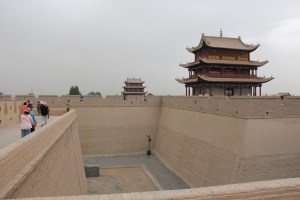
We stood atop the west gate of Jiayuguan fortress, looking out at the sands and mountains beyond. Through this gate, disgraced officials and scholars, poets and criminals walked out of the Chinese empire, banished into the wastes, most never to return.

To the west, ahead of us, lay the vast wasteland of the western deserts. To the east, behind us, civilization.

To the west, ahead of us, lay the vast wasteland of the western deserts. To the east, behind us, civilization.

Known as the “First and Greatest Pass under Heaven”, Jiayuguan is the most intact ancient military fort along the Great Wall of China. Located at the narrowest point of the Hexi Corridor – China’s throat – it was the first pass at the western end of the Ming Great Wall. Built in the late 1300s, its purpose was to protect China’s heartland from the “barbarians”, and for centuries it served as a key chokepoint along the Silk Road.

The fortress is massive: Concentric walls 11 meters high and 733 meters in diameter enclose an area of 33,500 square meters.  The walls, turreted at each corner, connect to the Great Wall and the northern and southern sides.

But where before those walls garrisoned China’s westernmost armies, today they garrison a tourist trap.

Dancers, juggles, face changers, and contortionists abounded. Camels waited for passengers. Dune buggies hummed out into the waste. And overhead some kind of lawnmower-powered hang glider buzzed the tops of the gatehouses.
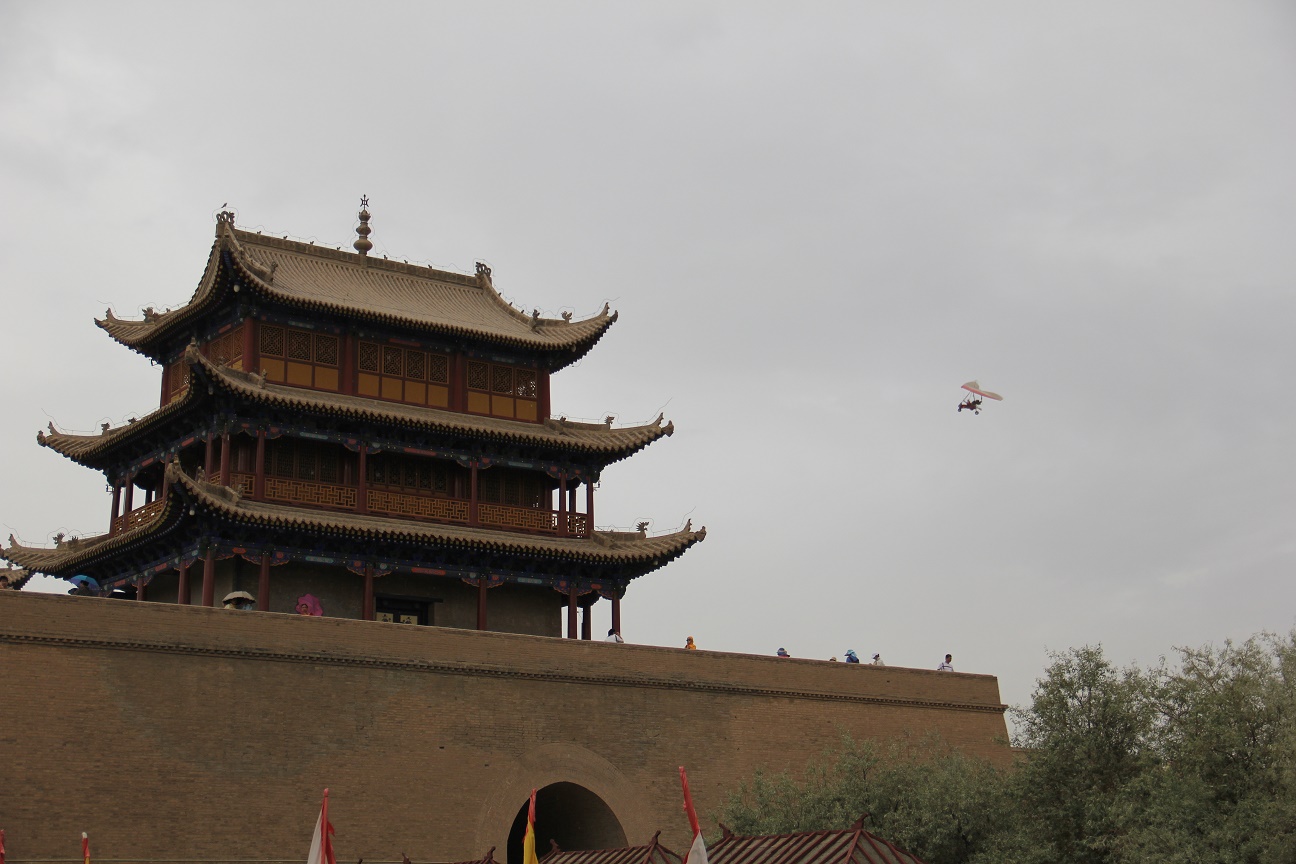
The hang glider was omnipresent.

The hang glider was omnipresent.

Even when I found a quiet spot on a corner tower, it was all a bit much. The hang glider just wouldn’t go away.

So we circled the walls and headed for the Great Wall instead.

The western Great Wall little resembles its eastern cousin that climbs the shrubby hills outside of Beijing. Shorter and narrower than the famed gray stone wall, the western wall’s local-materials construction makes it a sandy brown mud structure, bonded together with straw. It follows the jagged curvature of the Gansu hills, making use of the local terrain to reinforce its defensive purpose.

We climbed the stairs of the open-to-tourists section to the topmost tower. From the roof, the purpose of the wall is clear: It commands hundreds of empty kilometers of flat, dead plains. Now, nuclear power plants dot the distance, but in the 16th century, no invading army could get even consider approaching the wall without raising the alarm and calling the garrison out from Jiayuguan.

From the tower, though, we spied something else: The dusty remains of skeletal pagodas dotting the steep and shifty hilltops around us. We had to investigate.

Picking our way along the treacherous, crumbling rocks, we wound along the hillsides passing whimsical shapes built by people who’d come before us with collections of the desert stones. We tried to convince ourselves that a fall down the jagged side wouldn’t be all that bad. In places, the trail narrowed to barely a boots width, sloping downward into the space below.

Periodically Matt would insist we go no further. As the man with the most mountaineering experience in our band, that should’ve given us pause. But Dave and I pushed ahead, dragging Matt, muttering this and that about “dangerous” and “hate” and “unstable traverses”, behind us.

At last we reached the splintering pagoda, robed in faded and unravelling prayer flags. Two other pagodas capped hills just below us. Between them, more lines of once-colorful prayer flags stretched like a cobwebs above decrepit temple buildings at the hill base.

To our north the Great Wall slithered up the peak from which we’d come. To the south, it slithered down another hill, then ran rail straight across the empty plain, out to the commanding Jiayuguan fortress, then disappeared into the desert over the horizon.
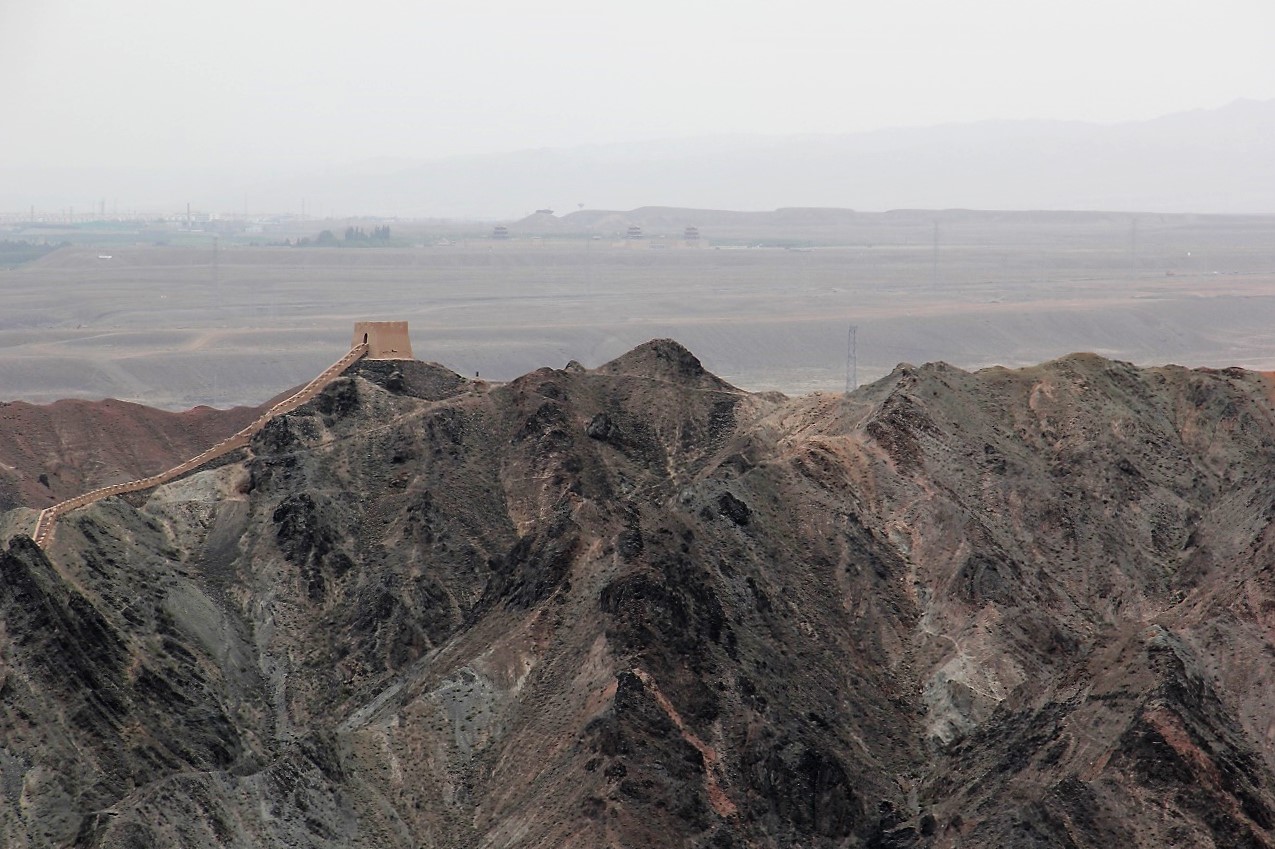
The Great Wall snakes along the hills, then connects with Jiayuguan in the distance.

The Great Wall snakes along the hills, then connects with Jiayuguan in the distance.

We snapped a few photos, then ambled and slid down to the peeling monastery.

A lone nun, bald and grey clad and trailed by a shaggy malamute, scuffled along among the sand-blasted buildings.

Then we had our closest call of the trip.

As we walked out of the monastery, Dave spied a trashcan for his empty water bottle. Nearby, a tiny mongrel of a dog lay asleep on the sidewalk. As Dave approached the trashcan, the dog lifted its head just a little, but when the bottle clanged to the bottom of the metal bin, he transformed into a demon.

With a snarl he tore from his resting place, flinty eyes locked on Dave’s ankles. With a yelp, Dave slung the bag off his back, wielding it like half like medieval flail, half like shield to keep the dog at bay. Whichever way Dave turned, the dog spun faster, yipping hatred all the way. Each time Dave turned to run, the dog was on at his ankles, forcing Dave to swing around once more and bring his baggy weapon to bear.

Matt and I looked on in horror and delight, flinching backward each time the dog spun closer us, unsure whether to gape or flee. Finally, with something of a strangled battle cry, Dave saw his opening and bolted toward us. On the tiny demon came, still, and the three of us sprinted around a copse of trees, dog in pursuit.  At last, Dave’s foe relented and broke off growling while we broke into nervous laughter as the terror faded into shame.

“Man,” Dave said, trying to recover some bit of his pride. “I just do not want to get a rabies shot in China.”

Dave retreats.

Dave retreats.

History in Huizhou Country

October 4, 2015 – Tunxi, Anhui Province

My legs felt liked they’d been beaten with hardwood staves, but the thing I felt most was fear.

After what I’d just experienced on Huangshan, there was no way I was going to find a room for the night in the nearby town of Tunxi, where I planned to base myself for the next couple of days.

Tunxi, hosting a mere 150,000 people, is the central district of the greater Huangshan City and with its busy bus station, it serves as something of a gateway to both the mountain and the outlying Huizhou villages.

The Huizhou region of southern Anhui province boasts its own distinct culture, including its own language – which is mutually unintelligible with standard Mandarin – its own culinary style – which is recognized as one of China’s eight main cuisines – and most recognizably, its own architecture – which has earned two of the area’s ancient villages World Heritage status.

And that’s why I was there. Rather, why I’d planned to be there, if I could find a place to sleep.

I caught the late-afternoon bus to Tunxi, about an hour from Huangshan, after spending an hour in a Chinese restaurant bashing my head against the spotty internet and failing to find an available room. Fingers crossed, I arrived outside of the city’s famous Old Town, a touristy street full of Huizhou-style buildings, antique shops, souvenir stands, and packed-house restaurants.

My guidebook only listed two hostels, so it was going to be that or pay Huangshan-summit prices for a too-big bed. If I was lucky. The first hostel I tried was booked up. Along the humming Old Town street, things looked bleak. I started to prepare myself to sleep in my tent in a park corner. Two Germans I met once in Kyrgyzstan had done this for a month in China. They said the police only bothered them sometimes. I also considered what it would be like to sleep face down on the table top at KFC. Chinese friends of mine do this all the time.

But I caught a break. The second hostel had a single bunk left. It was mine. No parks or KFC table-tops. The fear dissipated. All that was left was the wood-cane pain. I booked a bunk for two nights just to be sure, then took my first shower in three days. When the front desk attendant rented me a towel she told me to bring my deposit slip back to the desk.

After I showered, she emphasized.

Cleaned up, I wandered the sea of people along Old Street, trying to marvel at the Ming Dynasty-era architecture without knocking anyone over. The sun blazed through the legion of Chinese flags adorning the eaves in celebration of national week and turned the crowd orange. When the sun set, so did I.

Morning came early after sweating it out in my hostel bunk. I set out in the dark for Hongcun Ancient Village, about an hour and a half from Tunxi brushing against the southwestern slope of Huangshan. Getting there required taking a long-distance bus to a different county bus station, then transferring to local bus. My first bus was nearly an hour late – this was normal – so I arrived later than I’d hoped, and The Horde had already arrived.

I ducked out of the main square and into Hongcun’s still-deserted back alleys.

Hongcun was founded during the Southern Song dynasty with a history stretching more than 900 years. For much of its history it, its residents were mostly merchant families, which used their fortunes to construct elaborate entranceways famed for their distinct horsehead eaves and intricately carvings adorning the tops of their doorways. Homes in Hongcun mostly date from the Ming and Qing Dynasties, between about 600 and 200 years old, and are typical of Huizhou style: white walls with black tiled roofs and those horsehead eaves, originally designed to prevent the spread of fires before taking on a more decorative nature.

Hongcun, in particular, has an irrigation system composed of a large lake, a small lake, and a stream, which flows alongside winding stone alleyways of village, flushing water all the way through and providing a convenient place to wash vegetables or clean out chicken innards. The village elders designed the village in the shape of an ox, two trees making up its horns, the hill at the back the head, the lakes and stream making up its entrails, and the four bridges that span it making up the ox’s legs. Purportedly, this formation resulted in some positive geomancy.

For Westerners, the most distinctive feature is the main bridge leading over the south lake into the village. That’s because Hongcun was the setting for a number of shots in Crouching Tiger, Hidden Dragon, the bridge featured in the opening shot.

Hongcun's famous bridge was featured in Crouching Tiger, Hidden Dragon.

Hongcun’s famous bridge was featured in Crouching Tiger, Hidden Dragon.

But I was more giddy to find that the oldest surviving building in Hongcun once served as the headquarters for the Taiping Heavenly King.

A historical aside:

In 1837, a would-be imperial scholar, a Hakka-minority born named Hong Xiuquan failed the imperial service examination – which had a pass rate of about 1 percent – again, this time due to what was apparently a nervous breakdown. The mental break brought on dreams and hallucinations of terrifying intensity. Six years later, upon reading Christian tracts gifted to his family nearly a decade earlier, he reinterpreted this dreams as mystical, heaven-sent visions. Then he declared he was the younger brother of Jesus Christ. And he began to gather a flock.

By 1850, Hong Xiuquan had a following that numbered in the tens of thousands. The increasingly alarmed imperial authorities tried to disperse the multitude in 1851, but Hong Xiuquan’s followers routed them, then beat back a full-scale assault by the imperial army. On January 11, 1851 Hong Xiuquan declared that the Heavenly Kingdom of Transcendent Peace had arrived in China.

For the next 14 years, China would be riven in two pieces – Southern China the domain of the Taiping with their capital at Nanjing, Northern China the domain of the Manchurian emperor with his capital at Beijing. Over that time, perhaps as many as 100 million people would die (though a precise estimate is hard to come by), some by violence, some by disease, some by starvation.

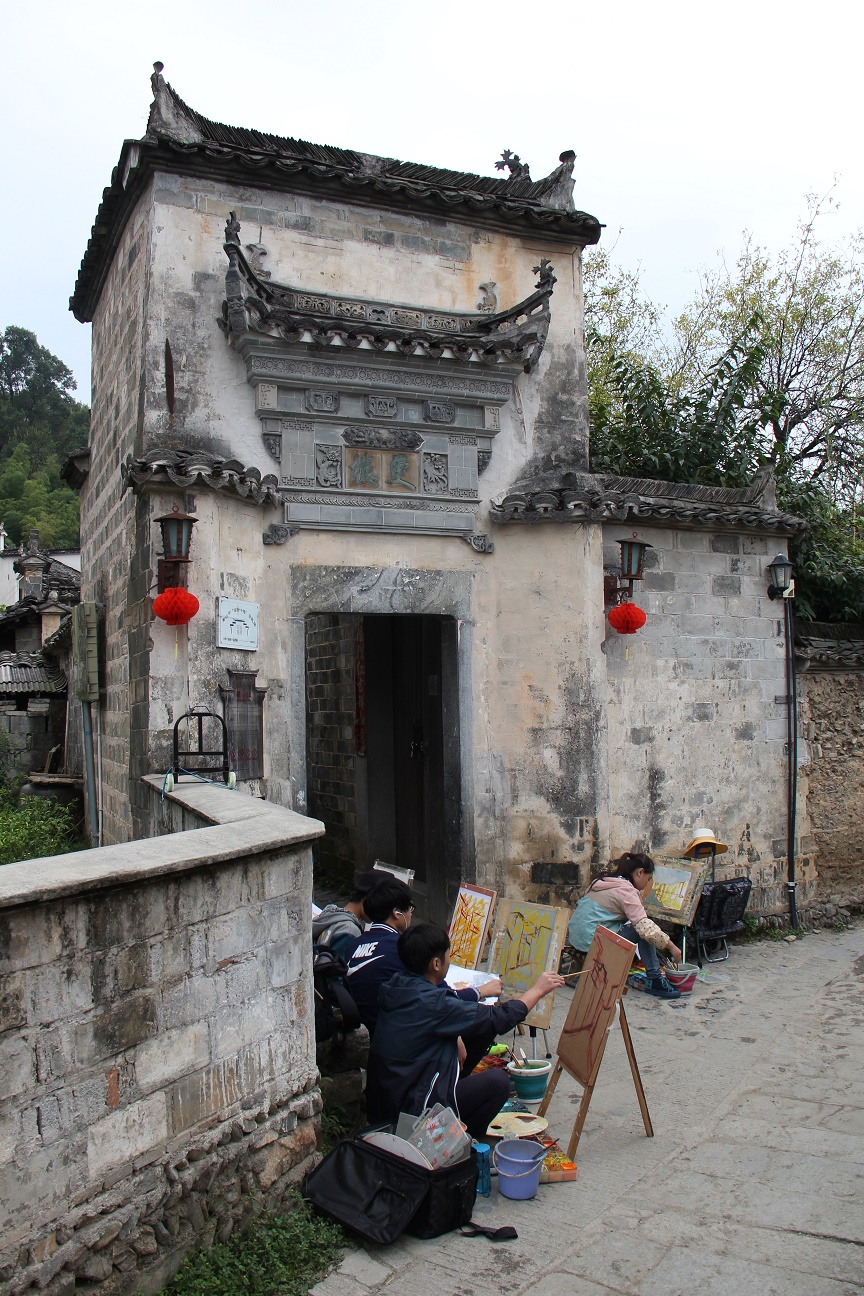
Sometime in those years between 1843 and 1964, Hong Xiuquan lived, preached, and commanded from a small, stone gate tower in a little village in Anhui Province. And I was standing in it.

The Heavenly King made his headquarters in this watchtower, the oldest building in Hongcun.

The Heavenly King made his headquarters in this watchtower, the oldest building in Hongcun.

My moment of wonder, didn’t last long. The village peace was soon shattered by the omnipresent scourge of Chinese tourist sites: Chinese tour groups, each equipped with its own speaker-equipped tour guide.

Through the narrow stone lines their tinny drone hounded me as I skipped from one village tourist site to the next, never quite escaping except in gloom of dusty, lonely alcoves in the back corners of ancestral temples.

Nevertheless, there was always just enough breathing room to admire the never-quite-the-same wood carvings that shaded the window light set in those distinct whitewashed walls.

I spent a few hours marching along with the crowds, snacking on a local style of tofu, and trying my best to imagine what the village would’ve been like in the 1850s as longhaired rebels crowded the lanes, or in the 1940s when a ragged band of communist soldiers including Mao Zedong made Hongcun a hotel during the Long March.

By the time I felt like I’d marveled enough, there was just enough time left to try to make a quick tour of the bamboo sea a few kilometers up the road. The first cab refused to take me, saying that the traffic was too bad. I had a hard time believing it, as my destination was just up the road, and found room in a van instead.

Thirty minutes later, I was on the main road to the bamboo sea. I could still see the village gate through the choking exhaust of unmoving buses. Should’ve listened to the cabbie.

The time started to press one me. The van driver told me not to worry, I could just call him when I was done with the bamboo and he’d take me back to Tunxi. For about 500 yuan. The bus was 18. No thanks. I paid him 25 yuan for the 300 meters we’d moved and jumped out into the traffic jam.

As I walked along the road back to Hongcun, I tried to imagine the army of the Heavenly King tramping through the lush and sweltering hills around me. I tried to put myself behind the eyes of Zeng Guofan – commander of the Hunanese Provincial Army who would in 1864 finally capture Nanjing and bring an end to the war – as he peered into the winter mists from the mountain peaks to the north, unable to see his enemy, sure of his impending destruction, and paralyzed with fear and regret. And I tried to picture the barren and blackened earth that pushed the price of human flesh so high in Anhui in the last days of the Taiping Civil War that only the richest of folk could afford to eat their dead.

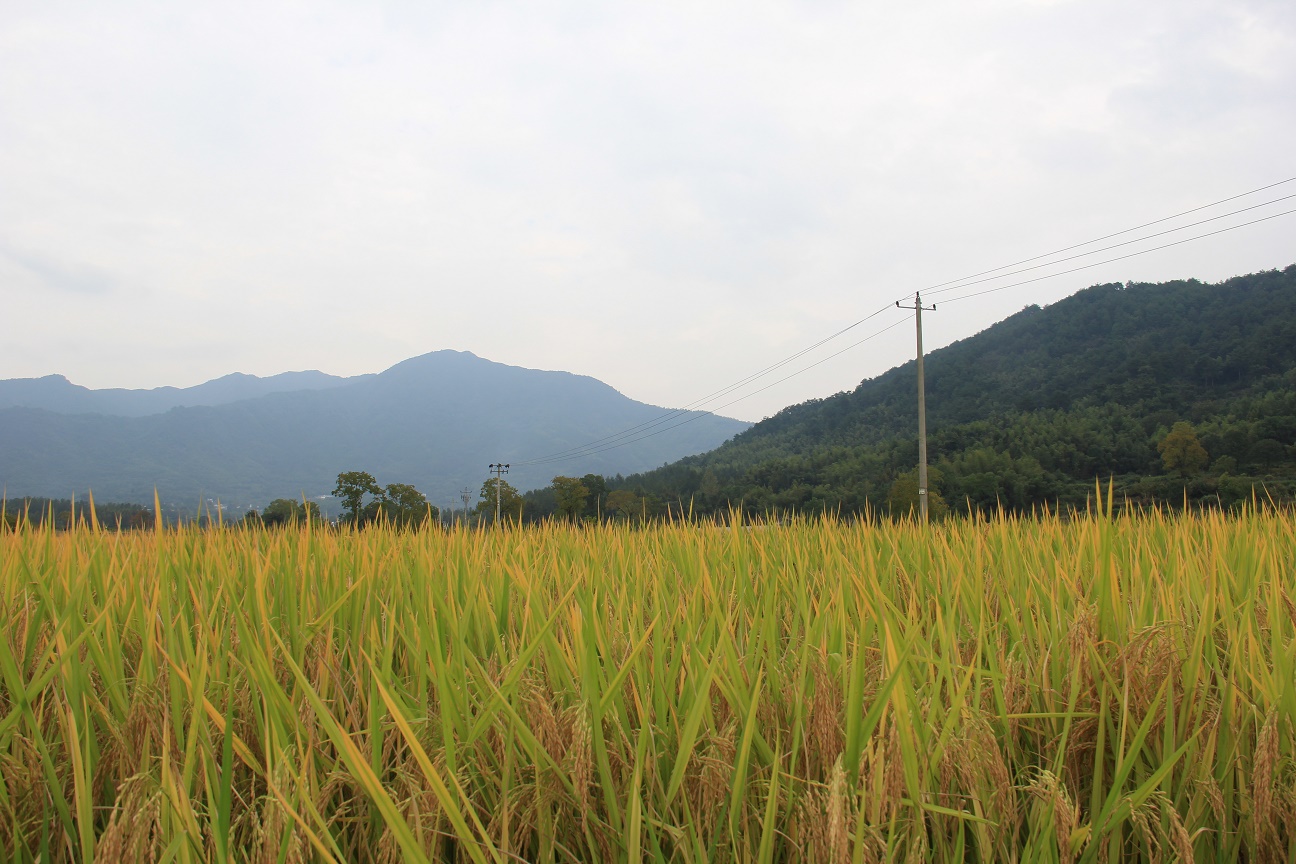
Around me, the yellow grasses swayed, peaceful and alive in the afternoon breeze.

Anhui grass

Anhui grass

Lolling about in Lanzhou

August 6, 2015 – Lanzhou, Gansu Province

In my two years in China I’d never heard anything good about Lanzhou. But after about 25 hours on a train, the last six of which were spent surrounded by a murder of children begging me to teach them English tongue twisters in between singing unique renditions of Happy Birthday, I thought I was ready for anything.

I was not ready to be sold a timeshare.

Matt, Dave, and I had about six hours to kill in Waystation Lanzhou before it was time to get back in the bunks, and we had only one goal: Eat Lanzhou beef noodles. Aside from the yellow Yellow River, Lanzhou Beef Noodles are Lanzhou’s claim to fame.

Well, that and find Dave some allergy pills for the cold that he refused to admit he had.

(“It’s not a cold, man! My nose is just stuffed up and I have a sore throat. I know what a cold feels like.”)

We found both, first the noodles in a joint that insisted we take pictures in front of their sign – I can only guess that we’re now prominently displayed next to the counter – and the second, after sorting through the chaff of pharmacies trying to sell us traditional Chinese remedies for “allergies”.

And then we found a Starbucks. While we waited for Dave to return from the dark-wooded, dark-roasted interior, five or six white-shirted young people surrounded me and Matt. I knew something was wrong. When Matt accepted a cigarette from one of the young men, I knew we were doomed.

“Hey, man. Can you do us a big favor? … It’d be a real big help … Just five minutes … You don’t need to do anything. Just come with us,” they crooned.

I said no. I thought about the cigarette. I said yes. I told my friends we were going upstairs. They looked confused, then worried.

“Don’t worry,” I said. “It’s doing them a big favor, a real help. It’ll just be five minutes. We don’t need to do anything. We’ll just go with them.”

They glanced at each other.

“They’ll tell us how to get to the Yellow River,” I said.

They shrugged and gave me a pair of looks that said: “This better not take long.”

Our crowd of chaperons herded us into a big, salesy room with tables scattered here and there. The middle was dominated by a giant model of what I can guess was somewhere in downtown Lanzhou. I sat at an adjacent table, accepted a cup of hot water, and waited for the pitch. It wasn’t long in coming. Something about beautiful apartments, lovely views, good locations, and bargain prices. I listened for three or four minutes, then broke the news: “Sorry, I live in Beijing.”

The salesman looked crestfallen.

“Well, what about Xian? It’s a nice place.”

But he knew the gig was up. I gave my chaperon crowd a knowing smile and asked them where the Yellow River was and we left. They smiled and thanked us. Then told us the wrong directions.

By the time we found it, we’d been lost in Lanzhou’s back alleys and bumbled around a lovely, muck-filled lake park and the sun started to dip behind the dirty hills that surround the city, reflecting orange light of the barge-plied, slit-filled waters. We stood on the apex of the one of the bridge’s spanning the waters that gave birth to Chinese civilization some five millennia ago, watched the sun go down, and agreed that Lanzhou wasn’t so bad after all.

Then it was back to the train station. On the walk, we ran into a distraught Korean woman who told us the hotel she had booked seemed to no longer exist and she didn’t know what to do. We helped her lug her five bags up to the next intersection and check into a different hotel. We asked where she was going:

From Korea, through China, across Central Asia and ending in Iran some three months later.

With all those bags. And we thought we were in for a long trip.