Beer in a bag

The first thing to know about Qingdao is that they serve beer in a bag. Like the kind of bag inside which you’d take a fish home from a pet store.

Nearly every corner store, market, and restaurant – even some hotels, it looked like – has lurking in its doorway a keg or two or three of Qingdao’s most famous export: Tsingdao Beer. Because foremost, Qingdao is a beer city. A German beer city. In China. And they serve beer in a bag.

Stop your car! Buy some beer in a bag!

Stop your car! Buy some beer in a bag!

Nestled on the Shandong Province coastline, Qingdao today is a city of about three million people and small for The Middle Kingdom.  It always has been. For centuries it existed as a fishing village and strategic port, exporting salt instead of beer. The beer came in 1903, just six years after Kaiser Wilhelm II set his mind to turning Qingdao into a little Germany in Asia, wresting control of its strategic seaward batteries in 1897 and signing a 99-year lease on the territory. With the Tsingdao Brewery came electric lights, the railroad, and many of the Bavarian-style buildings whose red-tiled roofs still line the gently rolling hills looking out over the bay and make the city a sharp break from China normal.

Despite the castle-like mansion the German governor built in those then-empty hills, the German dream didn’t last. Qingdao was the site of the only World War One battle fought in Asia, a standoff between the cutoff German garrison under orders to hold out as long as it could and a sleek new fleet of Japanese warships eager to prove their mettle. A months-long joint British-Japanese naval bombardment brought the city under Japanese control in 1914. The Rising Sun was rewarded with a strengthened grip over Northern China at the Treaty of Versaille in 1919, sparking the May 4th Movement, a massive student protest movement which would spread across China, which is where a young Mao Zedong would cut his teeth, and which is credited today as the seeds of the later-day communist faction. Although the city was returned to the Chinese in 1922, the Japanese would retake it in the Sino-Japanese theater of World War Two and hold it until their surrender.

The brewery, however, didn’t go away, first being absorbed by the Japanese brewers of Asahi and Kirin, then reverting to Chinese control later in the century. Today it’s modern, still holds with German brewing purity law and known all over the world, its label emblazoned with the Huilan Pavilion that sits in the waters of Qingdao’s harbor off the shore of its old town and the edge of an always-packed pier.

Despite the crowding, the pier is one of Qingdao’s many pleasant walks, especially on a clear day as the sun sets when a stroller can watch the lights pop onto the German architecture lining the Oceanside street while the megasized container ships ply the waters heading out of the container port down the coast. And Qingdao is full of pleasant walks:

Walks past the endless little seafood restaurants serving up fresh seafood picked – by you – from tanks in front of the restaurant. When you pick a fish or octopus, the staff will beat it to death on the ground in front of you. We tried the clams at three different restaurants. Dabbed in garlic infused oil and topped with hot peppers, they were all delicious … for clams.
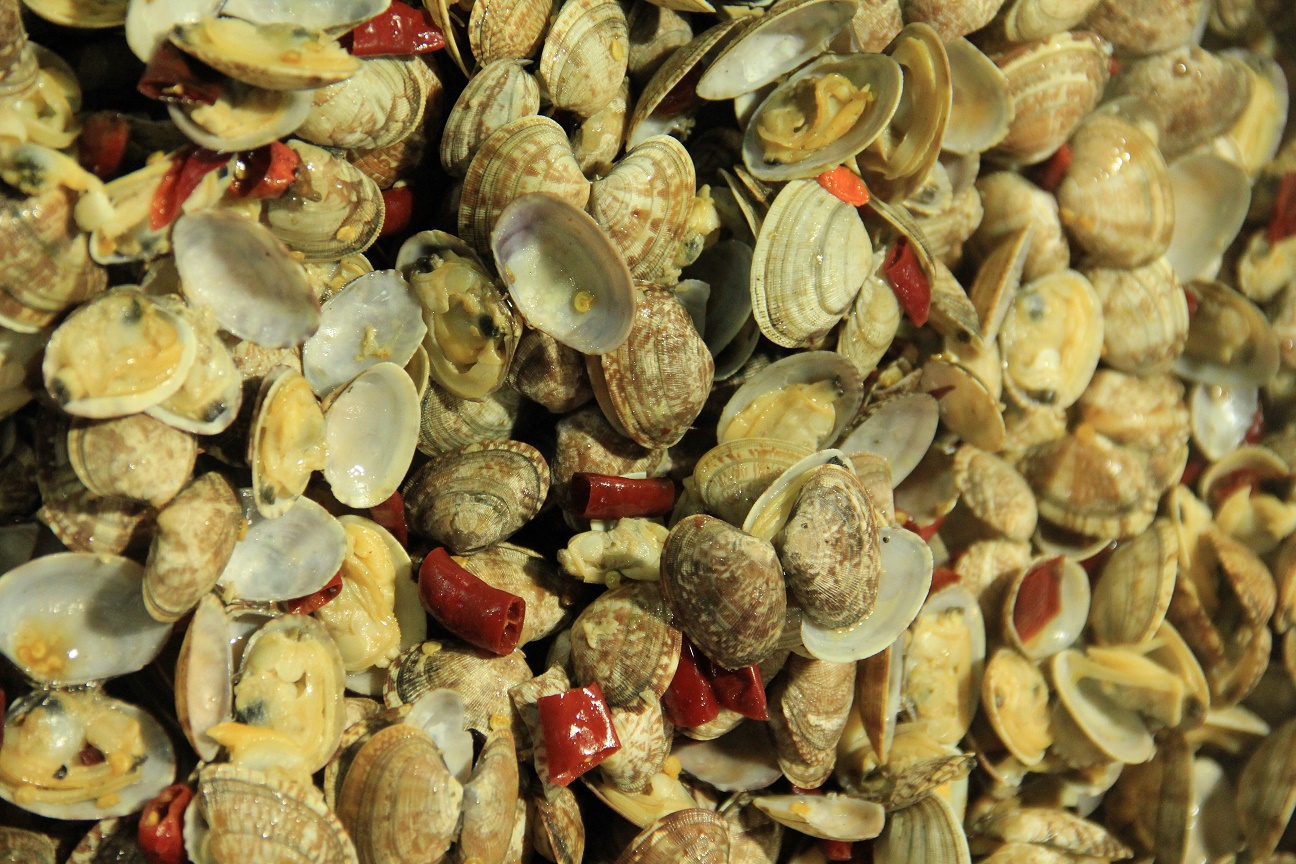
Clams. I don't they they beat these to death before the cook them. But they do add peppers.

Clams. I don’t they they beat these to death before the cook them. But they do add peppers.

Walks through the leafy avenues of European-style houses now filled with coffee shops and restaurants and residences.
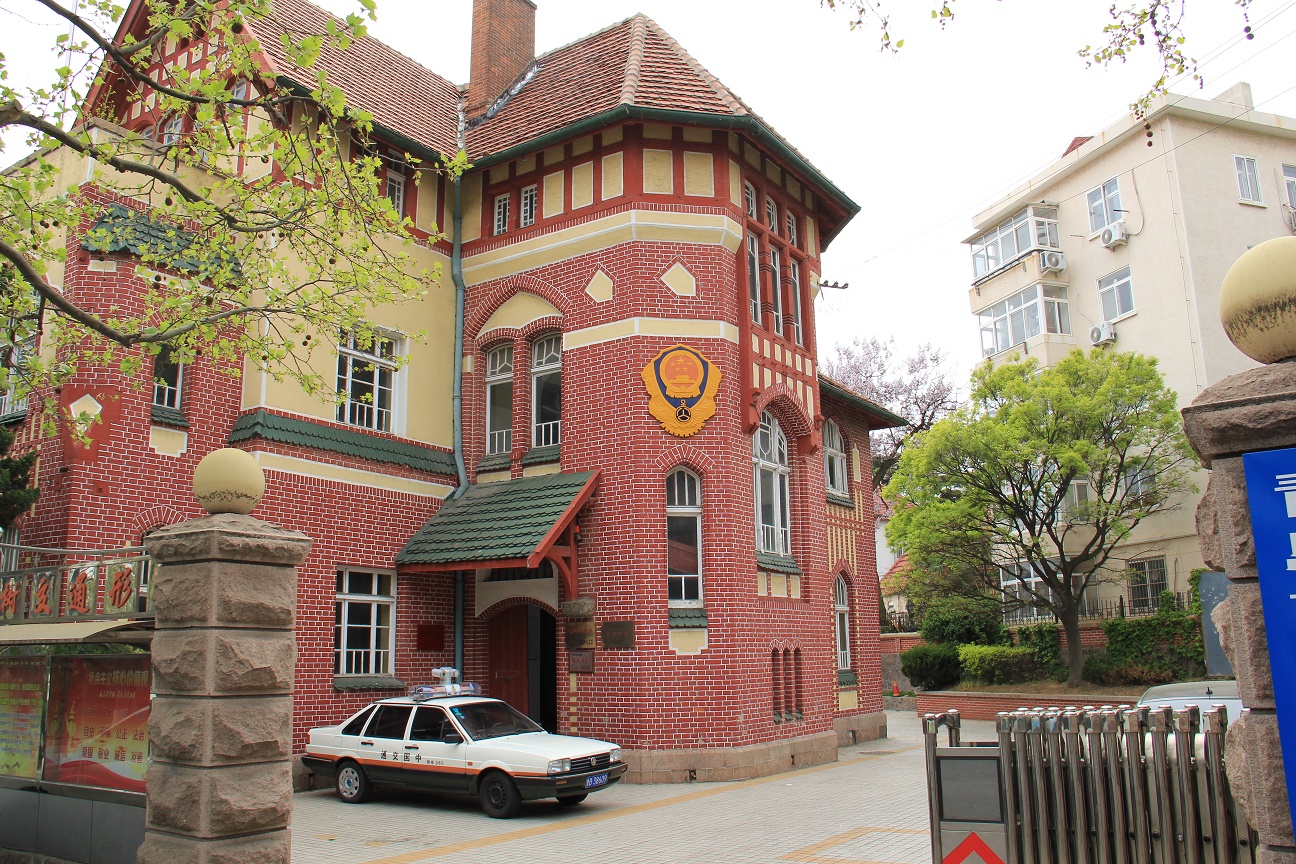
A Chinese police station.

A Chinese police station.

Walks under the turrets of St. Michael’s catholic cathedral – the capping crosses of which were buried during the Cultural Revolution by locals in the nearby hills to keep them safe and found by accident during construction work in the early aughts – and the old protestant church stocked to the gills with Chinese bibles and song books for the Chinese hordes, locals and tourists alike, to flip through.

For those who prefer to play 007 missionary and milk their congregations for greenbacks, though, I’m sure there are some house churches to skulk around, too. It’s all very hush-hush, I hear.

Walks along the boardwalk under central business district’s glass and steel towers and past May 4th Square and the now-dark torch overlooking the waters which hosted the 2008 Olympics’ sailing event.

Qingdao's CBD and the May 4th Square overlook the Olympic sailing venue.

Qingdao’s CBD and the May 4th Square overlook the Olympic sailing venue.

Walks through aristocratic halls of the governor’s mansion which hosted military men Germanic and Japanese alike and their families.
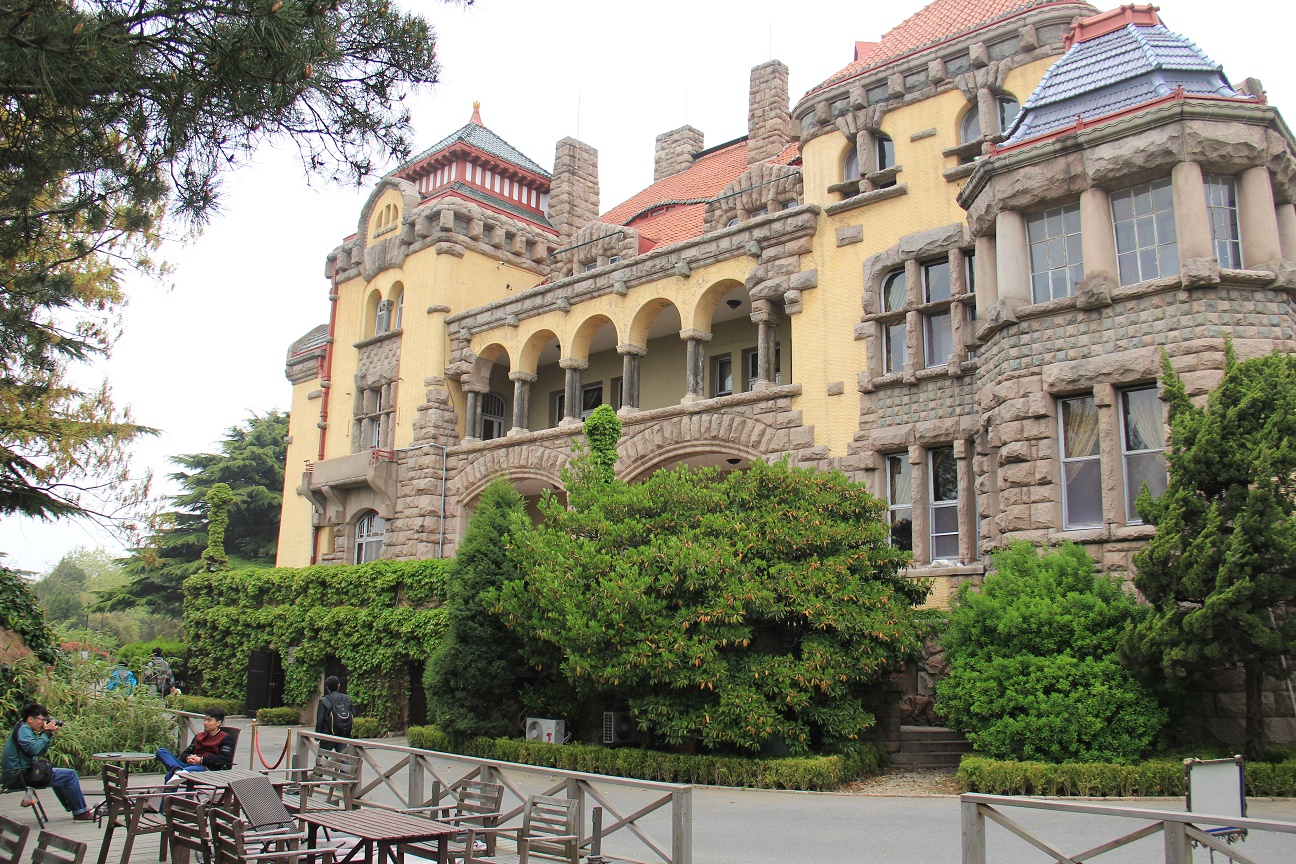
The first governor was sacked for the exorbitant cost of his palace, which overlooks the bay from a hilltop.

The first governor was sacked for the exorbitant cost of his palace, which overlooks the bay from a hilltop.

Walks across the decks of retired Chinese destroyers and past the rusting parts of jets, anti-aircraft guns, missiles, and mines at the naval museum. All of the exhibits on China’s naval development were in Chinese. A shame. I’d have loved to learn the “facts”.

Walks through lines of old brewing equipment explaining the history of Qingdao’s most famous export, and past the endless kegs of that export. The original 1903 buildings are still standing and house a museum of the brewery’s fascinating history. Outside is Qingdao’s “Beer Street”, a collection of all-the-same seafood restaurants offering the standard fare plus on tap the unfiltered and stout versions of Tsingdao beer, which are difficult to find anywhere else in the world

Walks under the late-night blaze of neon lights in the back alleys of Qingdao’s food street where those so inclined can buy fried crabs on a stick; ice cream crepe; scorpions; shrimp dumplings; all variety of fish, clams, and prawns; fire-seared squid; and of course, beer bags with a straw.

Beer bags are a good way to reduce your inhibitions for practicing your Chinese. They are also a good way to reduce your inhibitions for prodding live scorpions with your pointer finger.

Walks over boulder-strewn slopes of Laoshan Mountain, on the south side of Qingdao. It took a sickening cab drive to get there, but the mountain park is a sprawling and enchanting collection of naked stone, seaward views, and millennia-old Taoist temples. China’s first Emperor, Qin Shihuang, even ascended the slopes seeking immortality and in the fifth century, the pilgrim Faxian landed on its shores in a return from India bearing the first Buddhist scriptures to enter China. All along the routes winding through the rocks are teahouses and snack shops where you can stop and take in the slopes and the sea over a cup of green tea. Chinese ingenuity shows up here, too, as the shopkeepers have all diverted the river with little plastic pipes and created mini waterfalls cascading gently downward from one bowl of fruits or drinks to the next keeping everything cold by letting gravity do the lifting.

Walks through the bright blue-tiled gate to one of China’s first Taoist temples, Taisqing Palace, sheltered hulking, leafy Ginko trees and by the rocky slopes of the rolling mountains above. For atmosphere, as well as beauty, this temple ranked among my favorite. It seems the temple is also in the process of constructing and monumentally sized monument – Lao Tze himself – to glower out at the crusty, wooden fishing boats bobbing in the sea, circling their nets around the catch under the afternoon sun.

Walks under the white walls of the lighthouse that sits on Little Qingdao island. The lighthouse was destroyed during the Japanese bombardment in WW1 but was rebuilt to look out over Qingdao’s old town and keep ships clear of its shores.
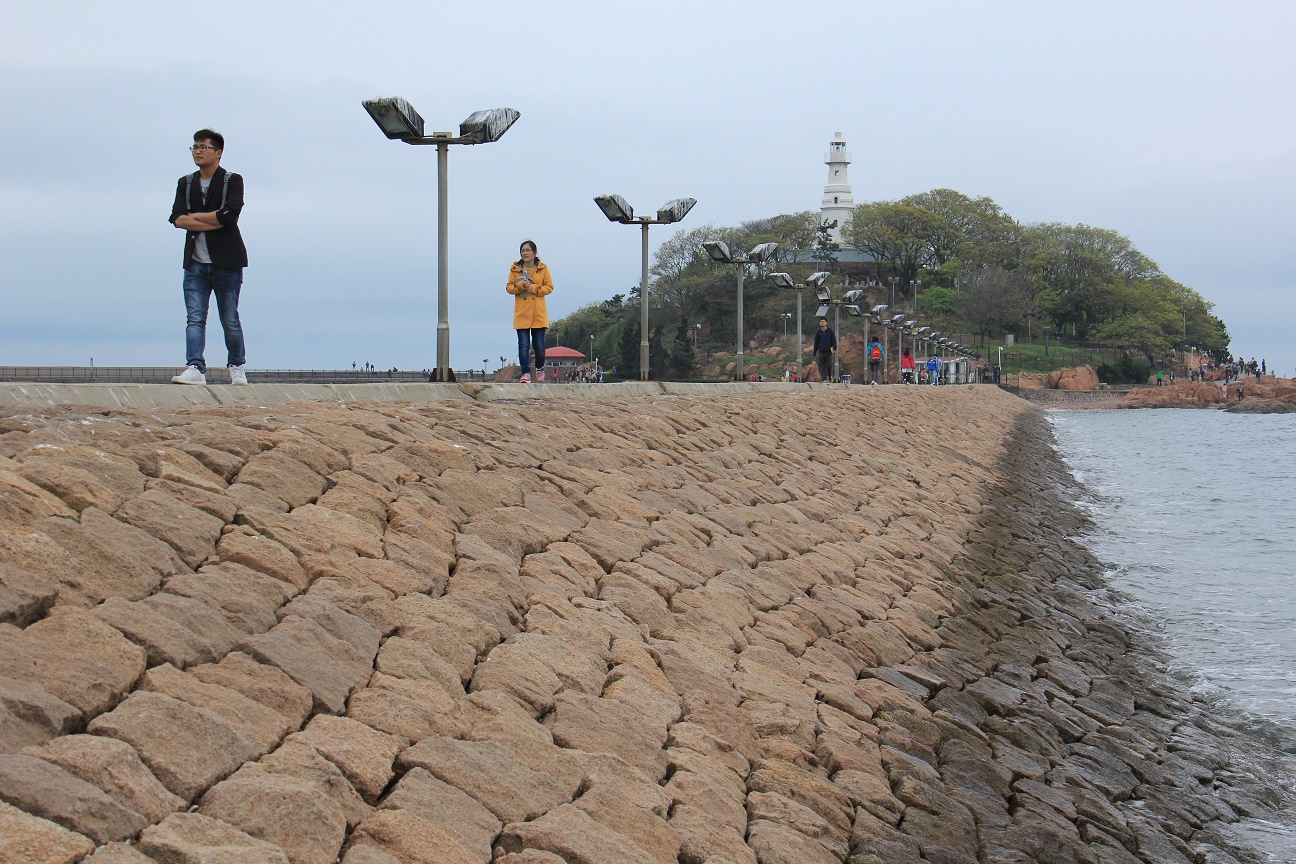
The Little Qingdao lighthouse watches over the harbor and the seawall protects it.

The Little Qingdao lighthouse watches over the harbor and the seawall protects it.

Walks through the Qingdao Eastern Bear Park, where you can see hundreds of Asiatic Black Bears laying atop of one another. They can be fed with peanuts, while they hop up and down begging for a treat. Then you can watch grim-faced trainers lead bears around by a chain leash and tap them with sticks until the ride bicycles, walk on balls, walk a tightrope, juggle fire, and more. This place was utterly weird and utterly depressing, even if the view of the aquamarine ocean was lovely and even if we did get a VIP tour from one of the grizzled trainers who told us all about the different bears and asked us about America. When I asked him why two of the bears were fighting he shrugged and said “I don’t know. They just hate.”

Walks along the yellow sand of Old Stone Man beach, past the touts begging you to go on a boat ride on their speedboat moored just strides of the swimming beach. With the sea on one side and the mountains on the other and Qingdao’s modern skyline splitting the difference, this beach really was pretty nice.
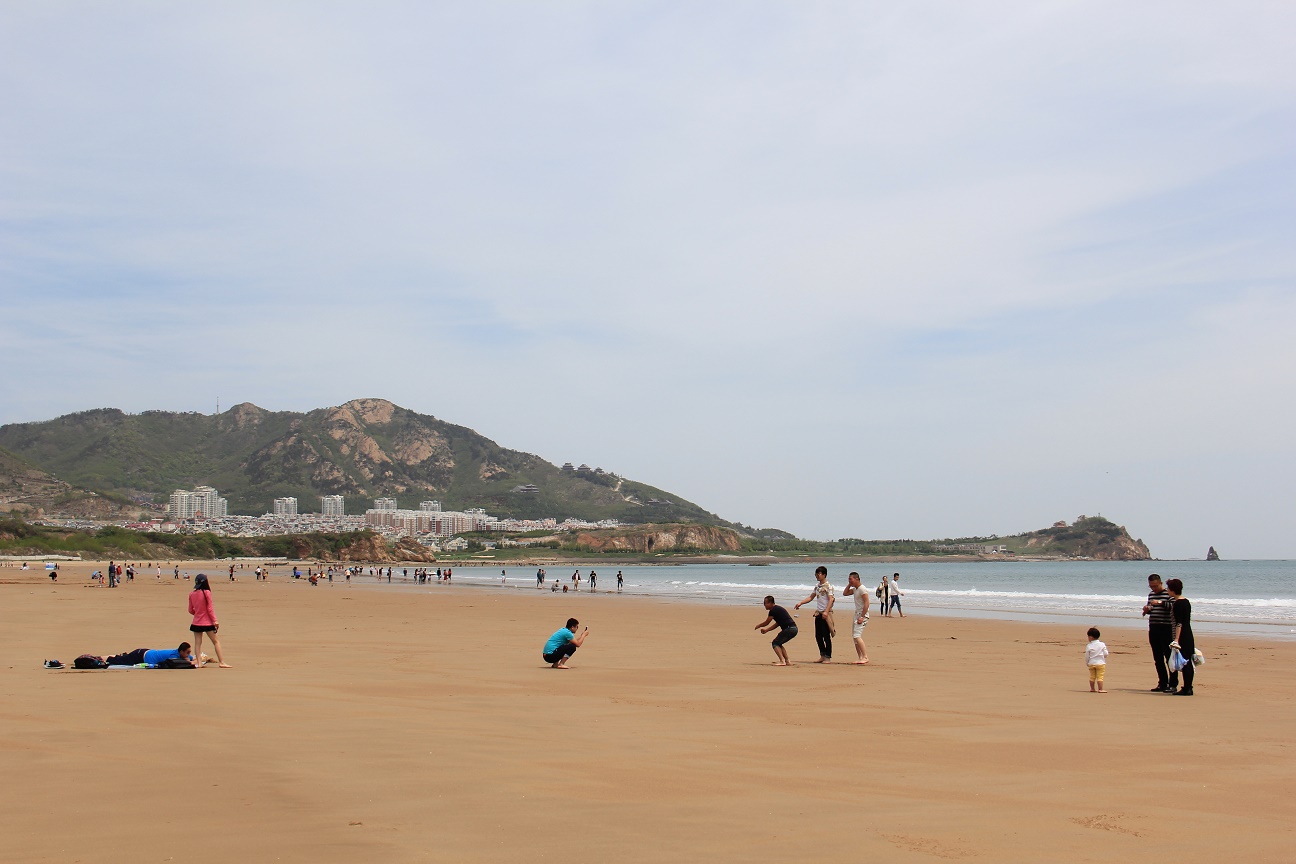
Old Stone Man beach.

Old Stone Man beach.

In three days, we did a lot of walking, but that’s pretty standard for us. And if it’s not clear, I came away impressed with Qingdao. It’s skies are clear, it’s old buildings gorgeous, and it’s modern streets clean. It’s got stunning mountains on one side, stunning ocean on the other.

Plus they serve beer in a bag.

Too many clams, too many clocks

It was near 2 a.m. when I stepped out of the cab 120 yuan poorer on a dark street in downtown Qingdao. I’d spent the day running around Beijing on work-related errands, and now, finally, all I had left to do was find my hostel and I could get some rest before my Labor Day holiday started.

The street was unlit except for one giant business hotel. Not it. I walked past a doorway cluttered with old bicycles, wagon wheels, lanterns, and who knows what else. Inside, light by a half dozen tiny lights sat a graying Chinese man so hemmed in by clocks, tools, clothes, and other antiques, he could hardly move.

Can’t be, I thought.

The internet listing said the place had multiple levels and even a swimming pool. I walked up and down the street. Nothing else was open.

Guess so, I thought.

I clamored over a mini folding bicycle while trying to keep it from rolling off the step to reach the door and knocked on the glass. His eyes lit up, and he scrambled for the door, banging into various rusted knickknacks.

“I’ve been waiting for you!,” he said, his wispy, grey beard swaying. “She (Jordyn) told me you’d be here about 1:15. It’s so late!”

I apologized and told him I didn’t know the airport was so far, then I waited for him to show me to my room. I started to wonder how there could even be “rooms”; the “reception” area looked an awful lot like the tiny living room of a junk hoarder. And there were ticking clocks everywhere. At least a dozen in the living room.

“Sit, sit,” he said motioning to a stool at his old-style wooden table, it too covered in trinkets and lamps and half-eaten clams. Then he handed me a plastic bag of beer.

“Yours. Drink,” he said. “You drink beer. I’ll drink baijiu,” he said motioning to a half empty bottle of Chinese infamous sorghum-based spirit. He poured himself a cup and motioned for me to do the same with my beer. I looked at him confused. He shuffled over and showed me how to pour it out of the bag without spilling.

“In Qingdao, we get beer in a bag,” he said, then added in English and with a cackle: “Very cheap, very fresh!”

As I started to pour he whipped out a camera – antique of course – and asked me to pose, mid-pour, for a picture. It was the first of perhaps three dozen pictures he would take over the next hour with at least three different cameras. He adjusted his lamps for light for almost each one of them.

Jordyn had warned me about this hours before, so I was somewhat prepared. What I wasn’t prepared for was the extend of his obsession. In between snapping picture of me pouring beer and drinking beer, we toasted to one another and his pointed to a TV screen behind his head.

Behind me were two TVs: One old, one – surprisingly – not. The old TV was playing a soundless nature documentary about giant river fish. The new TV was playing a loop of what must have been thousands of pictures of my host with various Chinese and foreign guests. Thousands. And as the loop progressed, so did the clutter of the living room. I looked around and saw that some of his pictures, many of them of him and a black cat, were blown up and pasted to the walls.

Meanwhile my host talked up the great cheap seafood and “Fresh!”  beer available just out back. He talked about his many foreign friends. About Qingdao and its special dishes. He had me try some kind of green. It was bitter and salty, but delicious. Then he told me about that for a while. It’s good with baijiu, he said. And baijiu, of course, is “good for your health!” (in English).

Soon I was out of beer. He refilled my cup, to the top, with baijiu. His bottle was almost gone. Chinese manners were about to get me in trouble.

“And you know what’s good with baijiu? Clams!” More trouble. He leapt up. “Wait 5 minutes,” he said, and swayed into a back room. He returned with a plate of hot clams, spilling some clam sauce on my legs.

Even if I weren’t a mostlyvegetarian, I don’t particularly like clams. He picked one up and with much ado, slurped – and I mean slurrrppped – it down.

“Ahhhh.”

The black cat I’d seen in the pictures sprinted into the room.

“Ah, xiaobai!” he said.

I was confused. The name meant “small white”. The cat was black. When he saw the confusion writ on my face, he broke out with another cackle.

Xiaobai! It’s a great name,” he nearly shrieked, then in English. “Cat black, name white. Then muttered and chuckled again, “Xiaobai” before returning his attention to the clams and mine with it.

I decided to bite the clam, so to speak. I picked one up and swirled it in the sauce that remained in the dish rather than on my legs. I slurped it down.

“Not bad,” I said, then in English. “Very fresh!”

He laughed and motioned for me to take another one. Great, I thought, I’m in it now.

I picked up another one. As I lifted it up, xiaobai put its paws up on my legs and gently extended its claws. The closer the clam got to my mouth, the more it dugs its claws into my flesh.

My host looked at me expectantly. I gingerly tugged the clam meat with my teeth. The cat yanked my leg meat with all its might. The cat yowled. My host shooed it away. It went nowhere.

My host handed me another and looked at me expectantly. I tugged the clam. The cat shredded my leg. The cat yowled. My host shooed it away. It went nowhere.

And so we went until my glass of baijiu was empty, more than an hour had passed, and I was thoroughly sloshed. I was having a great time.

My host was interesting if bizarre. His home was interesting if bizarre. It was going to be an interesting, if bizarre, weekend.

Then, things got bad.

My host showed me to our room, taking a detour to the bathrooms, which were so small and low I couldn’t fit without crouching like a troll. He called the room “The Captain’s Room”, Jordyn said, and it usually cost more but since he had no other guests, he let us have it for the night.

The Captain's Room

The Captain’s Room

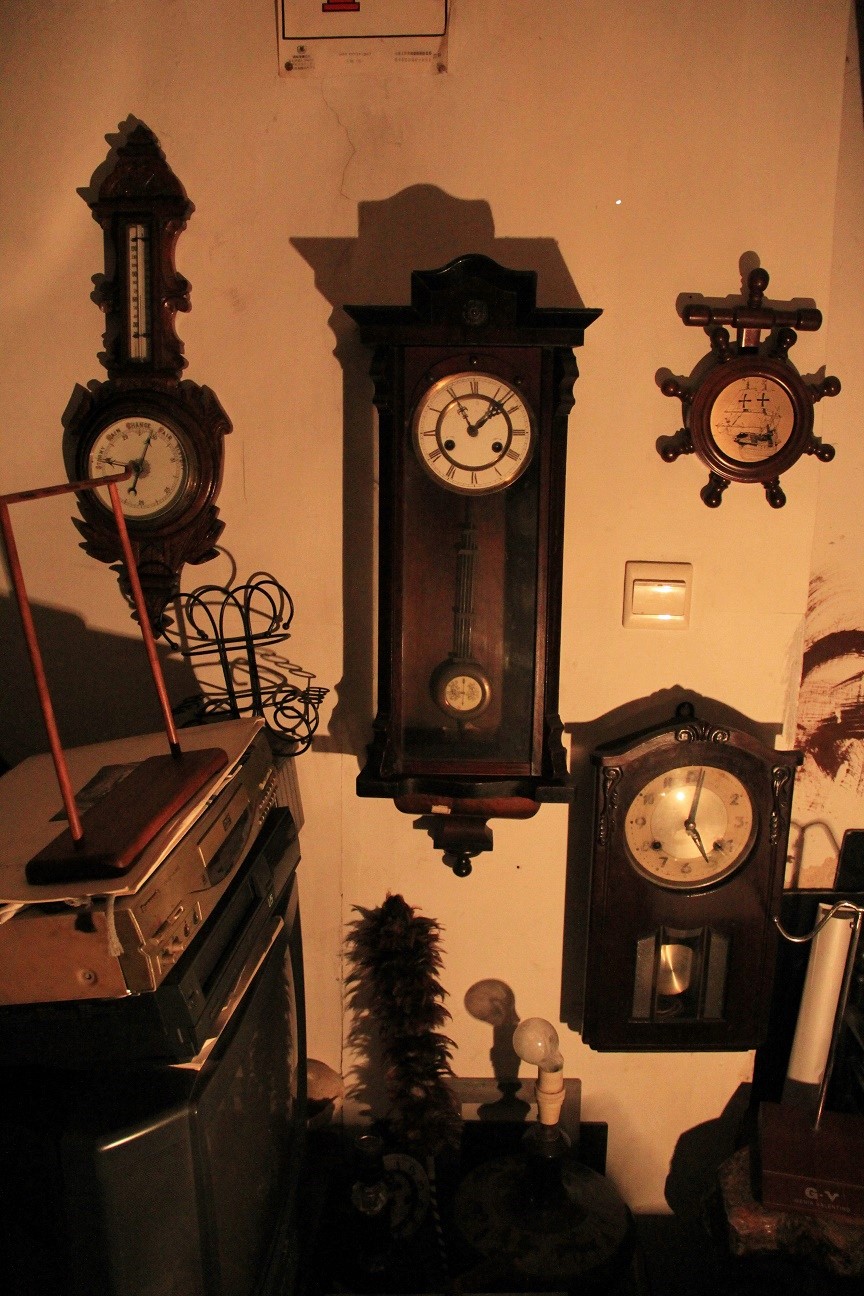
The first thing I noticed when I entered were the clocks. There were nearly two dozen of them, wall clocks and grandfather clocks alike. Half of them weren’t working, it seemed, but the other half were doing what clocks do: Tick, tock, tick, tock, tick, tock, tick, tock. None of them in sync.

Tick tock.

Tick tock.

In the following moments, my horror grew as each crowed at different intervals its own, unique cry. Some chimed every 15 minutes, and some rang. Some tinkled every 30, and some shrieked. And none of that in sync either.

I crawled into bed, knowing it was going to be a long night. Within moments, my eyes started to itch. Then my nose started to run. Soon my whole neck felt like I’d shaved with poison ivy.

I spent the next six hours starting at every clock squawk, scratching at my face and rubbing my eyes and wishing I’d had about three cups more baijiu.

When morning came at last, we packed up our stuff. If it were just the clocks, we might have been able to figure something out. But the allergies — and I don’t usually have them — were too much. Wanting to leave our hosts face intact, we decided not to tell him the truth. Instead we told him we had to change our plans and go up north and just couldn’t stay.

He looked incredulous. “You booked four nights. You only stayed one.”

“Zen me ban? – what can I do?”

He made us pay for an extra night. Zen me ban, indeed.

Every time we walked by his little hostel over the next three days, I peeked in the front door. And every time day or night, there he was, sitting in his living room, watching the pictures on the TV go by.

4:15 a.m. and a stranger’s in my room

It was about 4:15 on Saturday morning when I heard the door latch click. Through the webs of half sleep, I saw a shadow twist from the door, then lumber silent through the gloom. Slowly I raised myself from the pillow and pressed myself against the headboard.

I tried to shake myself awake without moving. Moments before I’d been dreaming that the clothes rack standing in the corner had been a bird-beaked man looming over my sleeping form like a vulture waiting for my breath to cease. As my mind slipped back to reality, the vulture man faded. The lumpy shadow didn’t. And it kept moving toward me from the door.

Despite its reeling gait, I watched it move toward the foot of the bed, managing somehow to dodge the shoes strew about the floor. It moved past the foot of the bed, then paused at the clothes rack to bury its face in my drying underwear. By that point, I could tell it was some kind of woman. After breathing deep of my underwear, it moved to the curtain and began persistently pawing the flowing fabric.

I was out of options. I flicked on the light. A heavyset, red-faced, 30-something woman turned to gaze upon my half-naked form.

“Uhhhh,” I said.

“Uhhhh,” she said.

“This is my room. Who are you?”

She looked baffled.

“What are you looking for? Do you know where you are? Where are you supposed to be?” I asked.

“I need to use the bathroom,” she slurred.

I put on a shirt and told her I had one of those. I led her out of my room to the kitty-corner bathroom. She closed the door, and I looked around. My roommate’s door was gaping open but he was wrapped up tight in his bed, asleep. The front door was cracked ajar, too. I sat down on the couch and started to piece together what must be going on.

My apartment complex is full of foreigners. Europeans, Koreans, Americans, most of them college students studying abroad. Friday and Saturday nights, then, can be pretty raucous. I put it together:

Somewhere on the floors above me, the foreigners threw one of their weekend ragers. The woman currently in my bathroom probably lived in my building, or at least had a friend here that she was staying with. She’d wandered smashed down the half-lit stairwells or hit a wrong button on the elevator or taken a wrong turn into the corridors. She’d found my unmarked and unlocked door and stumbled in, thinking she was “home” only to end up in a stranger’s house and a stranger’s bedroom. All I had to do then, was figure out where she was supposed to be and get her home. Then I could get back to sleep for a few more hours before work.

She came out of the bathroom.

“Do you know where you’re supposed to be?” I asked.

“Yeahhhhh,” she said.

“Where?”

“We’re all cool, man. I’m cool. Are you cool? You’re cool.”

“Yeah, I’m cool. But where are you supposed to be? I don’t know you.”

“I don’t know youuu.”

“But this is my house! You are in my house! And I don’t know who you are!”

“I don’t know who you are,” she said.

“Where are you supposed to be? Do you know what apartment you should be at?”

We weren’t getting anywhere. It was s clear she doesn’t know where she was or hardly even who she was. I couldn’t even get a name out of her. I asked her repeatedly who she knows. If she knows anyone who lived at my apartment.

All she said is, “I don’t know you.”

Briefly I wondered how she managed to navigate my entire room in the pitch dark with the dexterity of a monitor lizard if not the speed. Then she laid down on my couch.

“I’ll just sleep here,” she said. “We’re all cool. I’m cool. You’re cool. Are you cool?”

“You can’t sleep here!” I was starting to grab my hair. “I don’t know you!”

For a moment, I considered letting her sleep on my couch. Then the scenarios started to run through my head:

  • I wake up; a bunch of stuff is gone; my roommates find out I let a stranger sleep on our couch
  • I wake up; a stranger wandered into my roommates room; something bad happens; my roommates find out I let a stranger sleep on our couch
  • I wake up at 7:30 to go to work; she’s so drunk she refuses to leave; I can’t get her to leave without calling the cops; my roommates find out I let a stranger sleep on our couch and the only way to get her to leave is to cause us all a lot bigger problems; we miss work
  • I wake up at 7:30 to go to work; I can’t wake her up; my roommates find out I let a stranger sleep on our couch; a stranger died on our couch
  • And so on

“You can’t sleep here!” I shrieked again.

“You want me to leave,” she said, arms stretched out straight above her head, a look of contentment on her face.

“Yes. I want you to go home.”

She got and looked at her feet. No shoes. More evidence she’d wandered into the wrong apartment. (I had a friend who was arrested twice for doing this). We hunted around for a couple of minutes. They were nowhere to be found. I tried to give her my shower shoes and told her I’ll walk her to her apartment.

“Nahhhh,” she said, making wheel-turning motions with her hands. “I’ll just drive myself home.”

“You don’t have any shoes.”

She looked at her tattooed feet, then back at me, startled.

“Oh.”

“Look, you can sleep on my couch for a couple of hours,” I finally relent. “Just sleep there, it’s no problem.”

“No. I’m going home.”

“Do you live in this building? This is apartment 404. Really, just sleep on the couch for a while.”

“Yeah, I’ll just walk home.

She walked out the door. I sat on the couch for a moment. A half hour had passed. Work was coming fast. But I felt like I was doing the wrong thing. I got up and put on some shoes. I couldn’t just let this too-drunk-to-see woman stumble around alone all night. I had to help her get somewhere.

By the time I got to the elevators, she was gone. One of lifts was in the basement. One of them was one floor up. One of them was in transit down. I ran up a floor and scurried around to the different crannies. Nothing.

I ran down to the ground floor. Nothing. Through a window I got a glimpse of a lumbering shadow. I ran outside. Nothing. Gone. Around the buildings. Nothing. Nothing, nothing, nothing.

I went back to my apartment thinking maybe she’d returned there. Nothing. I didn’t know what else to do, so I crawled back into bed. After another hour lying awake worrying, I drifted off.

I woke up feeling pretty good, if also pretty tired. I packed to leave for work, and when I opened my door my roommate was also walking out the door.

“Hey man, you didn’t have a heavy-set woman sleeping in your room last night, did you,” I said half-joking and ready to tell him of my ordeal.

He blanches. “Yeah, where is she?”

Uh oh.

Turned out she’s a friend. The night before, the two of them had been playing pool at a bar down the street. She’d gotten too drunk, and he’d agreed she could just sleep in his room since her house was a few kilometers away. Last he remembered, she’d asked him where the bathroom was. It all clicked together.

When he’d woke up, she was gone, of course. He’d run all over the apartment complex looking for her. Nothing.

“And the thing is, all of her stuff is in my room. All of it. Her phone, her keys, her wallet, her shoes.”

He took a breath.

Her shoes!”

—-
—-
—-

*Postscript:* She was eventually found barefoot but unharmed at a friend’s house about a kilometer and a half from our complex. All’s well that ends well, they say. She doesn’t remember much.