June 8 — Guangzhou
First, I was to test the bed.
“Slower. Slower! Lightly, lightly, lightly!” the old man, shirtless in the sweltering bunk room, yelled as I hauled myself up a loose ladder onto the top bunk.
“Now, lay down. Carefully,” he said. “Carefully!”
I leaned back as slowly and carefully as I could until my head touched the plywood and waited as the old man examined the underside of the bed. He grunted.
“I think it’s fine,” I said.
“How much do you weigh?” he asked.
“Let me think. I know it in American,” I said, unhelpfully.
His eyes narrowed.
“You weigh the same no matter where you are,” he said. “What are you talking about.”
I didn’t bother replying while I did the conversion on my phone. “About 71 kilograms,” I said.
The old man sucked on his teeth. Reaching behind him he produced a bent aluminum bar.
“This is what happens when you’re too heavy. Or not careful,” he said, eyeing me. “Just move lightly and it’ll probably be okay.”
By now, I must have looked doubtful because one of my new roommates spoke up to tell the old man that the bottom bunk across the way in this ten-person room had been vacated earlier that day.
“Ah, perfect!” The old man said. He transferred my mattress from top bunk to the bottom.
I sat down and looked around. Across the way a heavyset man with a whispy beard stared at his hand. He would continue this way for the next ten or 15 minutes as I quietly unpacked my bag. Above me a shirtless twenty-something watched a Chinese drama at full volume on his phone. Across the room a stick-thin man with silvered hair and a clothed only in a tiny pair of underwear wrote number after number on a practice pad for Chinese characters. When he got up moments later to go to the shared bathroom in the hallway, he put on his uniform–a blue collared shirt, black slacks, and shiny black shoes. When he returned, he took it all back off and went back to writing.
Before long, the bigger bearded man stood up and turned to stare at the wall.
I walked out onto the balcony, where several persons worth of laundry hung on various lines. A half dozen trunks lay stacked in a corner. One planter was full of cigarette butts and a banana peel. On all the railings had been scrawled, in rough handwriting and permanent marker: “Dangerous!”
I went back inside. In the middle of the five rickety bunks was a card table, on which was strewn a variety of shower products and half drank bottles of tea and soda. Sandals of various colors and wear, some matched, lay strewn about the room. Mosquitoes bounced off the ceiling.
It dawned on me that at two dollars a night, I’d booked myself into a migrant laborer bunk room — fitting, in a way. That realization was confirmed moments later when a beaming face slunk through the door.
“Hello,” the face ventured.
“Hello,” I replied.
“I saw you earlier,” he said. “But I was too shy to say anything. You’re staying here?”
“I am,” I said.
We talked, as we would would the next day and the next as far as our mismatched language skills would take us. He was from a village on the far southern end of the Qiongzhou Penninsula, here in Haikou for a construction job after several years in Zhuhai, near Macao and Hong Kong, so his native language was Cantonese, Mandarin a second and in the tongueless southern style. And my Mandarin, after five years away, has gotten rusty.
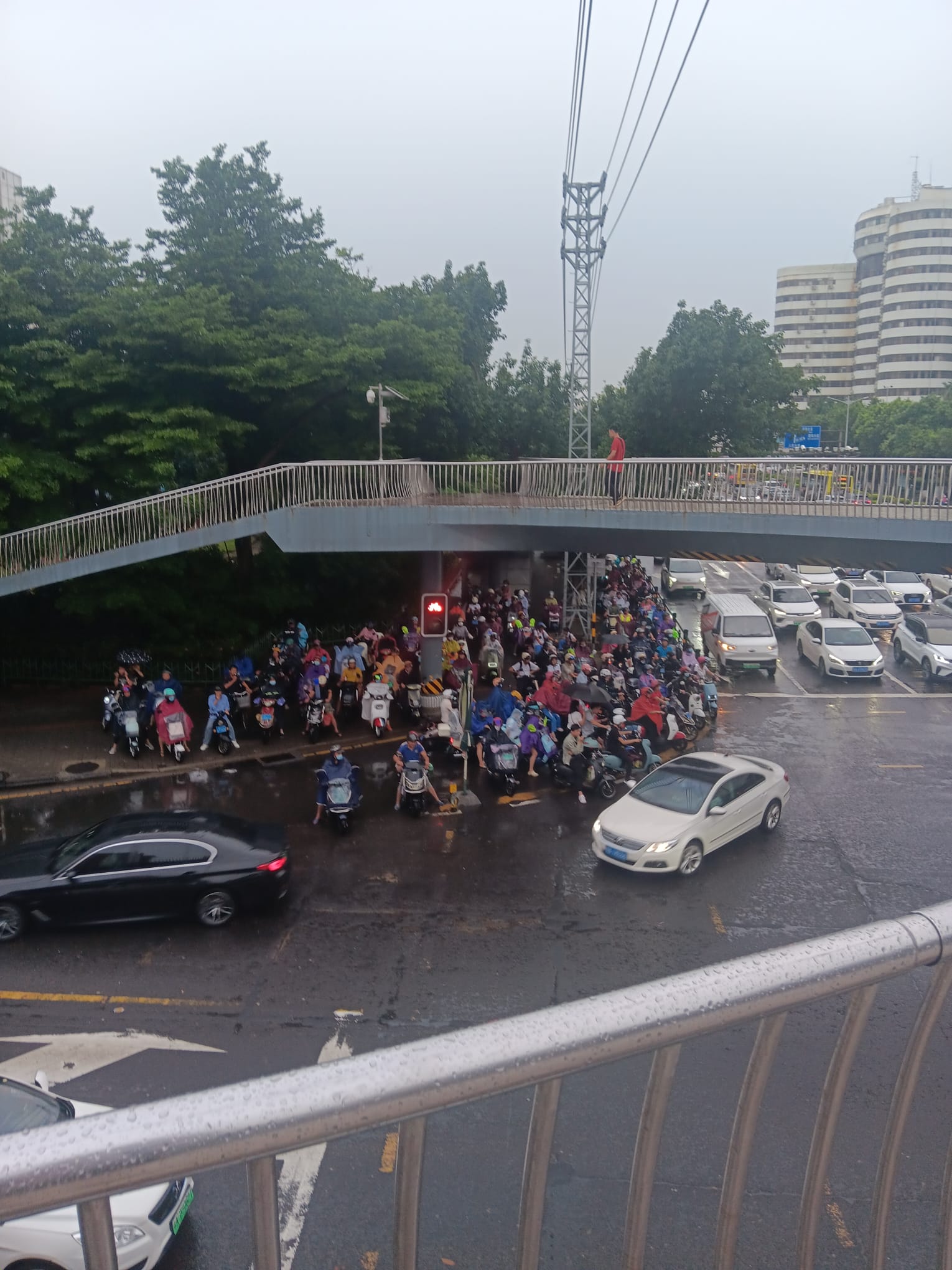
Still, he was patient and easier to understand than the rest, who interjected loudly and often with their own thoughts and queries in their own dialects, which we would all struggle to make sense of. My new friend had just gotten a good job, higher up in the construction company and was waiting on medical approval, necessary for a “formal” job higher up than the informal itinerant laborers. The old man was a doorman, studying numbers with hopes of moving up in the world even at his advancing age. One of the kids was had done various odd jobs but was looking for something more permanent — anything would be better, after all, than the army of food delivery scootermen who now clog the streets of Haikou, Hainan Island’s capital city of two million, racing to scrape together a meager living against the unforgiving clock.
The heavyset man, meanwhile, interject English words here and there. But had just suffered a bad head injury on the job. That’s why he stared, he said apologetically, and why he couldn’t remember the right words.
As the night wore on, the conversation died down. The old man went back to his numbers. The kid back to his phone. The heavyset man back to staring. My new friend brought me a bottle of Coke.
“Thank you,” I said.
“Don’t thank me,” he said. “In China, our foreign friends shouldn’t pay for anything.”
I started to say something, but he cut me off.
“No, no, no,” he said.
It’s been a long time.
 Sojourns